FRANKFURT AM MAIN: One of Germany’s top courts will decide Thursday whether some diesel vehicles can be banned from parts of cities like Stuttgart and Duesseldorf to reduce air pollution, a possible landmark judgment for the “car nation.”
Eyes have turned to the Federal Administrative Court in Leipzig after years of failure by federal, state and local governments to slash harmful emissions.
Fine particle pollution and nitrogen oxides (NOx) contribute to as many as 400,000 premature deaths from respiratory and cardiovascular disease per year in the EU.
That has brought Germany and other air quality sinners like France or Italy into the European Commission’s sights for possible legal action.
Some 70 cities in Europe’s most populous nation suffered from average annual nitrogen dioxide levels above EU thresholds last year, with Munich, Stuttgart and Cologne the worst offenders.
“The air is bad here, you cough and you get a scratchy throat, especially in winter,” clean air campaigner Peter Erben said standing beside the exhaust-blackened facades of Stuttgart’s busy Neckartor main road.
“We want immediate action, and there is no more immediate action than reducing traffic.”
After years of warnings, environmental campaign group Deutsche Umwelthilfe (DUH) took dozens of municipalities to court to force them into tougher action.
Thursday’s case is an appeal by Baden-Wuerttemberg and North Rhine-Westphalia states after lower-level judges ruled they could impose bans on some diesels in their respective capitals Stuttgart and Duesseldorf.
An in-principle decision could be announced during the day after deliberations begin at 1000 GMT.
“It’s a question of jurisdiction: can or must a state act, or is it up to the federal government to do it?” Baden-Wuerttemberg transport minister Winfried Hermann said.
In Stuttgart, local drivers and business leaders are against even limited driving bans, joined by the city branch of Chancellor Angela Merkel’s conservative Christian Democratic Union (CDU) and the pro-business Free Democrats (FDP).
In their thinking, “we can’t limit people’s freedom, we can’t dispossess diesel owners,” explained Hermann — himself a member of the ecologist Greens.
A ruling would affect all vehicles sold before so-called “Euro 6” standards arrived in September 2015.
To fend off bans and protect the keystone auto industry with its 800,000 jobs, Berlin has offered a cascade of initiatives, including a billion-euro ($1.2 billion) fund for cities to upgrade public transport and buy electric vehicles.
Ministers even suggested to the European Commission they could offer free public transport to cut down on urban car use, although without a detailed plan or budget.
Nevertheless, Merkel — sometimes known as the “car chancellor” for her close ties to the industry — and her government have been “too timid” in dealing with bosses, Association of German Cities chief Helmut Dedy told magazine Der Spiegel.
Experts and environmentalist groups agree government and industry efforts fall far short.
Berlin’s proposals “are just a drop in the ocean” said Ferdinand Dudenhoeffer, of the CAR automobile research center.
While he has called for extensive modifications to the diesel engine, a longstanding symbol of German engineering prowess, the carmakers argue they would be too costly and complex.
Instead, manufacturers Volkswagen, Daimler and BMW have offered software upgrades to millions of vehicles to reduce polluting emissions or trade-ins for newer, cleaner models.
Since Volkswagen confessed in 2015 to a global scheme to cheat regulatory NOx tests on millions of diesel vehicles, the fuel’s share of the new car market has plunged, from 48 percent to around 39 percent last year.
Minister Germann expects the judges in Leipzig to confirm that “people’s health is more important than the right to drive a car.”
Upholding the court decisions in Stuttgart and Duesseldorf would open the way to local authorities imposing a patchwork of bans.
Stuttgart and Baden-Wuerttemberg state have called instead for a standardized, nationwide “blue badge” that would identify the least polluting cars, but so far the federal government has demurred.
A ruling from the highest administrative court would also send an important signal to other tribunals and put pressure on Berlin.
“I would be very surprised if we escape diesel bans” on Thursday, cities’ association chief Dedy said.


![]()
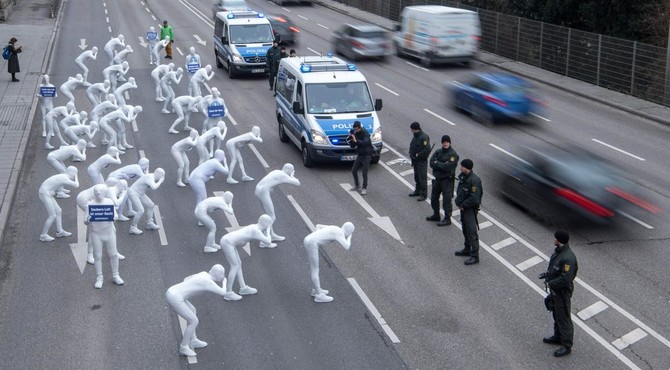
German court could issue landmark judgment regarding ban on diesel cars
German court could issue landmark judgment regarding ban on diesel cars

Latest updates


Recommended


© 2026 SAUDI RESEARCH & PUBLISHING COMPANY, All Rights Reserved And subject to Terms of Use Agreement.