ALEXANDRIA: When Amir Al-Awad fled Syria for Egypt, he intended to cross the Mediterranean for a European country.
But instead, the boyhood Syrian wrestling champion opted against the risky sea journey and found work at a restaurant in Alexandria, where he was introduced to the city’s Syrian community.
Together they established the Syrian Sports Academy, and he replaced his dream of an Olympic medal with a goal to “create champions from the young refugees” from his country, says Awad.
This was “so that one day they will be able to raise their flag as we have in the past after they return to Syria,” says the 34-year-old.
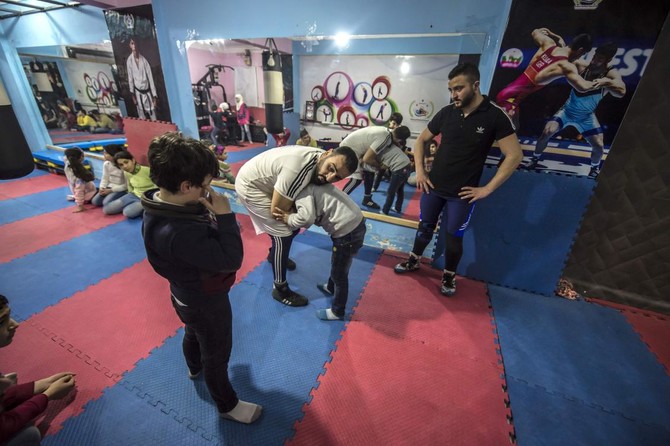
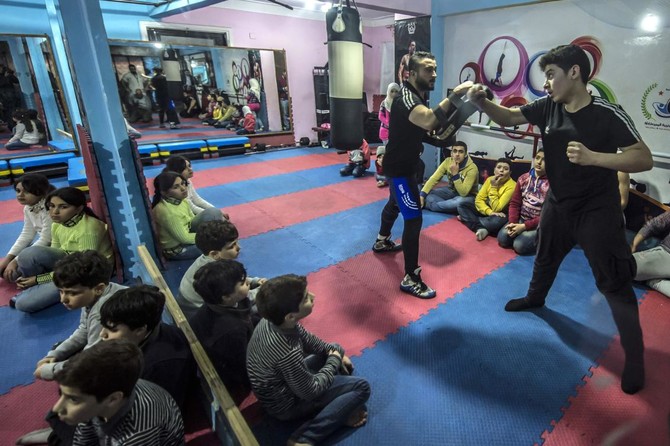
The academy is squeezed into just 30 square meters (320 square feet), in a modestly equipped hall at the bottom of a residential building in the Alexandria neighborhood of Khaled bin Al-Waleed.
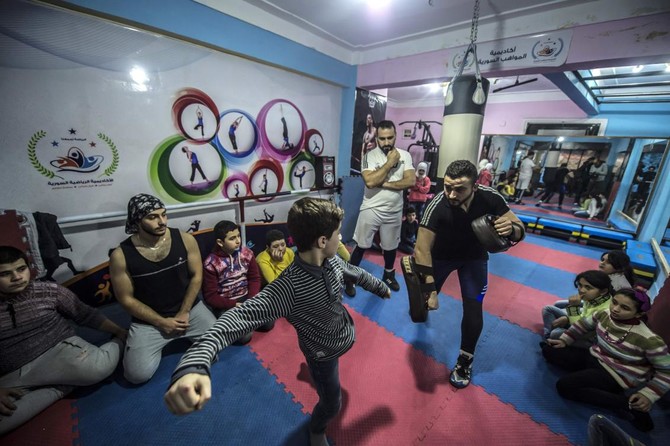
Inside, Syrian children aged of seven to 10 dressed in T-shirts and jeans form a line after arriving at the end of a school day.
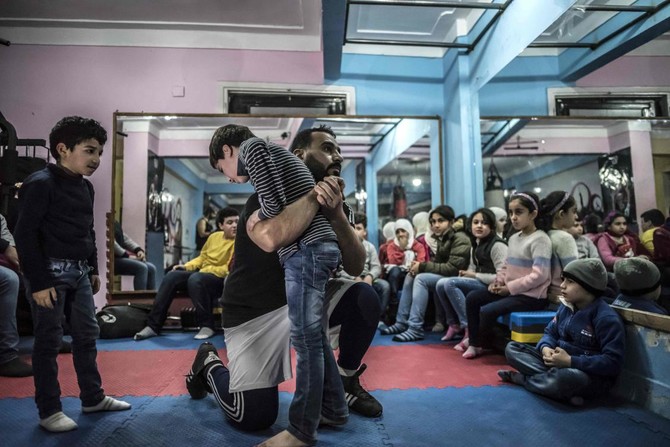
“Let’s go, guys, so you have enough time to study,” Awad yells in encouragement, as he moves on to coaching them wrestling.
With a small administrative office, and the lone training hall, Syrian youngsters practice martial arts, aerobics, ballet, and gymnastics.
In addition, the academy organizes football tournaments, especially for Arab and African refugees in the city.
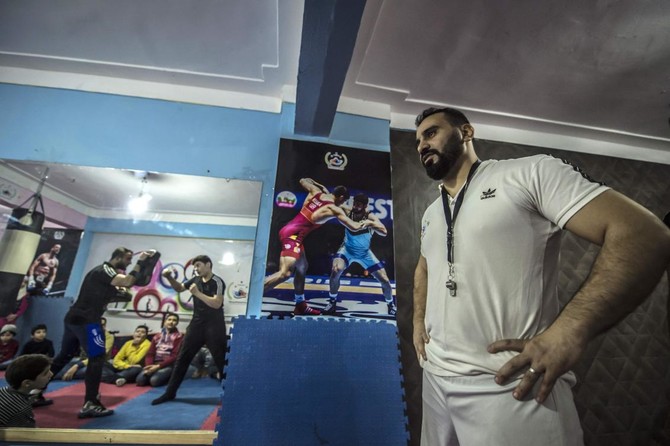
On its aging walls hang pictures of international martial arts and weightlifting champions.
The academy’s founders began the project in 2016 with just 3,000 Egyptian pounds (about $430 at the time).
The financing came from the United Nations High Commissioner for Refugees, which provided 25 percent used to buy equipment, and the rest from the Caritas humanitarian group.
“We prepared the training hall step by step, including paint and design,” says Awad.
The academy’s growing reputation in the neighborhood drove Egyptian parents to also enrol their children there.
“We’re keen to teach the children sports ethics: to learn how to win and how to lose, which helps them in their life, instead of giving in to a bad lifestyle,” he says.
Karima Amer, an Egyptian mother from Khaled bin Al-Waleed neighborhood, cited “discipline” as the reason she takes her son and daughter to the academy.
She praised “Captain Amir” and how he “talks with the children about everything: their problems, food, and ethics.”
Adel Bazmawi, 21, a co-founder and coach, says he transitioned from a professional wrestling to coaching martial arts after coming to Egypt from Idlib in 2013.
“In Egypt I’m not recognized as a wrestler who can participate in international competitions” given he does not carry the Egyptian nationality, says Bazmawi, who was Syria’s freestyle wrestling champion for his age in 2006 and 2008.
Now “the most I can do is to fight in local clubs,” he says.
On the other hand, in addition to Alexandria, he says he has become known in other cities, including the Nile Delta provincial capitals of Tanta and Kafr el-Sheikh.
Still, he says “I miss international competitions.”
Even after receiving invitations to tournaments in Canada and Germany in 2015, he was unable to go because “Syrian nationality has become an obstacle to obtaining visas to European countries.”
There are more than 126,000 UN-registered Syrian refugees in Egypt, but the real figure is thought to be much higher.
Bazmawi, who did not complete his studies in sports education because of the devastating seven-year war in his homeland, helps his family to prepare Syrian shawarma at a restaurant close to the academy.
Those who train the youths go unpaid, something that is unavoidable given that 75 percent of the children are exempt from fees.
“The academy’s goal is to be developmental, and not to make a profit,” says Awad.
But older youths pay a “token” fee, up to 100 pounds a month, which the academy uses to pay electricity bills and rent, he says.
As busy as they are, Awad says his team “aren’t able to compete in various tournaments because of their Syrian nationality,” while to participate they need to officially register the academy.
On several occasions, they even had to cancel some activities on police orders, and they lack the licenses for gatherings, he says.
But for Karim Jalal Al-Deen, 10, the academy is a place to nurture his dream of going back to Syria one day after perfecting kickboxing.
“I want to go back to Syria as a champion, and beat Captain Adel, and I might even be a kickboxing coach myself.”


![]()
![]()
![]()
![]()
![]()
![]()
![]()
![]()
![]()
Sports academy in Egypt gives Syrian children hope




Sports academy in Egypt gives Syrian children hope
Latest updates




© 2026 SAUDI RESEARCH & PUBLISHING COMPANY, All Rights Reserved And subject to Terms of Use Agreement.