ANKARA: The Syrian regime is on the verge of deploying pro-government forces to help Kurdish rebels caught up in a Turkish offensive in the north of the country, opening a new front in a conflict that is threatening to escalate across the wider region.
Syrian state media reported yesterday that militias backed by the regime of President Bashar Assad will soon be sent to the district of Afrin, near Aleppo, in an attempt to counter Turkey’s assault on the area.
News of the plan brought an immediate reaction from Ankara, which warned that any attempt to protect the Kurdish fighters of the People’s Protection Units, known as the YPG, would fail.
The deployment of the pro-Assad forces comes at a particularly delicate time, with much of the region balanced on a knife edge as outside powers including Israel, Iran, Russia and the US all compete for leverage in the Syrian civil war
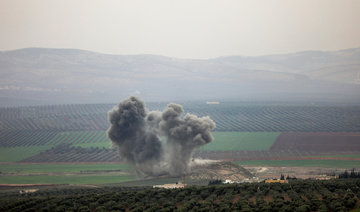
Turkey’s offensive, “Operation Olive Branch,” began on Jan. 20, with the aim of targeting Kurdish militants, including members of the YPG and the Kurdistan Workers’ Party, or PKK. Turkey views both groups as terrorist organizations and threats to its sovereignty, but Washington has provided the YPG with military and logistical support in the fight against Daesh.
Analysts told Arab News that any alliance between Damascus and the Kurds in Afrin would add a further layer of complexity to an already complicated situation.
Middle East researcher Mete Sohtaoglu, who predicted this latest development in an interview with Arab News last month, said Ankara would not be pressured into ending its offensive early.
“Throughout the operation, Turkey has always set up observation and military posts in the areas it has captured so it cannot be expected to withdraw immediately,” he said.
Damascus has traditionally regarded Kurdish rebels in the country warily and the two sides have often clashed since the Syrian civil war began on the back of a wave of peaceful civil unrest against the Assad regime in 2011.
But they have also shown a willingness to work together when it suits their mutual interests and Sohtaoglu claimed the YPG recently agreed to hand over its heavy weapons to the Syrian government in exchange for military support. This could assuage Ankara’s fears that the arms would otherwise end up in the hands of the PKK, he said.
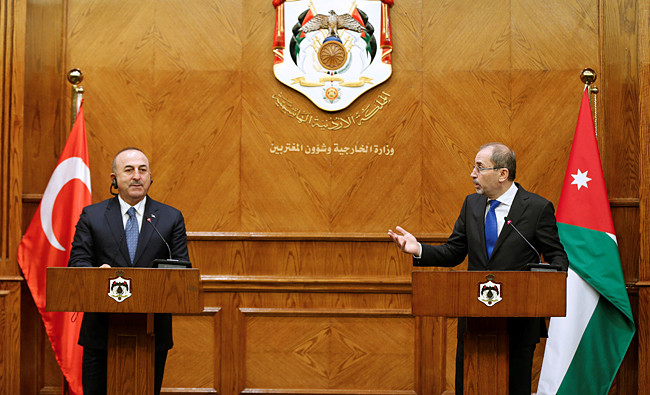
On a visit to Jordan, Turkey’s Foreign Minister, Mevlut Cavusoglu, told journalists in Amman on Monday that Ankara was still assessing the intentions of the Assad regime.
“If the regime is entering (Afrin) to oust the PKK, YPG, there is no problem,” he said. “But if they are entering to protect the YPG, then no one can stop us and Turkish soldiers.”
Also on Monday, Turkish President Recep Tayyip Erdogan discussed the situation in Afrin in a phone conversation with his Iranian counterpart, Hassan Rouhani.
Turkey claims that more than 1,600 YPG and Daesh fighters have either been killed, captured or surrendered since “Operation Olive Branch” began. However, the US has warned Ankara not to expand the offensive against its Kurdish allies.
Sohtaoglu told Arab News that a direct military confrontation between Turkish forces and the Assad regime would probably be avoided with the help of mediation from Moscow.
He predicted that “Russian soldiers may be deployed” around Afrin to create a buffer zone between the two sides. Any such move would be yet another sign that the Syrian conflict has degenerated into a proxy war for competing regional powers.
Earlier this month, Iranian militias killed one Turkish soldier and injured five others in an attack on an outpost in Idlib province, southwest of Aleppo city.
Soon afterwards Israel launched a large-scale air raid near Damascus after one of its fighter aircraft was downed by Syrian anti-aircraft fire. Meanwhile, Israeli Prime Minister Benjamin Netanyahu has accused Iran of using its long-term alliance with the Assad regime to try to build a “continuous empire surrounding the Middle East.”
Emre Ersen, a Syria analyst at Marmara University in Istanbul, told Arab News that the Syrian government’s decision to send forces to Afrin needed to be seen within this wider context. Moscow, in particular, stood to benefit from the move, he said.
“We already know that Russia has been uneasy about the implications of ‘Operation Olive Branch’ from the beginning. Nevertheless, it felt obliged to approve Turkey’s military operation in Afrin in order not to alienate Ankara at a time when Turkish-US relations were strained due to the YPG issue,” he said.


![]()
Syrian forces prepare to back rebels against Turkish offensive
Syrian forces prepare to back rebels against Turkish offensive


Latest updates


Recommended


© 2026 SAUDI RESEARCH & PUBLISHING COMPANY, All Rights Reserved And subject to Terms of Use Agreement.