ANKARA: The street in Ankara where the US embassy is located was renamed after Turkey’s offensive against a Kurdish militia on Monday, just days after the two sides agreed on the need to normalize relations.
Already tense ties were strained further when Ankara started a ground and air offensive dubbed “Olive Branch” last month against the Kurdish People’s Protection Units (YPG) in its enclave of Afrin in western Syria.
Ankara views the YPG as a terrorist offshoot of the Kurdistan Workers’ Party (PKK), an insurgency in Turkey which is listed as a terror organization by the US and the European Union.
But in Syria, Washington has been providing arms to the YPG against the Daesh group, much to Ankara’s chagrin in a dispute that has ignited the biggest crisis in bilateral ties since the 2003 US-led invasion of Iraq.
The US has previously called on Ankara for restraint and said operation “Olive Branch” risked becoming a distraction from the fight against jihadists in Syria.
The renaming of the street follows a visit by US Secretary of State Rex Tillerson to Ankara last week when he met Turkish officials including President Recep Tayyip Erdogan and the two sides agreed to cooperate in Syria.
“We are not going to act alone any longer, not US doing one thing, Turkey doing another,” Tillerson said after talks with Turkish counterpart Mevlut Cavusoglu.
The two sides said they would set up working groups to solve key issues affecting relations.
Ankara mayor Mustafa Tuna mooted the plan to change the name from Nevzat Tandogan (a former Ankara governor) to Olive Branch avenue before Tillerson arrived on Thursday.
City workers switched the actual signs on Monday.
Although the American embassy is located on what is now Olive Branch avenue, the mission’s official address is given as the street behind the building, which is named after Ataturk, the founder of the Turkish republic.
Renaming streets has become a favored diplomacy tool for Ankara.
Tensions with the UAE flared last month when the emirate’s Foreign Minister Sheikh Abdullah bin Zayed Al-Nahyan retweeted a post on Twitter critical of the former Ottoman rulers of the region.
In response Ankara renamed the street where the UAE embassy is located after the Ottoman governor of the time.


![]()
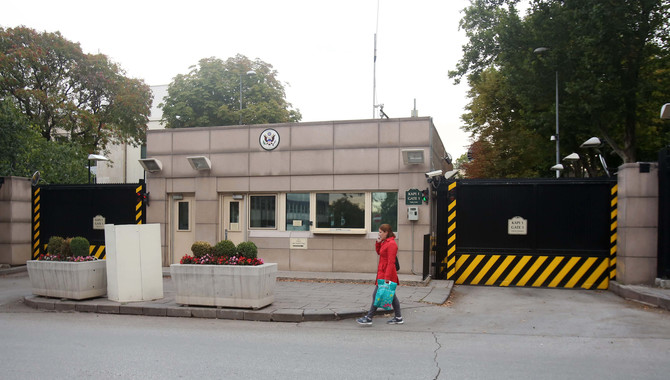

Turkey renames US embassy street amid row over Syria operation
Turkey renames US embassy street amid row over Syria operation

Fire from Iran, Lebanon triggers sirens across Israel
- Alerts were sounded in Jerusalem, Tel Aviv, Haifa and several other northern regions
- The Israeli army had noticed a gradual decrease in the number of Iranian missiles launched at Israel since Saturday
JERUSALEM: The Israeli military said it had detected multiple missile barrages from Iran on Wednesday, as well as launches from Lebanon, but added that the number of missiles fired from the Islamic republic at Israel was declining.
AFP journalists heard several blasts and multiple rounds of sirens from Jerusalem, while alerts also sounded in Tel Aviv, central Israel, Haifa and several other northern regions.
“The IDF identified missiles launched from Iran toward the territory of the State of Israel. Defensive systems are operating to intercept the threat,” the military said four times throughout the afternoon and early evening.
In a statement shortly after the first salvo was announced, the military said that “several launches... from Lebanon toward Israeli territory were successfully intercepted” after sirens sounded in central Israel.
The new salvos came on the fifth day of the Middle East war, which began on Saturday with joint US-Israeli strikes on Iran.
Lebanon was dragged into the war on Monday when the Tehran-backed Hezbollah group launched an attack on Israel to “avenge” the killing of Iran’s supreme leader Ayatollah Ali Khamenei, prompting ongoing Israeli air strikes.
Israeli military spokesman Lt. Col. Nadav Shoshani told reporters Wednesday evening that the army had noticed a gradual decrease in the number of Iranian missiles launched at Israel since the start of the war.
“We are speaking about many dozens the first day going down gradually to a few dozen and very low amounts,” he said.
“The barrages are much smaller. Today, some of them weren’t even a barrage, they were just one missile,” he added.
Shoshani said that some projectiles were launched from Iraq too, where some militias act as Iran proxies.
“We’ve seen small amounts of fire coming from Iraq, mostly UAVs (drones), but the vast majority of fire is from Iran and now from Hezbollah,” he said.
Israel’s Magen David Adom (MDA) emergency services said they had evacuated to hospital two people in central Israel with mild injuries, including “a man of about 30 with shrapnel wounds and another casualty with blast injuries.”
Police said in a statement that officers were dispatched to five locations in the Jerusalem area “where various intercepted projectiles had fallen, causing only damage.”
The military said that the “majority of the launches” from Lebanon were intercepted.
Not including Wednesday’s figures, MDA said that since the start of the war its teams had provided medical treatment to 414 casualties including “10 fatalities, 2 seriously injured, 6 moderately injured and 396 lightly injured.”
AFP journalists heard several blasts and multiple rounds of sirens from Jerusalem, while alerts also sounded in Tel Aviv, central Israel, Haifa and several other northern regions.
“The IDF identified missiles launched from Iran toward the territory of the State of Israel. Defensive systems are operating to intercept the threat,” the military said four times throughout the afternoon and early evening.
In a statement shortly after the first salvo was announced, the military said that “several launches... from Lebanon toward Israeli territory were successfully intercepted” after sirens sounded in central Israel.
The new salvos came on the fifth day of the Middle East war, which began on Saturday with joint US-Israeli strikes on Iran.
Lebanon was dragged into the war on Monday when the Tehran-backed Hezbollah group launched an attack on Israel to “avenge” the killing of Iran’s supreme leader Ayatollah Ali Khamenei, prompting ongoing Israeli air strikes.
Israeli military spokesman Lt. Col. Nadav Shoshani told reporters Wednesday evening that the army had noticed a gradual decrease in the number of Iranian missiles launched at Israel since the start of the war.
“We are speaking about many dozens the first day going down gradually to a few dozen and very low amounts,” he said.
“The barrages are much smaller. Today, some of them weren’t even a barrage, they were just one missile,” he added.
Shoshani said that some projectiles were launched from Iraq too, where some militias act as Iran proxies.
“We’ve seen small amounts of fire coming from Iraq, mostly UAVs (drones), but the vast majority of fire is from Iran and now from Hezbollah,” he said.
Israel’s Magen David Adom (MDA) emergency services said they had evacuated to hospital two people in central Israel with mild injuries, including “a man of about 30 with shrapnel wounds and another casualty with blast injuries.”
Police said in a statement that officers were dispatched to five locations in the Jerusalem area “where various intercepted projectiles had fallen, causing only damage.”
The military said that the “majority of the launches” from Lebanon were intercepted.
Not including Wednesday’s figures, MDA said that since the start of the war its teams had provided medical treatment to 414 casualties including “10 fatalities, 2 seriously injured, 6 moderately injured and 396 lightly injured.”
Latest updates


© 2026 SAUDI RESEARCH & PUBLISHING COMPANY, All Rights Reserved And subject to Terms of Use Agreement.