DAMMAM: In recent years, Turkey and Armenia have been locked in a culinary squabble over who “owns” what. UNESCO’s 2011 decision to declare keskek — a ceremonial wheat and meat porridge — an intangible cultural heritage of Turkey has angered the Armenians. They claim keskek is, in fact, their centuries-old porridge known as harissa.
When lavash, the unleavened flatbread, made it on to UNESCO’s list as an “expression of Armenian culture,” protesters in Turkey, Azerbaijan, Iran, Kyrgyzstan and Kazakhstan asserted that lavash does not originate or belong solely to Armenia. Similarly, did the lamadjo originate in Armenia, or do the Turkish make the most authentic lahmacun?
As the debate continues between Armenians and the Turks or the Azerbaijanis, one thing is for sure: Saudis cannot get enough of Armenian cuisine and its assimilation into Levantine cooking. Reputedly the first Armenian restaurant in Saudi Arabia, Lusin — with three branches in the country; Riyadh, Jeddah and now Alkhobar — bears testament to that popularity.
When owners Mira Foods Company found Saudi tourists frequenting Armenian restaurants in Jordan and Lebanon, they decided to bring Armenian fine dining to Saudi Arabia in 2009. Lusin, the Armenian word for “moon,” is a product of transporting the culture and cuisine of Armenia to Saudi Arabia.
Lusin’s restaurants can best be described as present-day Armenian, with modern elements like sleek light fixtures and a modish ambience coexisting alongside a rich heritage. The walls are tiled with the pink tuff stone found in the Yerevan region of Armenia. It is a peculiar shade of pink that is reminiscent of the Pink City, but it gives the interior the feel of an upscale restaurant.
Common in California, New York and Paris, Armenian food is now gaining traction in London and the Arab world. Typical to Armenian cuisine is the use of fresh and seasonal produce like pomegranates, apricots, prunes, apples, pears, grapes, eggplants, pumpkins, walnuts, pine nuts, herbs, and also cracked wheat, meat, and dairy products.
Developed by Armenian culinary expert and author Anahid Doniguian, the menu at Lusin is as close to Armenian heritage as you can get. To start our fine dining experience, freshly baked lavash bread was served with a creamy walnut dip. Soon after, we were given a rich pumpkin soup and crisp, fiery potatoes.
The authentic itch is a piquant red salad made with bulgur wheat, parsley and tomato sauce, which makes it a tantalizing treat for the taste buds. Departing from the usual dolma, try the yalanji grape leaves, stuffed leaves served with fermented matzoon yogurt.
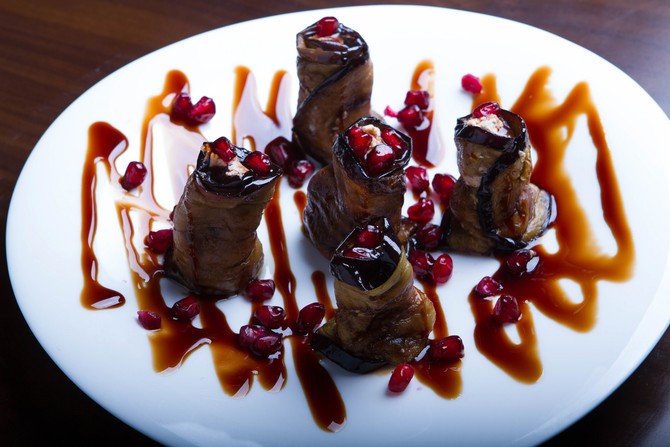
Not to be missed are Lusin’s signature eggplant rolls: Chargrilled eggplant slices rolled and stuffed with a cream and walnut paste and pomegranate seeds, lending it a tangy flavor that complements the velvety texture and smoky flavor of the eggplant.
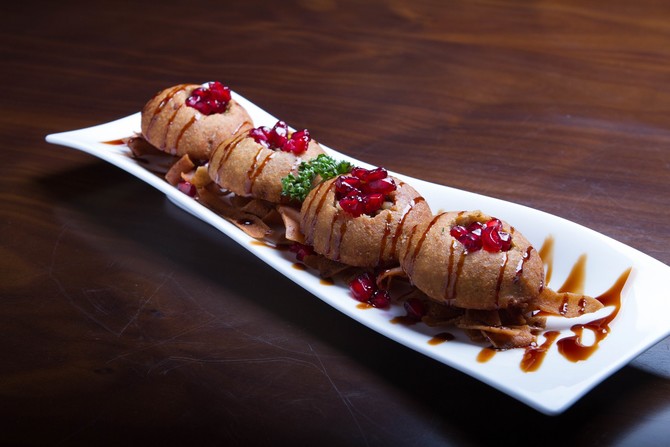
Moving on to the hot entrees, we tried the Lusin kibbeh, made of bulgur and meat and garnished with pine nuts and pomegranate molasses. The sujuc rolls — dried beef sausage baked into soft dough — are like nothing you will have tasted before.
“As Armenian winters are hard, natives are known to prepare food during the summer and store it in pots or in the cellar to survive the winter. It is said that Armenians can throw a winter wedding banquet without having to visit a supermarket,” Doniguian explains.
From the mains, we tried the house favorite, cherry kebab — spiced kebab served with a cherry puree — which makes for an interesting mix of sweet and sour flavors. However, the star of the evening was the gapama. “The traditional Armenian gapama is a wedding dish, usually presented to the newlyweds by a group of young boys and girls in a dance,” Doniguian says.
Here, in an elaborate process, a pumpkin is stuffed with rice, meat, herbs and nuts, and baked in a tanour for four hours. The result is a succulent pumpkin, sliced to reveal a hearty rice and meat dish soaked with juices from the sweet pumpkin.
For dessert, we tried the rose ice-cream topped with cotton candy and the traditional Armenian maamoul stuffed with cheese, cardamom and nuts, and doused with sugar syrup. In between sinful bites of the maamoul, we were sure to sip from shots of orange blossom tea.
Lusin promises to be a fine-dining experience, but it offers much more: Authentic Armenian food, a cultural experience and, most importantly, a glimpse of the renowned Armenian hospitality.


Armenian cuisine at Saudi Arabia’s Lusin restaurant eclipses the competition


Armenian cuisine at Saudi Arabia’s Lusin restaurant eclipses the competition


Saudi retail spending holds steady near $4bn during early Ramadan, while postal services rise
RIYADH: Saudi Arabia’s point-of-sale spending remained close to $4 billion in the week ending Feb. 21, even as overall transaction volumes declined during the early days of Ramadan, central bank data showed.
According to the latest data from the Saudi Central Bank, also known as SAMA, total POS transactions settled at SR13.9 billion ($3.71 billion), representing a 9.3 percent week-on-week decline, while the number of transactions fell 12.5 percent to 220.57 million.
Spending on freight transport, postal and courier services rose 24.4 percent week on week to SR80.68 million, marking one of the strongest sectoral gains as demand for deliveries increased during the holy month.

In an interview with Arab News, Saudi economist Talat Hafiz attributed the broader slowdown in spending to seasonal consumption patterns linked to Ramadan.
“During the first week of Ramadan, consumer behavior typically shifts, as individuals focus more on purchasing goods related to the holy month while reducing discretionary spending,” he said.
SAMA’s report showed that spending on food and beverages increased by 2.1 percent to SR2.62 billion, accounting for the largest share of total POS transactions.
Meanwhile, spending at restaurants and cafes fell by 28.3 percent to SR1.24 billion.
Hafiz said this purchasing pattern is expected to continue as Eid Al-Fitr approaches.
“Spending behavior is likely to shift again, with increased expenditure on travel-related services, apparel, clothing, and accessories in preparation for Eid. During the Eid holiday itself, we can expect a noticeable rebound in spending on recreation, entertainment, restaurants, and cafes,” he added.
Expenditure on public utilities saw an increase of 2.3 percent to SR63.06 million, while spending on apparel and clothing outlays followed with a 4.8 percent decrease to reach SR1.32 billion.
Spending at pharmacies and medical supply outlets decreased by 7.9 percent to SR206.1 million, while spending on medical services fell by 10.6 percent to SR482.53 million. Expenditure on personal care declined by 23.6 percent to SR93.34 million.

The Kingdom’s key urban centers mirrored the negative changes. Riyadh, which accounted for the largest share of total POS spending, saw a 10.8 percent drop to SR4.75 billion. The number of transactions in the capital reached 69.8 million, down 13.3 percent week on week.
In Jeddah, transaction values decreased 11.1 percent to SR1.88 billion, while Dammam reported a 9.1 percent fall to SR678.29 million.
POS data, tracked weekly by SAMA, provides an indicator of consumer spending trends and the ongoing growth of digital payments in Saudi Arabia.
The data also highlights the expanding reach of POS infrastructure, extending beyond major retail hubs to smaller cities and service sectors, supporting broader digital inclusion initiatives.


