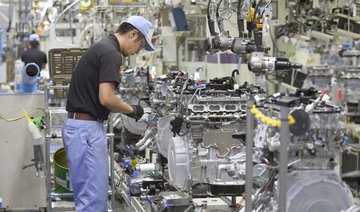
TOKYO: Japan’s steel industry said on Monday the US Commerce Department proposal to President Donald Trump to impose curbs on steel imports violate the principles of free trade, calling for Washington to make a careful and appropriate decision.
The US Commerce Department recommended on Friday that Trump impose steep curbs on steel and aluminum imports from China and other countries, ranging from global and country-specific tariffs to broad import quotas.
“The recommendations violate the principles of free trade, which are the foundation for development and prosperity of the global economy,” Japan Iron and Steel Federation Chairman Kosei Shindo said in a statement.
“We hope Trump would make a careful and appropriate judgment,” said Shindo, who also heads Japan’s biggest steelmaker Nippon Steel & Sumitomo Metal Corp.
Yasuji Komiyama, director of the metal industries division of Japan’s Ministry of Economy, Trade and Industry, on Monday declined to comment on the US Commerce Department’s proposal, saying a US final decision has not been reached.
“But Japan believes any steel and aluminum imports by the US from Japan do not pose any threat to the US national security,” he said.
Japan exports about 2 million tons of steel products a year to the US, only about 5 percent of its total steel shipments abroad, but the nation’s steelmakers are concerned over the US trade policy.
“My biggest fear is how far President Trump will close down trade,” Eiji Hayashida, president of JFE Holdings Inc, Japan’s No.2 steelmaker, said last week.
“If the US takes action (to curb imports), it may trigger retaliation by other countries. What is most troublesome is to see the world heading to protectionism,” he said.
Nippon Steel’s senior executive also said the company is worried that US trade action could flood Asia with steel products as there is nowhere else for them to go.
“I don’t know if a US move would really make US steelmakers, steel users and consumers happy,” Kiyoshi Imamura, Managing Director at Tokyo Steel Manufacturing, Japan’s top electric-arc furnace steelmaker, said on Monday.
Some US lawmakers and steel and aluminum users have urged caution in taking any trade actions that could cause disruptions or price spikes in raw materials that are found in everything from autos to appliances and aircraft and construction.

Japan’s steel industry urges Trump to make careful trade decision
Gulf-EU value chain integration signals shift toward long-term economic partnership: GCC secretary general
RIYADH: Value chains between the Gulf and Europe are poised to become deeper and more resilient as economic ties shift beyond traditional trade toward long-term industrial and investment integration, according to the secretary general of the Gulf Cooperation Council.
Speaking on the sidelines of the World Governments Summit 2026 in Dubai, Jasem Al-Budaiwi said Gulf-European economic relations are shifting from simple commodity trade toward the joint development of sustainable value chains, reflecting a more strategic and lasting partnership.
His remarks were made during a dialogue session titled “The next investment and trade race,” held with Luigi Di Maio, the EU’s special representative for external affairs.
Al-Budaiwi said relations between the GCC and the EU are among the bloc’s most established partnerships, built on decades of institutional collaboration that began with the signing of the 1988 cooperation agreement.
He noted that the deal laid a solid foundation for political and economic dialogue and opened broad avenues for collaboration in trade, investment, and energy, as well as development and education.
The secretary general added that the partnership has undergone a qualitative shift in recent years, particularly following the adoption of the joint action program for the 2022–2027 period and the convening of the Gulf–European summit in Brussels.
Subsequent ministerial meetings, he said, have focused on implementing agreed outcomes, enhancing trade and investment cooperation, improving market access, and supporting supply chains and sustainable development.
According to Al-Budaiwi, merchandise trade between the two sides has reached around $197 billion, positioning the EU as one of the GCC’s most important trading partners.
He also pointed to the continued growth of European foreign direct investment into Gulf countries, which he said reflects the depth of economic interdependence and rising confidence in the Gulf business environment.
Looking ahead, Al-Budaiwi emphasized that the economic transformation across GCC states, driven by ambitious national visions, is creating broad opportunities for expanded cooperation with Europe.
He highlighted clean energy, green hydrogen, and digital transformation, as well as artificial intelligence, smart infrastructure, and cybersecurity, as priority areas for future partnership.
He added that the success of Gulf-European cooperation should not be measured solely by trade volumes or investment flows, but by its ability to evolve into an integrated model based on trust, risk-sharing, and the joint creation of economic value, contributing to stability and growth in the global economy.
GCC–EU plans to build shared value chains look well-timed as trade policy volatility rises.
In recent weeks, Washington’s renewed push over Greenland has been tied to tariff threats against European countries, prompting the EU to keep a €93 billion ($109.7 billion) retaliation package on standby.
At the same time, tighter US sanctions on Iran are increasing compliance risks for energy and shipping-related finance. Meanwhile, the World Trade Organization and UNCTAD warn that higher tariffs and ongoing uncertainty could weaken trade and investment across both regions in 2026.