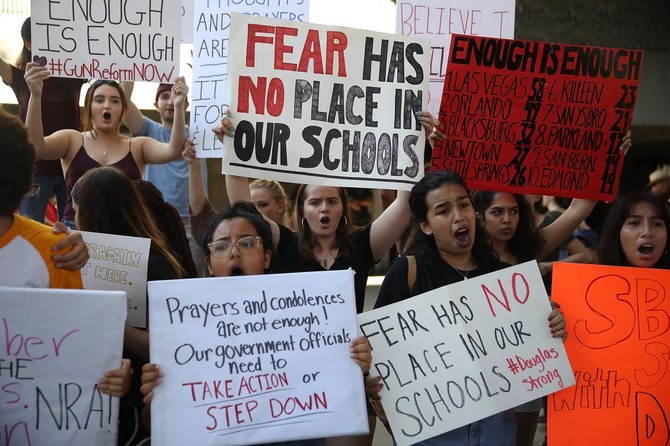
PARKLAND: Stunned by the deadliest high school shooting in US history, students mobilized across the country on Sunday to organize rallies and a national walkout in support of stronger gun laws, challenging politicians they say have failed to protect them.
Students from Marjory Stoneman Douglas High School, where a former student is accused of murdering 17 people on Wednesday using an assault-style rifle, joined others on social media to plan the events, including a Washington march.
“I felt like it was our time to take a stand,” said Lane Murdock, 15, of Connecticut. “We’re the ones in these schools, we’re the ones who are having shooters come into our classrooms and our spaces.”
Murdock, who lives 20 miles (32 km) from Sandy Hook Elementary School where 20 children and six adults were shot to death five years ago, drew more than 50,000 signatures on an online petition on Sunday calling on students to walk out of their high schools on April 20.
Instead of going to classes, she urged her fellow students to stage protests on the 19th anniversary of an earlier mass shooting at Columbine High School in Colorado.
Students from the Florida high school are planning a “March for Our Lives” in Washington on March 24 to call attention to school safety and ask lawmakers to enact gun control.
They also plan to rally for gun control, mental health issues and school safety on Wednesday in Tallahassee, the state capital. The students were expected to meet with a lawmaker who is seeking to ban the sale of assault-style weapons like the AR-15 allegedly used in the school shooting.
The demands for change by many still too young to vote has inflamed the country’s long-simmering debate between advocates for gun control and gun ownership.
Students from the Florida school have lashed out at political leaders, including Republican President Donald Trump, for inaction on the issue. Many criticized Trump for insensitivity after he said in a weekend Twitter post that the FBI may have been too distracted with a Russia probe to follow leads that could have prevented the massacre.
“You can’t blame the bureaucracy for this when it’s you, Mr. President, who’s overall responsible,” David Hogg, an 18-year-old Douglas senior, said in a phone interview.


![]()
US students plan Washington march to demand gun control after mass shooting
US students plan Washington march to demand gun control after mass shooting
Latest updates


© 2026 SAUDI RESEARCH & PUBLISHING COMPANY, All Rights Reserved And subject to Terms of Use Agreement.