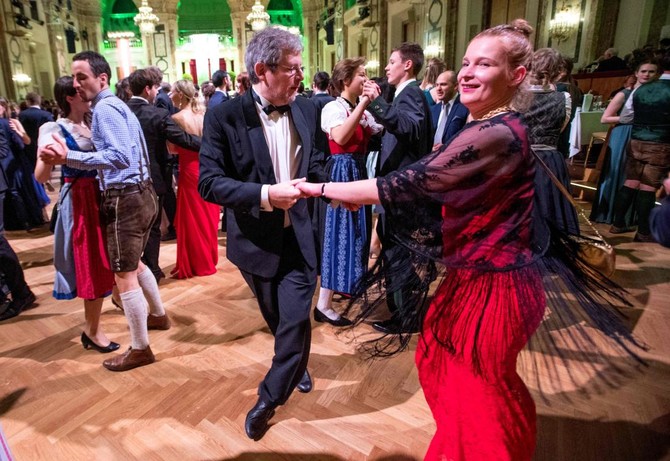
VIENNA: It’s her third Vienna ball of the season and Renate Drabek plans to dance until the small hours. Tango, waltz, rumba, boogie: her dance partner can’t say ‘no’ as she’s hired him for the evening.
Vienna’s famous ball season, which peaks in January and February, is where hard-headed business sense meets more than 100 years of tradition, whether it’s hiring someone to dance with, taking a crash course in waltzing or handing out promotional freebies.
Some 450 balls organized in the Austrian capital through the winter are expected to attract more than 500,000 revellers, mostly from Vienna, while about 55,000 of them are visitors from abroad.
All the while, thousands will earn their living in the flourishing sector, in hotels, restaurants, fashioning evening wear, hairdressing, floristry as well as the all-important ballroom orchestras.
Rono Alam is one of the season’s entrepreneurs: several times a week he’s a “taxi dancer,” accompanying female ball lovers who need a partner.
Fifty-something and impeccably dressed, Alam was formerly a keen participant in dance competitions and set up his own company around 10 years ago when he realized that “many women couldn’t find a partner to dance with.”
Working for a rival outfit, 49-year-old “taxi dancer” Edgar Kogler is the quintessential Viennese waltzer: trained in the capital’s dance schools and a youth spent opening some of its most famed balls.
A secondary schoolteacher by day, by night Kogler indulges his love of dancing, taking to the ballroom floor and carefully attuning himself to his partner’s level, tastes and conversation.
Drabek feels at ease with the dancers she “hires” for a cost of around 150 euros an evening several times during the season, ever since the death of her husband.
“I love dancing, it’s my sort of sport,” says the retiree, resplendent in a daring bustier gown.
“And I adore this atmosphere,” she says, pointing to the marble columns, chandeliers, bouquets of fresh flowers and majestic staircase at the Hofburg palace, former residence of the Habsburg emperors and one of the most sought-after ball venues.
Austria’s chamber of commerce expects ball guests to spend a record 139 million euros ($172 million) this season — eight million more than last year, or 275 euros more on average per guest.
Every ball has an entry charge, with greatly varying ticket prices that rise according to the evening’s prestige. Students pay 25 euros for a university ball held at the Hofburg, compared to 70 euros for a full-price guest.
“Some balls have become big business,” says Ronan Svabek, master of ceremonies at the most famous of them all, the Opera Ball, which took place on February 8 and where the cheapest ticket costs 290 euros.
The ball season can prove a useful way to wine and dine important business contacts, especially from abroad.
“In many business branches it is a perfect tool to get close contact to business people,” said the manager of a family-owned Austrian milling and farming company who declined to be named.
Although many of his business partners are local and are ball-goers anyway, he said he did invite certain colleagues who are keen hunters to the hunters’ ball.
These days, ball sponsors, along with press offices and product placement, are the norm.
Ball-goers at the “BonbonBall” (“Vienna’s Sweetest“) received samples and freebies from an array of biscuit, ice cream and confectionery makers.
But Svabek stresses that there are still “lots of small neighborhood balls, school balls, balls for co-workers” which all embody the essence of the Viennese institution of “gathering different people together in one place, who don’t know each other but who spend the evening together, they talk and they get to know each other, all through the sheer love of dance.”
The tradition originates in the 18th century, when the balls of the Habsburg royal court ceased to be reserved for the aristocracy alone. The Viennese began adopting court customs and ways for their own soirées.
Now there is a ball for every taste.
Hunters, café owners, florists, butchers, building caretakers, vegans, hip-hop lovers and fans of space exploration can all find a dedicated event.
Certain customs, however, unite them, such as a strict dress code, an imperial ambiance, a choreographed opening dance by young, hand-picked débutants or first-time ball attendees, a succession of dance styles and musical genres, all capped off with a midnight quadrille.
It is no longer de rigueur for attendees to have gone to a formal dance school, whose numbers in Vienna have dropped from 70 in 1998 to around 20.
Many prefer instead to take a few hours’ instruction when they can, or even a crash course in waltzing before the ball.
Though, cautions Svabek, they risk missing out on learning the finer points of Viennese manners, the key to being ball-ready.
“How to approach someone, how to get to know them, how far one should persevere, at what point one should accept,” he said, referring to ball etiquette.
“Useful rules for dancing but also in society, for our way of living together,” he says.