Two-thirds of Australians want deputy PM to resign over sex scandal-poll

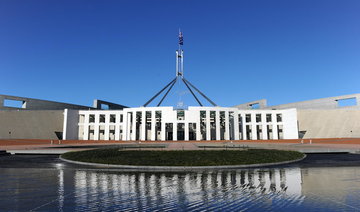
The Australian High Court decision against Deputy Prime Minister Barnaby Joyce, right, has left Prime Minister Malcolm Turnbull’s coalition in the precarious position of a minority government. (AFP)
Updated 19 February 2018
Follow

Two-thirds of Australians want deputy PM to resign over sex scandal-poll

SYDNEY: Two-thirds of Australian voters want Deputy Prime Minister Barnaby Joyce to resign following his extramarital affair with his former press secretary, a poll showed on Monday, adding pressure on a government already fractured by the scandal.
Joyce, a Catholic who campaigned on “family values” and who has been married for 24 years, refused to resign when it was made public he was expecting a child with his former staffer.
Some 65 percent of voters want Joyce to step down as leader of the rural-based National Party, the junior partner in the government led by the Liberal Party, The Australian newspaper’s Newspoll showed.
The Liberal-National coalition has existed since 1923, with the National leader usually taking on the deputy prime ministership.
The scandal has damaged the government’s re-election chances, according to Newspoll. The government, which has only a one-seat majority, now trails the main opposition Labour Party by a margin of 53-47 percent on a two-party basis.
The government must call an election by May 2019.
With mounting public pressure, Joyce sought to turn the tide of public opinion, giving a rare interview on Monday with the Sydney Morning Herald newspaper, where he blamed public life for the breakdown of his marriage.
Joyce has began a highly unusual week-long leave of absence at the urging of Prime Minister Malcolm Turnbull, who will this week travel to Washington, which would have typically seen Joyce installed as acting prime minister. Finance Minister Mathias Cormann will now be acting leader.
As well as alienating voters, the scandal has fractured the ruling conservative government, with Joyce last week publicly criticizing Turnbull for “causing further harm” through comments about his affair.
The scandal has prompted Turnbull to ban sexual relationships between ministers and their staff.
Turnbull and Joyce held urgent talks on Saturday. “We’ve put whatever tensions there were behind us,” Turnbull told a radio station in Melbourne on Monday.
However, Turnbull said there was no guarantee that Joyce would continue as deputy prime minister with the leadership decision in the hands of National Party lawmakers.
On Sunday, Australian media reported that senior National Party figures were openly canvassing constituents with a view to removing Joyce from the party leadership.


Israel says Netanyahu will meet with Trump on Wednesday about Iran talks

Updated 2 sec ago
Follow

Israel says Netanyahu will meet with Trump on Wednesday about Iran talks

  • Israeli Prime Minister Benjamin Netanyahu will meet with US President Donald Trump in Washington on Wednesday about the US talks with Iran
JERUSALEM: Israeli Prime Minister Benjamin Netanyahu will meet with US President Donald Trump in Washington on Wednesday about American talks with Iran, his office said Saturday, while Iran’s foreign minister threatened US military bases in the region a day after the discussions.
“The prime minister believes that all negotiations must include limiting the ballistic missiles, and ending support for the Iranian axis,” Netanyahu’s office said in a brief statement, referring to Tehran’s support for militant groups, including Hezbollah in Lebanon and Hamas in the Palestinian territories. Trump and Netanyahu last met in December.
There was no immediate White House comment.
The US and the Islamic Republic of Iran held indirect talks on Friday in Oman that appeared to return to the starting point on how to approach discussions over Tehran’s nuclear program.
Trump called the talks “very good” and said more were planned for early next week. Washington was represented by Middle East special envoy Steve Witkoff and Jared Kushner, Trump’s son-in-law.
Trump has repeatedly threatened to use force to compel Iran to reach a deal on its nuclear program after sending the aircraft carrier USS Abraham Lincoln and other warships to the region amid Tehran’s crackdown on nationwide protests that killed thousands.
Gulf Arab nations fear an attack could spark a regional war, with memories fresh of the 12-day Israel-Iran war in June.
For the first time in negotiations with Iran, the US on Friday brought its top military commander in the Middle East to the table. US Navy Adm. Brad Cooper, head of the military’s Central Command, then visited the USS Abraham Lincoln on Saturday with Witkoff and Kushner, the command said in a statement.
Iranian Foreign Minister Abbas Araghchi told journalists Friday that “nuclear talks and the resolution of the main issues must take place in a calm atmosphere, without tension and without threats.” He said that diplomats would return to their capitals, signaling that this round of negotiations was over.
On Saturday, Araghchi told the Al Jazeera satellite news network that if the US attacks Iran, his country doesn’t have the ability to strike the US “and therefore has to attack or retaliate against US bases in the region.”
He said there is “very, very deep distrust” after what happened during the previous talks, when the US bombed Iranian nuclear sites during last year’s Israel-Iran war.
Araghchi also said the “missile issue” and other defense matters are “in no way negotiable, neither now nor at any time in the future.”
Tehran has maintained that these talks will be only on its nuclear program.
However, Al Jazeera reported that diplomats from Egypt, Turkiye and Qatar offered Iran a proposal in which Tehran would halt enrichment for three years, send its highly enriched uranium out of the country and pledge to “not initiate the use of ballistic missiles.”
US Secretary of State Marco Rubio said Wednesday that the talks needed to include all those issues.
Israel, a close US ally, believes Iran is pursuing a nuclear weapon and wants its program scrapped, though Iran has insisted that its atomic plans are for peaceful purposes. Israel also wants a halt to Iran’s ballistic missile program and its support for militant groups in the region.
Araghchi, speaking at a forum in Qatar on Saturday, accused Israel of destabilizing the region, saying that it “breaches sovereignties, it assassinates official dignitaries, it conducts terrorist operations, it expands its reach in multiple theaters.” He criticized Israel’s treatment of Palestinians and called for “comprehensive and targeted sanctions against Israel, including an immediate arms embargo.”