US still unsure who directed Syria attack, despite Russian dead

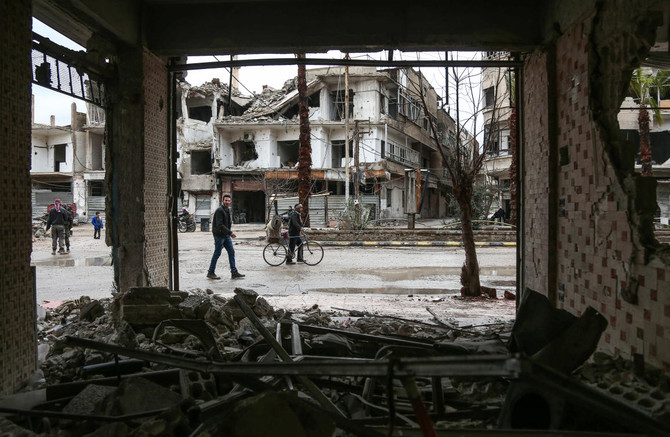
A picture taken on February 17, 2018 shows people walking down a rain-soaked street past damaged and destroyed buildings in the Syrian rebel-held enclave of Arbin in the Eastern Ghouta near the capital Damascus. (Abdulmonam Eassa/AFP)
Updated 18 February 2018
Follow

US still unsure who directed Syria attack, despite Russian dead

WASHINGTON: The United States is still unsure who directed a Feb. 7 attack on US and US-backed forces in Syria, Defense Secretary Jim Mattis said on Saturday, even as he acknowledged accounts that Russian civilian contractors were involved.
Reuters has reported that about 300 men working for a Kremlin-linked Russian private military firm were either killed or injured in Syria.
The US has estimated about 100 pro-Syrian government forces were killed by US strikes to repel the Feb. 7 attack.
Russian military officers told the United States during the incident that Moscow was not involved. The Pentagon has declined to comment on the exact makeup of the attacking forces and Mattis appeared at a loss to explain the incident 10 days later.
“I still cannot give you any more information on why they would do this. But they took direction from someone,” Mattis told reporters flying back to Washington with him from a trip to Europe, according to a Pentagon transcript.
“Was it local direction? Was it from external sources? Don’t ask me. I don’t know.”
Mattis said he “understood” that Moscow had acknowledged contractors were involved, without elaborating on whether that understanding came from press reports. Russian officials have told reporters that five Russian citizens may have been killed in clashes with US-led coalition forces.
Still, Russian officials deny they deploy private military contractors in Syria, saying Moscow’s only military presence is a campaign of air strikes, a naval base, military instructors training Syrian forces, and limited numbers of special forces troops.
But according to people familiar with the deployment, Russia is using large numbers of the contractors in Syria because that allows Moscow to put more boots on the ground without risking regular soldiers whose deaths have to be accounted for.
The contractors, mostly ex-military, carry out missions assigned to them by the Russian military, the people familiar with the deployment said. Most are Russian citizens, though some have Ukrainian and Serbian passports.
The United States and Russia, while backing opposite sides in the Syria conflict, have taken pains to make sure that their forces do not accidentally collide. But the presence of the Russian contractors adds an element of unpredictability.
The US military has said that in its effort to repel the attack on Feb. 7, US forces on the ground called in coalition strikes for more than three hours, involving F-15E fighter jets, MQ-9 drones, B-52 bombers, AC-130 gunships and AH-64 Apache helicopters.
The US military has said the attacking forces were aligned with the Syrian government and were backed by artillery, tanks, multiple-launch rocket systems and mortars.
“I doubt that 257 people all just decided on their individual own selves to suddenly cross the river into enemy territory and start shelling a location and maneuvering tanks against it,” Mattis said.
“So whatever happened, we’ll try to figure it out. We’ll work with, obviously, anyone who can answer that question, but I cannot, at this time.”


Syrian government and SDF agree to de-escalate after Aleppo violence

Updated 37 min 40 sec ago
Follow

Syrian government and SDF agree to de-escalate after Aleppo violence

  • Turkiye views the US-backed SDF, which controls swathes of northeastern Syria, as a ⁠terrorist organization and has warned of military action if the group does not honor the agreement

DAMASCUS: Syrian government forces and the Kurdish-led Syrian Democratic Forces agreed to de-escalate on Monday evening in the northern city of Aleppo, after a wave of attacks that both sides blamed on each other left at least two civilians dead and several wounded.
Syria’s state news agency SANA, citing the defense ministry, said the army’s general command issued an order to stop targeting the SDF’s fire sources. The SDF said in a statement later that it had issued instructions to stop responding ‌to attacks ‌by Syrian government forces following de-escalation contacts.

HIGHLIGHTS

• SDF and Syrian government forces blame each other for Aleppo violence

• Turkiye threatens military action if SDF fails integration deadline

• Aleppo schools and offices closed on Tuesday following the violence

The Syrian health ministry ‌said ⁠two ​people ‌were killed and several were wounded in shelling by the SDF on residential neighborhoods in the city. The injuries included two children and two civil defense workers. The violence erupted hours after Turkish Foreign Minister Hakan Fidan said during a visit to Damascus that the SDF appeared to have no intention of honoring a commitment to integrate into the state’s armed forces by an agreed year-end deadline.
Turkiye views the US-backed SDF, which controls swathes of northeastern Syria, as a ⁠terrorist organization and has warned of military action if the group does not honor the agreement.
Integrating the SDF would ‌mend Syria’s deepest remaining fracture, but failing to do ‍so risks an armed clash that ‍could derail the country’s emergence from 14 years of war and potentially draw in Turkiye, ‍which has threatened an incursion against Kurdish fighters it views as terrorists.
Both sides have accused the other of stalling and acting in bad faith. The SDF is reluctant to give up autonomy it won as the main US ally during the war, which left it with control of Islamic ​State prisons and rich oil resources.
SANA, citing the defense ministry, reported earlier that the SDF had launched a sudden attack on security forces ⁠and the army in the Sheikh Maqsoud and Ashrafiyah neighborhoods of Aleppo, resulting in injuries.
The SDF denied this and said the attack was carried out by factions affiliated with the Syrian government. It said those factions were using tanks and artillery against residential neighborhoods in the city.
The defense ministry denied the SDF’s statements, saying the army was responding to sources of fire from Kurdish forces. “We’re hearing the sounds of artillery and mortar shells, and there is a heavy army presence in most areas of Aleppo,” an eyewitness in Aleppo told Reuters earlier on Monday. Another eyewitness said the sound of strikes had been very strong and described the situation as “terrifying.”
Aleppo’s governor announced a temporary suspension of attendance in all public and private schools ‌and universities on Tuesday, as well as government offices within the city center.