Freed German-Turkish journalist says Ankara held him ‘hostage’

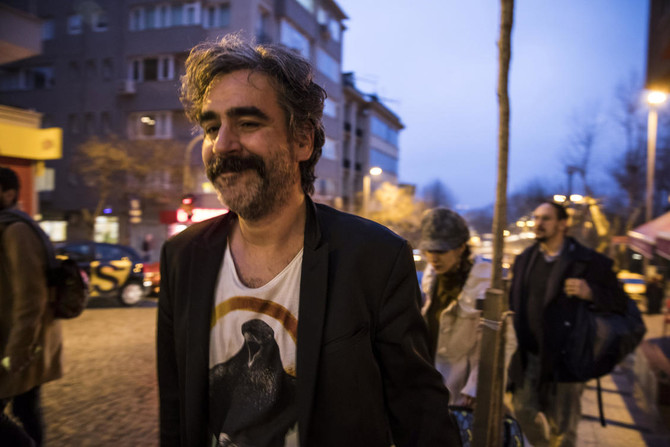
German-Turkish journalist Deniz Yucel is pictured in front of his home after he was released from prison in Istanbul, Turkey, Feb. 16, 2018. (Reuters)
Updated 17 February 2018
Follow

Freed German-Turkish journalist says Ankara held him ‘hostage’

BERLIN: A German-Turkish journalist who was freed in Turkey after spending more than a year in jail without trial said he was held “hostage” by Ankara and that other journalists are still stuck in Turkish prisons just “for doing their job.”
Deniz Yucel, 44, the Turkey-based correspondent of Die Welt newspaper, landed in Berlin on Friday night hours after being released from a high security prison in Istanbul.
In a video posted on social media during the night Yucel said: “The funny thing is that I still do not know why I was jailed for a year, why I was held hostage for a year.”
Yucel, who has both German and Turkish citizenship, had been accused of writing propaganda in support of terrorism.
He is among more than 100 journalists and writers to be detained in Turkey since the failed July 2016 coup against President Recep Tayyip Erdogan.
On Friday, prosecutors presented an indictment seeking up to 18 years in jail for Yucel on charges of “making terror propaganda” and “inciting public hatred and hostility,” but he left the country.
In the video, Yucel also highlighted the plight of other journalists jailed in Turkey, saying they had “done nothing but their job.”
On Friday, an Istanbul court also jailed three prominent Turkish journalists for life on charges of links to the group blamed for the failed coup.
Amnesty International said their sentencing had “drained the joy from celebrations” over Yucel’s release.
“I do not know why I was released today,” said Yucel in the video. “Of course I rejoice (my freedom) but there is a bitter aftertaste.”
Yucel’s surprise release may help repair severely-eroded ties between Ankara and Berlin.
However a number of German citizens or dual nationals — who are seen by Berlin as political hostages — remain in Turkish prisons, among the more than 55,000 people arrested since the failed coup.


Trending: BBC report suggests sexual abuse and torture in UAE-run Yemeni prisons

Updated 02 February 2026
Follow

Trending: BBC report suggests sexual abuse and torture in UAE-run Yemeni prisons

  • The investigation was produced by British-Yemeni BBC journalist Nawal Al-Maghafi

LONDON: A recent BBC video report diving into what it says was UAE-run prison in Yemen has drawn widespread attention online and raised fresh questions about the role of the emirates in the war-torn country.

The report, published earlier this month and recently subtitled in Arabic and shared on social media, alleged that the prison — located inside a former UAE military base — was used to detain and torture detainees during interrogations, including using sexual abuse as a method.

The investigation was produced by British-Yemeni BBC journalist Nawal Al-Maghafi, who toured the site, looking into cells and what appear to be interrogation rooms.

Al-Maghafi said the Yemeni government invited the BBC team to document the facilities for the first time.

A former detainee, speaking anonymously, described severe abuse by UAE soldiers: “When we were interrogated, it was the worst. They even sexually abused us and say they will bring in the doctor. The ‘so-called’ doctor was an Emirati soldier. He beat us and ordered the soldiers to beat us too. I tried to kill myself multiple times to make it end.”

Yemeni information minister, Moammar al Eryani also appears in the report, clarifying that his government was unable to verify what occurred within sites that were under Emirati control.

“We weren’t able to access locations that were under UAE control until now,” he said, adding that “When we liberated it (Southern Yemen), we discovered these prisons, even though we were told by many victims that these prisons exist, but we didn't believe it was true.”

The BBC says it approached the UAE government for comment, however Abu Dhabi did not respond to its inquiries.

Allegations of secret detention sites in southern Yemen are not new. The BBC report echoes earlier reporting by the Associated Press (AP), which cited hundreds of men detained during counterterrorism operations that disappeared into a network of secret prisons where abuse was routine and torture severe.

In a 2017 investigation, the AP documented at least 18 alleged clandestine detention sites — inside military bases, ports, an airport, private villas and even a nightclub — either run by the UAE or Yemeni forces trained and backed by Abu Dhabi.

The report cited accounts from former detainees, relatives, civil rights lawyers and Yemeni military officials.

Following the investigation, Yemen’s then-interior minister called on the UAE to shut down the facilities or hand them over, and said that detainees were freed in the weeks following the allegations.

The renewed attention comes amid online speculation about strains between Saudi Arabia and the UAE over Yemen.