ANKARA: The decision to free the Turkish-German journalist Deniz Yucel on Friday has removed one of the stumbling blocks to the normalization of relations between Germany and Turkey.
The surprise decision came 16 hours after Turkish Prime Minister Binali Yildirim’s meeting with German Chancellor Angela Merkel in Berlin on Thursday, when Yildirim hinted about “changes” in Yucel’s case.
German Foreign Minister Sigmar Gabriel, who has held regular talks with his Turkish counterpart, thanked the Turkish government on his Twitter account for its support toward a resolution.
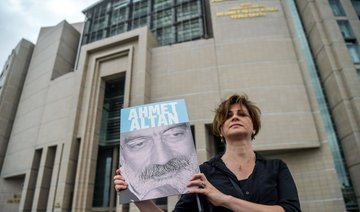
Yucel, a reporter for German daily Die Welt, was detained in Turkey a year ago on suspicion of “spreading terrorist propaganda to incite the population.” He denied the charges, but no indictment was prepared until hours before his release.
Yucel’s detention in an Istanbul prison was one of the major symbols of tension between the countries and Merkel called it a “burden” on bilateral relations.
Experts said that the release was the outcome of several mutual gestures between Ankara and Berlin to mend ties by respecting mutual sensitivities.
In a surprising move, Germany on Wednesday banned several gatherings planned by NAV-DEM, an organization affiliated with the PKK — listed as a terror group by the EU, Turkey and the US — in northwestern cities.
German police said they based the decision on the probability that members of the group might again carry outlawed symbols of the terrorist group as they did last month.
Alper Ucok, Berlin representative of the Turkish Industry and Business Association (TUSIAD), said the progress reached on the Ankara-Berlin axis was the result of a lengthy process.
“Despite the problematic relations over the last year and many ups and downs regarding bilateral relations, both Turkey and Germany were determined to make use of all available communication, including official and non-official back channels, which brought about this positive change toward normalization,” he said.
German human rights activist Peter Steudtner, German pilgrim David Britsch and German-Turkish journalist Mesale Tolu were released late last year by Turkey.
Ucok said Turkey has been keen on normalizing its strained ties with the EU for some time, particularly in the run-up to the EU-Turkey leaders’ meeting on March 26 in Bulgaria.
“In that respect, the normalization of relations with Germany was more vital than ever. The continuity of this constructive process depends partly on the German government to be formed soon, which must formulate new Turkish policy for the next term, and partly to the encouraging repercussions at the EU level,” he said.
Conversely, according to Ucok, it would also be very decisive if Turkey took steps toward normalization at the domestic level, including the re-evaluation of conditions for lifting the state of emergency rule, which had been in effect since last July’s failed military coup.
“If Turkey could not take positive steps to strengthen its democracy soon, these slow normalization steps with Germany and also with EU might be doomed unsustainable even sooner,” he said. There are more than 150 journalists still behind bars in Turkey.


Journalist’s release helps German-Turkish ties to thaw

Journalist’s release helps German-Turkish ties to thaw


Family of Palestinian-American shot dead by Israeli settler demand accountability
- Relatives say Abu Siyam was among about 30 residents from the village of Mukhmas who confronted armed settlers attempting to steal goats from the community
LONDON: The family of a 19-year-old Palestinian-American man reportedly shot dead by an Israeli settler in the occupied West Bank have demanded accountability, amid mounting scrutiny over a surge in settler violence and a lack of prosecutions.
Nasrallah Abu Siyam, a US citizen born in Philadelphia, was killed near the city of Ramallah on Wednesday, becoming at least the sixth American citizen to die in incidents involving Israeli settlers or soldiers in the territory in the past two years.
Relatives say Abu Siyam was among about 30 residents from the village of Mukhmas who confronted armed settlers attempting to steal goats from the community. Witnesses said that stones were thrown by both sides before settlers opened fire, wounding at least three villagers.
Abu Siyam was struck and later died of his injuries.
Abdulhamid Siyam, the victim’s cousin, said the killing reflected a wider pattern of impunity.
“A young man of 19 shot and killed in cold blood, and no responsibility,” he told the BBC. “Impunity completely.”
The US State Department said that it was aware of the death of a US citizen and was “carefully monitoring the situation,” while the Trump administration said that it stood ready to provide consular assistance.
The Israeli embassy in Washington said the incident was under review and that an operational inquiry “must be completed as soon as possible.”
A spokesperson for the Israeli Defense Forces said troops were deployed to the scene and used “riot dispersal means to restore order,” adding that no IDF gunfire was reported.
The military confirmed that the incident remained under review and said that a continued presence would be maintained in the area to prevent further unrest.
Palestinians and human rights organizations say such reviews rarely lead to criminal accountability, arguing that Israeli authorities routinely fail to prosecute settlers accused of violence.
A US embassy spokesperson later said that Washington “condemns this violence,” as international concern continues to grow over conditions in the occupied West Bank.
Palestinians and human rights groups say Israeli authorities routinely fail to investigate or prosecute settlers accused of violence against civilians.
Those concerns were echoed this week by the UN, which warned that Israel’s actions in the occupied West Bank may amount to ethnic cleansing.
A UN human rights office report on Thursday said that Israeli settlement expansion, settler attacks and military operations have increasingly displaced Palestinian communities, with dozens of villages reportedly emptied since the start of the Gaza war.
The report also criticized Israeli military tactics in the northern West Bank, saying that they resembled warfare and led to mass displacement, while noting abuses by Palestinian security forces, including the use of unnecessary lethal force and the intimidation of critics.
Neither Israel’s foreign ministry nor the Palestinian Authority has commented on the findings.


