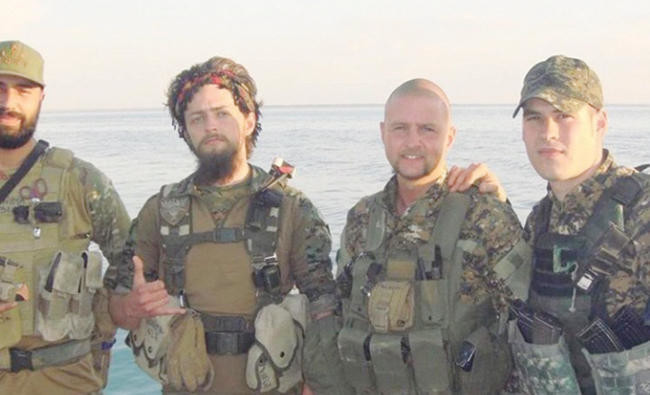
LONDON: To some, they are freedom fighters, willing to risk their lives in defense of a persecuted people, but others take a dimmer view of the Western volunteers battling Daesh alongside Kurdish forces in Syria.
On Wednesday, James Matthews, a former British soldier who fought with the Kurdish People’s Protection Units (YPG) against Daesh in Syria, was charged with terror-related offenses, making him the first Briton to be prosecuted for helping a group backed by the UK government overseas.
Matthews pleaded not guilty to a charge of attending a place or places where training was provided “for purposes connected with the commission or preparation of acts of terrorism.” Another former volunteer, student Joshua Walker, was acquitted in October 2017 of terror charges for possessing a copy of the “The Anarchist Cookbook.”
The charges raise questions about the challenges facing Western volunteers returning from foreign combat zones, as well as the difficulties — amid the legal wasteland of Syria’s bloodied battlefields — of sorting the heroes from the villains as Daesh’s self-declared caliphate crumbles and the combatants disperse.
For the many foreign fighters attending the funeral in southwest England earlier this month of 24-year-old Briton Jac Holmes, who died in Raqqa while fighting as a sniper with the YPG, the prosecutions are a bitter betrayal.
“How can countries like Britain and Canada persecute guys who went and fought against Islamic State (Daesh), which is a known terrorist group — how can they be harassed, detained, questioned and possibly prosecuted, in these countries?” asked Jeff Kup, an American YPG fighter.
Kurdish analyst Wladimir van Wilgenburg described the decision to prosecute foreign fighters for battling Daesh with the Syrian Democratic Forces and YPG, groups backed by the US-led coalition, as “strange.”
“How you can prosecute someone for terrorism offenses if they fight against terrorism?”
Kup, who joined the fight against Daesh after seeing “what they were doing to women, children, the elderly, people who really couldn’t defend themselves,” described the treatment being handed out to fellow volunteers as “nerve-racking.”
Hundreds of foreign fighters from the US, Canada, UK and other European countries have traveled to Syria to fight with the YPG and its women’s fighting unit, the YPJ, whose role in defeating Daesh on the battlefield and liberating Yazidi women held captive by the terror group has been widely documented by international media outlets.
“The Kurds are seen as the ‘good guys’ among the many actors fighting in Syria,” said Robert Lowe, deputy director of the Middle East Center at the London School of Economic and Political Sciences.
“The appeal lies in a combination of the radical leftist ideology, sympathy for an oppressed ethnic minority, and hostility toward Daesh.”
Many Western volunteers who travel to join the YPG have huge social media followings and hero status among supporters back home. One Norwegian volunteer, who gives his name as Mike Peshmerganor, has more than 74,000 followers on his Facebook page and 171,000 followers on Twitter.
Describing the appeal for foreign fighters in taking up arms for a campaign they often have no personal affiliation with, he said: “If you have skills (military or medical) that can be used, know you won’t break your country’s laws by joining the YPG/YPJ, and are aware you might not come home in one piece or at all, and are still willing to take that risk, then go for it. It’s a just cause.”
But while public perception of the YPG and its foreign volunteers may be largely positive, in legal terms, their status is uncertain.
“A case often made is that although the cause they fight for, defeating Daesh, making sure the caliphate crumbles, fighting in the name of freedom, preventing terrorists from conducting attacks against the West … is quite noble, the nature of their participation is problematic,” said Nick Heras, a fellow at the Center for a New American Security, based in Washington.
“(Their participation) is not through the formal state militaries of their home countries, so is, in fact, illegal.”
Kurdish fighters are a key part of the US-backed Syrian Democratic Forces, but the US downplays links with the YPG because of the Kurdish group’s ties with the Kurdistan Workers’ Party (PKK), a separatist movement labelled a terrorist organization by Turkey, the US and several other countries.
“The PKK is a proscribed terrorist organization in many European countries, so they’ve made a choice there,” said Rafaello Pantucci, director of international security studies at the the Institute for Defense and Security Studies in London.
The YPG denies links with the PKK, although some YPG leaders have historical connections with the party.
“There is sometimes a reason to worry about some of these people and their motivations, but I certainly think they are a different level of concern than a person who went off to fight with Daesh,” Pantucci said.
According to Heras, “a very strong counter-narrative” is emerging in the “Jekyll and Hyde” situation surrounding foreign fighters.
“One of the dominant narratives on any given day could be that these are Westerners who are putting aside materialism and fighting for a cause that serves all humanity, and then, on another given day, you might have a narrative that says these people are actually breaking the law of their own countries and actively supporting a movement that is trying to undermine and destroy a NATO ally.”
Last month, the Turkish military launched an offensive to drive the YPG out of Afrin, a Kurdish-majority enclave in northern Syria. Western powers have urged restraint after violent clashes left thousands of civilians homeless.
The crisis has escalated tensions between the US and Turkey, casting doubt over the nature of US support for the YPG as it seeks to mend relations with an important Middle East ally.
“How these foreign fighters who join the YPG will be remembered will depend to a great degree on what the future of Turkey’s relationship is with these Western nations,” Heras said.
“If Turkey continues to have an antagonistic relationship with the West, I do think there will be a degree of sympathy.” However, a renewal of the friendship could trigger “a significant amount of legal ramifications,” and leave Western governments “much more disposed to take Turkey’s point of view,” he said.
Ora Szekely, associate professor of political science at Clark University, Massachusetts, said that US support for the Kurds is mostly about pragmatism. “Of all of the parties in the Syrian conflict, the Kurdish forces have been by far the most effective against ISIS (Daesh), which, given American objectives in Syria, makes them the most practical choice as a local military ally.”
She pointed to sympathy for the ideals behind the Rojava revolution in northern Syria, where Kurds are establishing a multi-ethnic secular democracy that champions women’s rights.
“The ideological blueprint for governance in Rojava … is based on principles that are shared by many leftists in the US and Europe, for whom supporting the Kurds is, therefore, about supporting a larger cause.”
Szekely said: “Most international fighters who have traveled to Syria to join the YPG and YPJ are motivated by ambition for their political project.” Western volunteers have been traveling to the Middle East to support the Kurdish cause since the 1980s, but in the past five years there has been a surge in the numbers of foreign recruits. A few have gained near-celebrity status, helping to publicize their cause and highlight the suffering of Kurdish people.
Canadian YPJ fighter Hanna Bohman, who recently made a documentary film about the YPJ with actress Olivia Wilde, told Arab News in an earlier interview: “They love the Western volunteers because it improves morale, it shows that people are listening. People do care about what you’re doing.”
Spaniard Artiaga Arges, who was in the same sniper unit as fallen fighter Jac Holmes, said: “The role of Western volunteers in military terms is small, but it’s very important in terms of solidarity and justice.”
Arges said: “They stepped up against Daesh when the rest of the world was just looking at the TV.”


![]()
‘Harassed, detained, prosecuted’: Western anti-Daesh fighters feel betrayed
‘Harassed, detained, prosecuted’: Western anti-Daesh fighters feel betrayed


Latest updates


© 2026 SAUDI RESEARCH & PUBLISHING COMPANY, All Rights Reserved And subject to Terms of Use Agreement.