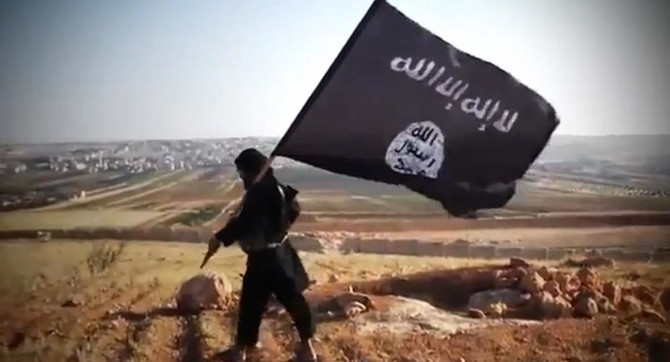
BAGHDAD: Iraqi authorities said Thursday they have managed for the first time to have a top leader of the Daesh group extradited from Turkey.
Ismail Alwan Salman Al-Ithawi, 55, was tracked to Turkey’s Sakarya region, detained and returned through cooperation between Turkish, Iraqi and US intelligence agencies, a senior official in the interior ministry’s Falcons unit hunting Daesh members told AFP.
The break came after his unit had “infiltrated the highest levels” of the extremist group, he said.
A native of the Iraqi city of Ramadi, Ithawi was the group’s “minister” in charge of religious edicts and headed a Daesh committee that decided on senior appointments, according to the official.
He had fled the group’s now-shattered “caliphate” in Syria and was living under his brother’s name in northern Turkey.
“We asked our ambassador in Ankara to intervene with the Turkish authorities by providing the arrest warrant issued by Iraqi courts and recent photos of Ismail,” the official said.
Daesh swept across Syria and northern Iraq in a lightning advance in 2014, unleashing a reign of terror across a vast swathe of territory that lasted some three years.
The group’s territory has now been wiped out in Iraq and reduced to a small foothold in Syria by a series of punishing assaults in both countries.
The focus has since switched to tracking down the group’s senior leadership and the thousands of foreign fighters who once flocked to its banner.

Senior Daesh leader extradited to Iraq from Turkey
Syria Kurds chief says ‘all efforts’ being made to salvage deal with Damascus
- Abdi said the Syrian Democratic Forces (SDF), the Kurds’ de facto army, remained committed to the deal
- The two sides were working toward “mutual understanding” on military integration and counter-terrorism
DAMASCUS: Syrian Kurdish leader Mazloum Abdi said Thursday that “all efforts” were being made to prevent the collapse of talks on an agreement with Damascus to integrate his forces into the central government.
The remarks came days after Aleppo saw deadly clashes between the two sides before their respective leaders ordered a ceasefire.
In March, Abdi signed a deal with Syrian President Ahmed Al-Sharaa to merge the Kurds’ semi-autonomous administration into the government by year’s end, but differences have held up its implementation.
Abdi said the Syrian Democratic Forces (SDF), the Kurds’ de facto army, remained committed to the deal, adding in a statement that the two sides were working toward “mutual understanding” on military integration and counter-terrorism, and pledging further meetings with Damascus.
Downplaying the year-end deadline, he said the deal “did not specify a time limit for its ending or for the return to military solutions.”
He added that “all efforts are being made to prevent the collapse of this process” and that he considered failure unlikely.
Abdi also repeated the SDF’s demand for decentralization, which has been rejected by Syria’s Islamist authorities, who took power after ousting longtime ruler Bashar Assad last year.
Turkiye, an important ally of Syria’s new leaders, sees the presence of Kurdish forces on its border as a security threat.
In Damascus this week, Turkish Foreign Minister Hakan Fidan stressed the importance of the Kurds’ integration, having warned the week before that patience with the SDF “is running out.”
The SDF control large swathes of the country’s oil-rich north and northeast, and with the support of a US-led international coalition, were integral to the territorial defeat of the Daesh group in Syria in 2019.
Syria last month joined the anti-IS coalition and has announced operations against the jihadist group in recent days.