Bulgaria wades into Macedonia name dispute

Macedonian President Gjorge Ivanov, right, shakes hand with his Bulgarian counterpart Rumen Radev as he greets him upon his arrival in Skopje. The Bulgarian president said that any name agreed on with Athens should not include ‘a geographical qualifier that is related to the territory of Bulgaria.’ (AFP)
Updated 16 February 2018
Follow

Bulgaria wades into Macedonia name dispute

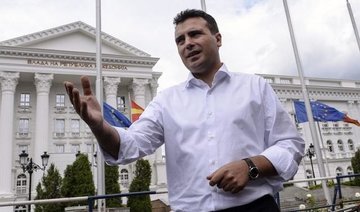
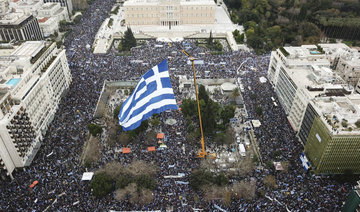
SKOPJE, Macedonia: Bulgaria has waded into a 25-year-long dispute between Greece and Macedonia regarding Macedonia's name, saying that issue also concerns Bulgaria.
Macedonia and Greece are in a renewed push to resolve their dispute. Greece objects to its northern neighbor using the name, saying it implies territorial claims on its own province of Macedonia. One solution being discussed is to add a qualifier such as "new," ''upper" or "north" to the name.
Bulgarian President Rumen Radev said Friday after meeting with his Macedonian counterpart Gjorge Ivanov that any name agreed on with Athens should not include "a geographical qualifier that is related to the territory of Bulgaria." He did not explain further.
The historical territory of Macedonia included lands that are now in Greece, Bulgaria and the country that calls itself Macedonia.


Philippines seeks to regain Chinese visitors as arrivals lag behind regional rivals

Updated 27 December 2025
Follow

Philippines seeks to regain Chinese visitors as arrivals lag behind regional rivals

  • 262,000 Chinese tourists visited Philippines in 2025, compared to 1.7m in 2019
  • Vietnam is top destination for Chinese travelers, with about 4.8m visitors this year

MANILLA: The Philippines is trailing behind other countries in Southeast Asia in winning back Chinese tourists, with arrivals well below a quarter of pre-pandemic levels so far this year, latest data showed.

Known for its white sandy beaches, famous diving spots and diverse culture, the Philippines was welcoming an increasing number of Chinese tourists in the period before the pandemic, with the number peaking at over 1.7 million in 2019, when it was the second-largest source market after South Korea. 

But the post-pandemic rebound has been slow, with China ranking sixth among international arrivals and the number of Chinese visitors reaching only 262,000 as of Dec. 20, according to data from the Philippine Department of Tourism.

“China remains one of the country’s largest and most important source markets,” the tourism department said earlier this week.

Chinese arrivals this year are equivalent to only around 15 percent of the numbers in 2019 and there is stiff competition with regional rivals like Vietnam, Thailand, Malaysia, Singapore and Indonesia each welcoming at least 1 million tourists from China in 2025.

Vietnam has become Chinese travelers’ top travel destination in Southeast Asia with around 4.8 million visitors so far this year, followed by Thailand, which has recorded about 4.36 million.

China is Singapore’s top source market, with nearly 3 million visitors as of November.

To attract more visitors from China, the Philippines reintroduced electronic visas for Chinese travelers in November, after suspending the system for two years.

“The eVisa resumption is a critical step forward and a clear signal that the Philippines is open, ready, and eager to welcome our Chinese friends,” said Ireneo Reyes, the tourism attache to China.

“While the timing meant that its full benefits could not be felt within the peak booking periods of 2025, we expect a more visible impact beginning the first quarter of 2026.” 

The Philippine tourism department said that “recovery has also been constrained by reduced flight capacity, with China-Philippines routes operating at only about 45 percent of pre-pandemic levels,” adding that officials were working closely with relevant stakeholders to “rebuild connectivity and confidence.”

Tourism is an important sector in the Philippine economy, according to a report by the ASEAN+3 Macroeconomic Research Office, accounting for about 13.2 percent of the country’s gross domestic product last year and making up around 13.8 percent of its labor force.