Aoun to Tillerson: Lebanon is sticking to its borders, rejects Israeli claims over disputed area

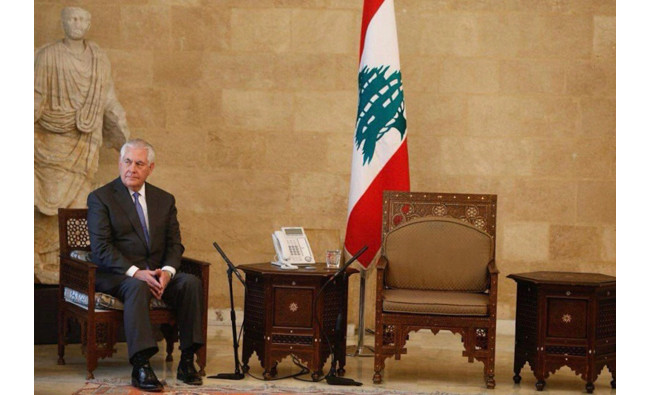
Photo of US Secretary of State Rex Tillerson waiting to meet Lebanon FM in Presidential palace in Beirut
Updated 15 February 2018
Follow

Aoun to Tillerson: Lebanon is sticking to its borders, rejects Israeli claims over disputed area

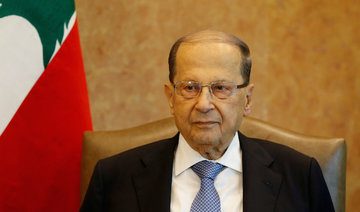
Lebanon's President Michel Aoun told US Secretary of State Rex Tillerson that Lebanon is sticking to its internationally recognised borders Thursday and rejected Israeli claims over a disputed area in Lebanese waters.
During a brief stopover in Beirut as part of a regional trip, he added that Lebanon was committed to preserving calm on its southern border and urged Washington to play an “effective role” to help resolve Beirut’s land and maritime disputes with Israel.
Aoun also urged the United States to “work on preventing Israel from continuing its assaults on Lebanese sovereignty” by land and sea, a statement from the presidency said. 
Israel has recently escalated its threats over Lebanon's invitation for offshore gas exploration bids along the countries' maritime border claiming that Lebanon will be drilling in areas owned by Israel. Lebanese officials deny the Israeli statements, saying the area where the country plans to drill belongs to Lebanon.
The long-standing dispute resurfaced recently as Lebanon signed a deal with an international consortium to start exploratory offshore drilling next year.
Israeli Defense Minister Avigdor Lieberman described the exploration tender as " provocative" and suggested that Lebanon had put out invitations for bids from international groups for a gas field "which is by all accounts ours."
There are over 800 square kilometers (300 square miles) of waters claimed by the two countries. US officials have previously tried to mediate the dispute, including most recently by David Satterfield, the US acting assistance secretary of state who visited the border area in south Lebanon last week, and was accompanying Tillerson on Thursday.



Syria Kurds chief says ‘all efforts’ being made to salvage deal with Damascus

Updated 25 December 2025
Follow

Syria Kurds chief says ‘all efforts’ being made to salvage deal with Damascus

  • Abdi said the Syrian Democratic Forces (SDF), the Kurds’ de facto army, remained committed to the deal
  • The two sides were working toward “mutual understanding” on military integration and counter-terrorism

DAMASCUS: Syrian Kurdish leader Mazloum Abdi said Thursday that “all efforts” were being made to prevent the collapse of talks on an agreement with Damascus to integrate his forces into the central government.
The remarks came days after Aleppo saw deadly clashes between the two sides before their respective leaders ordered a ceasefire.
In March, Abdi signed a deal with Syrian President Ahmed Al-Sharaa to merge the Kurds’ semi-autonomous administration into the government by year’s end, but differences have held up its implementation.
Abdi said the Syrian Democratic Forces (SDF), the Kurds’ de facto army, remained committed to the deal, adding in a statement that the two sides were working toward “mutual understanding” on military integration and counter-terrorism, and pledging further meetings with Damascus.
Downplaying the year-end deadline, he said the deal “did not specify a time limit for its ending or for the return to military solutions.”
He added that “all efforts are being made to prevent the collapse of this process” and that he considered failure unlikely.
Abdi also repeated the SDF’s demand for decentralization, which has been rejected by Syria’s Islamist authorities, who took power after ousting longtime ruler Bashar Assad last year.
Turkiye, an important ally of Syria’s new leaders, sees the presence of Kurdish forces on its border as a security threat.
In Damascus this week, Turkish Foreign Minister Hakan Fidan stressed the importance of the Kurds’ integration, having warned the week before that patience with the SDF “is running out.”
The SDF control large swathes of the country’s oil-rich north and northeast, and with the support of a US-led international coalition, were integral to the territorial defeat of the Daesh group in Syria in 2019.
Syria last month joined the anti-IS coalition and has announced operations against the jihadist group in recent days.