Philippines objects to China’s naming of undersea features

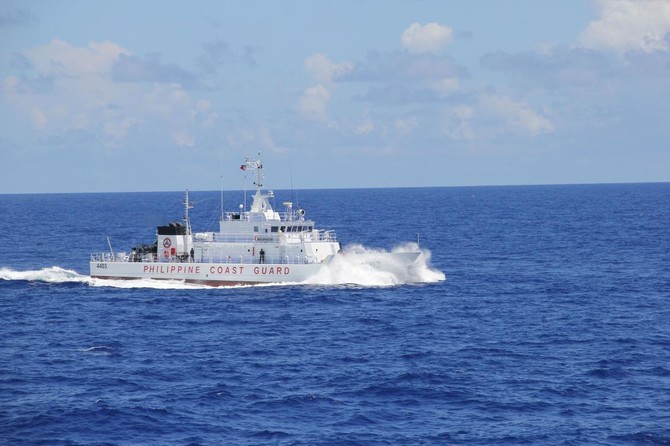
Above, a Philippine Coast Guard ship sails along Benham Rise, off the east coast of the main island of Luzon. (Department of Agriculture-Agriculture and Fisheries Information Division via AFP)
Updated 14 February 2018
Follow

Philippines objects to China’s naming of undersea features

MANILA: The Philippine government rejects Chinese names given to some undersea features in a vast offshore region where the Philippines has undisputed sovereign rights, the presidential spokesman said Wednesday in a new tiff despite the Asian neighbors’ mended ties.
The Philippines has already raised its concern to China over its naming of the undersea features in Benham Rise and may officially notify the international hydrographic body that lists such records, spokesman Harry Roque Jr. said.
China proposed the names for the features in 2015 and 2017, he said.
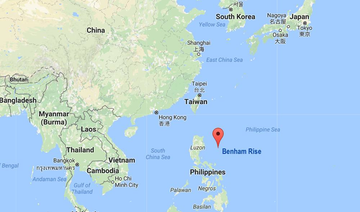
Benham Rise lies on the other side of the Philippine archipelago from the South China Sea, where Manila, Beijing and four other governments have been locked in territorial disputes.
Critics have questioned why President Rodrigo Duterte’s administration allowed a group from China to undertake scientific research in the waters given Manila’s long-simmering territorial conflict with Beijing in the South China Sea.
China has defied and refuses to comply with an international arbitration ruling that invalidated its claim to virtually all of the South China Sea on historical grounds.
“We object and do not recognize the Chinese names given to some undersea features in the Philippine Rise,” Roque said in a statement, using the name given by the Duterte administration to Benham Rise.
Duterte ordered an end last week to all foreign scientific research missions in Benham Rise after officials said the Philippines’ undisputed sovereign rights in the potentially oil- and gas-endowed body of water off its northeastern coast came under question.
The president followed up with a warning that he will order the navy to fire if other countries extract resources from within his country’s exclusive economic zone, a 200-nautical mile stretch of sea where a coastal state has internationally recognized exclusive rights to exploit resources under a 1982 UN treaty.
Foreign ships can pass but cannot fish or extract oil and gas from the under the seabed.
There were no immediate comments from Chinese Embassy officials.
Chinese and Philippine officials met Tuesday in Manila and discussed proposed joint projects in the South China Sea. They said China and Southeast Asian nations would begin negotiations early next month on a “code of conduct” aimed at reducing the risks of armed confrontations in the contested territories.


GCC, India relaunch negotiations on free trade deal

Updated 6 sec ago
Follow

GCC, India relaunch negotiations on free trade deal

  • India’s trade with GCC was valued at more than $178 billion in 2024-25 fiscal year
  • FTA will benefit infrastructure, petrochemicals sectors, Indian minister says

NEW DELHI: The Gulf Cooperation Council and India relaunched negotiations for a free trade agreement by signing the terms of reference for the talks on Thursday, about two decades after a first attempt stalled. 

India already has a Comprehensive Economic Partnership Agreement with two GCC members, Oman and the UAE, signed last year and in 2022, respectively.  

Its trade negotiations with the GCC — members of which also include Saudi Arabia — stalled following a framework agreement signed in 2004 and two rounds of talks held in 2006 and 2008. 

“It is most appropriate that we now enter into a much stronger and robust trading arrangement which will enable greater free flow of goods, services, bring predictability and stability to policy, help encourage greater degree of investments and take our bilateral relations between the six-nations GCC group and India to greater heights,” India’s Commerce Minister Piyush Goyal said in a press conference in New Delhi on Thursday. 

GCC-India bilateral trade was worth more than $178 billion in the 2024-25 fiscal year, accounting for more than 15 percent of India’s global trade. The region is also home to about 10 million Indians who live and work in the Gulf. 

The relaunched negotiations with Gulf countries came as Delhi accelerated discussions to finalize several trade agreements in recent months. 

Earlier this week, India reached a trade deal with the US after months of friction, following recent conclusions of similar negotiations with New Zealand and the EU. 

“As, I believe, the GCC and India come closer together, we will become a force multiplied for global good,” Goyal said. 

Food processing, infrastructure, petrochemicals and information and communications technology are sectors that will benefit from India-GCC FTA, he added. 

The free trade negotiations are taking place at a time when globalization was “under attack,” said GCC’s chief negotiator, Dr. Raja Al-Marzouqi. 

“It’s a message, a signal for the whole globe and it’s important for us at this time to try and be more cooperative,” he told reporters in New Delhi, adding that the first round of talks was likely to take place at the GCC headquarters in Riyadh. 

“When we agree, we will contribute as long as possible to the stability of the global economy.”