Mobile phone repair business booms in Pakistan

1 / 13
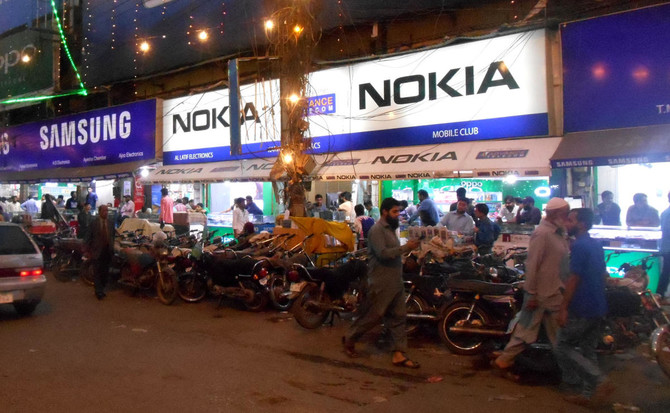
Pakistan’s largest mobile phone market in the Saddar area of Karachi. (AN photo by Khurshid Ahmed)
2 / 13
Students in repair class. (AN photo by Khurshid Ahmed)
3 / 13
Students listening to the instructor. (AN photo by Khurshid Ahmed)
4 / 13
A view of repair shops. (AN photo by Khurshid Ahmed)
5 / 13
Software faults being detected and repaired at Saddar. (AN photo by Khurshid Ahmed)
6 / 13
The technicians at the Saddar market. (AN photo by Khurshid Ahmed)
7 / 13
Screen of a mobile phone is being replaced. (AN photo by Khurshid Ahmed)
8 / 13
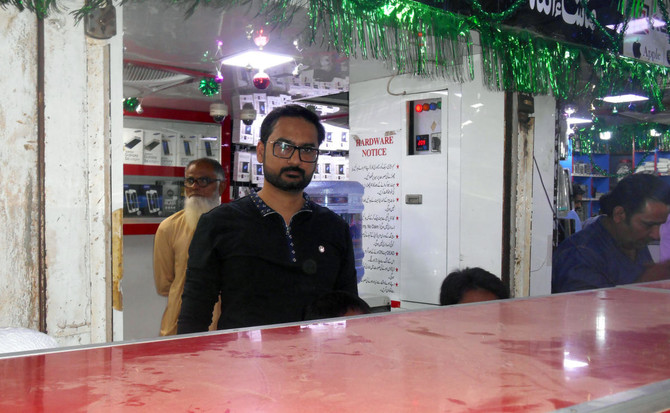
Muhammad Ahsan Mosani, owner of a repair center in the market. (AN photo by Khurshid Ahmed)
9 / 13
Muhammad Rizwan, president of the Karachi Electronic Dealer Association. (AN photo by Khurshid Ahmed)
10 / 13
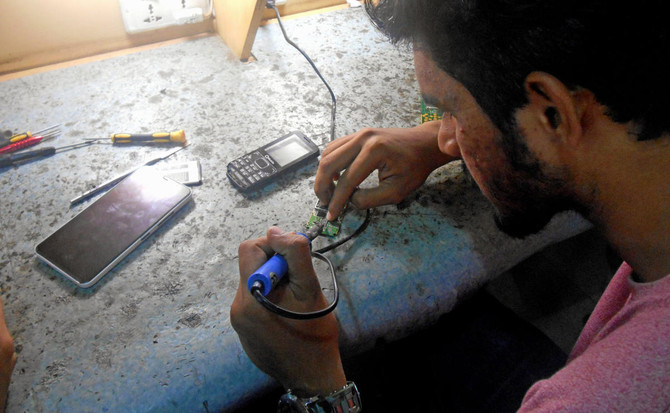
A technician repairs a mobile phone. (AN photo by Khurshid Ahmed)
11 / 13
Mobile phone accessories. (AN photo by Khurshid Ahmed)
12 / 13
Pakistan’s largest mobile phone market in the Saddar area of Karachi. (AN photo by Khurshid Ahmed)
13 / 13
A student repairs a mobile phone. (AN photo by Khurshid Ahmed)
Updated 13 February 2018
Follow

Mobile phone repair business booms in Pakistan

KARACHI: In the Saddar area of Karachi, Pakistan’s largest mobile phone market is buzzing with customers, some buying new smartphones, others seeking to get theirs repaired.
The number of mobile phone users in Pakistan is increasing daily, said Muhammad Ahsan Mosani, owner of a repair center in the market.
“Our technicians have acquired expertise either through training courses or while on the job,” he told Arab News.
“The presence of qualified technicians makes this market popular among mobile phone users.”
The advancement of cellular technology and huge investment have made Pakistan a major importer of mobile phones.
Every month, 1.5 to 2 million handsets are imported and sold in the country through legal channels, said Muhammad Rizwan, president of the Karachi Electronic Dealer Association.
He added that 30-40 percent of the electronic gadgets imported are smartphones, citing the introduction of 3G and 4G services in Pakistan. With no manufacturing facility in the country, most mobile sets are imported from China.
The huge influx has created employment opportunities for thousands of youths, as sales and repair shops have sprung up across Pakistan. Many technical institutions are now offering repair courses.
“I want to open my own mobile phone shop,” Muhammad Kamran, a student at the Memon Industrial and Technical Institute (MITI), told Arab News. “There’s huge demand for technicians.”
Muhammad Kashif, who is enrolled in a four-month course, said he has already opened a repair shop.
“There was no such facility in my area, so I decided to start my own business just weeks after starting the course,” he said.
MITI instructor Ayaz Mobin said the institute offers short courses of up to four months, and most students get jobs immediately.
Smartphone technology “is a bit complicated, but we have modern equipment to deal with it,” he told Arab News. “Our students are trained to use all kinds of equipment.”


Pakistan rejects India’s ‘irresponsible assertions’ after FM Jaishankar’s ‘bad neighbors’ remarks

Updated 03 January 2026
Follow

Pakistan rejects India’s ‘irresponsible assertions’ after FM Jaishankar’s ‘bad neighbors’ remarks

  • Indian FM Jaishankar accused Pakistan of fomenting militancy, backed New Delhi’s decision to put Indus Waters Treaty in abeyance
  • Islamabad calls the remarks an attempt to deflect attention from India’s ‘troubling record as a neighbor,’ vows to safeguard rights

ISLAMABAD: Pakistan on Saturday rejected “irresponsible assertions” made by Indian External Affairs Minister S. Jaishankar after his remarks about “bad neighbors” and the 1960 Indus Waters Treaty (IWT) between the two countries.

Jaishankar mentioned about “bad neighbors” at an event in Madras on Friday and said that New Delhi had a right to defend itself. “When you have bad neighbors... if you look to the one to the West, if a country decides that they will deliberately, persistently, unrepentantly continue with terrorism, we have a right to defend our people,” he was quoted as saying by The Hindu newspaper.

The remarks came months after New Delhi blamed Pakistan for a militant attack in Indian-administered Kashmir and conducted missile strikes inside Pakistan. Islamabad, which denied involvement in the Kashmir attack, responded to the strikes, leading to a four-day military conflict that saw the use of armed drones, fighter jets and artillery between the neighbors in May.

In a statement, Pakistani foreign office spokesman Tahir Andrabi said Islamabad firmly rejects the irresponsible assertions made by the Indian external affairs minister, describing the remarks as an attempt to deflect attention from India’s own “troubling record as a neighbor that promotes terrorism and contributes to regional instability.”

“India’s documented involvement in promoting terrorist activities in the region, particularly in Pakistan, is well known. The case of Commander Kulbhushan Jadhav remains a stark example of organized, state-sponsored terrorism directed against Pakistan,” he said.

“Equally concerning are recurring instances of extraterritorial killings, sabotage through proxies, and covert support to terrorist networks.”

Jadhav, an Indian navy officer who Islamabad said had been working with Indian spy agency, RAW, when Pakistani agencies arrested him in Balochistan in 2016. He was later sentenced to death by a Pakistani military court for alleged espionage. India disputes the conviction and has challenged it at the International Court of Justice.

Pakistan and India routinely accuse each other of supporting militant groups waging attacks against the other. The two countries have fought multiple wars, including two of them over the disputed region of Kashmir, since their independence from British rule in 1947. Both rule the region in part but claim it in full.

Jaishankar also spoke on Friday about the IWT that divides control of the Indus basin rivers between the neighbors and ensures water for 80 percent of Pakistani farms. India announced in April, following the Kashmir attack, that it was putting the 1960 World Bank-mediated treaty in abeyance.

“Many years ago, we agreed to a water-sharing arrangement — the belief was it was gesture of goodwill — because of good neighborliness we were doing it … but if you have decades of terrorism, there is no good neighborliness and you don’t get the benefit of good neighborliness,” Jaishankar was quoted as saying.

Pakistan foreign office spokesman Andrabi said the IWT is an international agreement concluded in good faith and at a considerable cost.

“Any unilateral violation of the Treaty by India would undermine regional stability and call into question its credibility as a state that claims to respect international legal obligations,” he said.

“Pakistan will take all necessary measures to safeguard its legitimate rights under the Treaty.”