OFER MILITARY BASE, West Bank: The closely watched trial of a Palestinian girl who slapped and punched two Israeli soldiers opened before an Israeli military court on Tuesday, but the judge ordered proceedings to be held behind closed doors in a case that has drawn wide criticism of Israel for prosecuting the teenager.
Ahed Tamimi, who turned 17 in prison last month, appeared fresh and confident as she was led into a courtroom packed with journalists and foreign diplomats.
She briefly gestured to relatives in the back of the room before the judge ordered everyone out except her family.
“Stay strong! Stay strong!” shouted her father, Bassem Tamimi.
After the prosecution read the 12-count indictment, the trial was adjourned until next month. Tamimi potentially faces years in prison if convicted of all charges, including assault and incitement in several incidents going back to April 2016.
She has been in detention since her arrest Dec. 19, four days after she was filmed confronting the soldiers outside her West Bank home.
Defense lawyer Gaby Lasky said she considers the court as an organ of what she described as an “illegal occupation” and that the indictment must be thrown out.
“It is a trial of occupation,” Lasky told reporters after the session. “This is a court of occupation, and Ahed was resisting occupation.”
Several senior Israeli officials have called for harsh punishment for Tamimi, describing her either as a terrorist, a serial troublemaker or a gullible teen being cynically manipulated by others.
The high-profile trial of Tamimi, one of an estimated 300 Palestinian minors in Israeli jails, has become the latest arena for the long-running battle between Palestinians and Israelis over global public opinion.
It also touches on the debate over what constitutes legitimate resistance to Israel’s rule over several million Palestinians, now in its 51st year.
Israel captured the West Bank, Gaza Strip and east Jerusalem in 1967, lands Palestinians seek for a future state. Repeated rounds of US-led Israeli-Palestinian negotiations on a partition deal have failed, and gaps have only widened between the sides.
Israel has framed Tamimi’s actions as purely criminal offenses. Among other things, she is being accused of incitement for comments she made on the same widely watched video that captured her scuffling with the soldiers.
In the Dec. 15 video, she talks about President Donald Trump’s recognition a week earlier of Jerusalem as Israel’s capital. She calls for large demonstrations as “the only way to reach results,” but says Trump must bear responsibility for any Palestinian reaction, including stabbings and suicide attacks, and that “everyone needs to do something and to unite.”
Tamimi’s family has said that she struck the two soldiers outside her West Bank home in frustration after having just learned that Israeli troops seriously wounded a 15-year-old cousin, shooting him in the head from close range with a rubber bullet during nearby stone-throwing clashes.
International human rights groups have criticized the full-throttle prosecution of a minor. Diplomats from the European Union and several European countries, including Germany and the Netherlands, attended Tuesday’s hearing as observers before they were kicked out along with journalists.
In his decision, the judge, Lt. Col. Menachem Lieberman, said the trial would remain closed for Tamimi’s own protection. “I didn’t think it’s good for the minor that there are 100 people in the courtroom,” he said.
Lasky, the defense lawyer, objected, saying the family wants the proceedings to be public. She accused the court of closing the hearings to prevent the world from watching.
“The court decided what is best for the court, and not what is good for Ahed,” she said. “The way to keep it out of everybody’s eyes is to close doors and not allow people inside the court for the hearing.”
She said her strategy would be to argue that Israel’s continued occupation over the West Bank, captured in the 1967 Mideast war, is illegal and that the indictment is aimed at deterring Ahed and other Palestinian youths “from resisting occupation nonviolently.”
Lasky said that her client did not respond to the charges read in court and that the next hearing was scheduled for March 11.
Earlier in the day, Tamimi’s father told The Associated Press as he headed into the court that he came “with no good expectations, because this a military court and it’s part of the Israeli military occupation.”
The Tamimis are from Nabi Saleh, a West Bank village of about 600 people, all members of the extended Tamimi family
Since 2009, residents there have staged regular anti-occupation protests that often ended with stone-throwing clashes.
Ahed Tamimi has participated in such marches from a young age, and has had several highly publicized run-ins with soldiers. One photo shows the then 12-year-old raising a clenched fist toward a soldier towering over her.


![]()
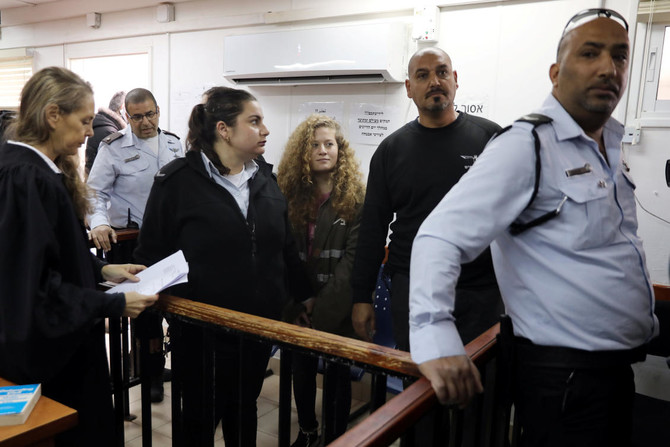
Palestinian teen goes on trial, Israeli judge bars public
Palestinian teen goes on trial, Israeli judge bars public
Latest updates



© 2026 SAUDI RESEARCH & PUBLISHING COMPANY, All Rights Reserved And subject to Terms of Use Agreement.