Couscous, a dish beloved far beyond North Africa

1 / 3
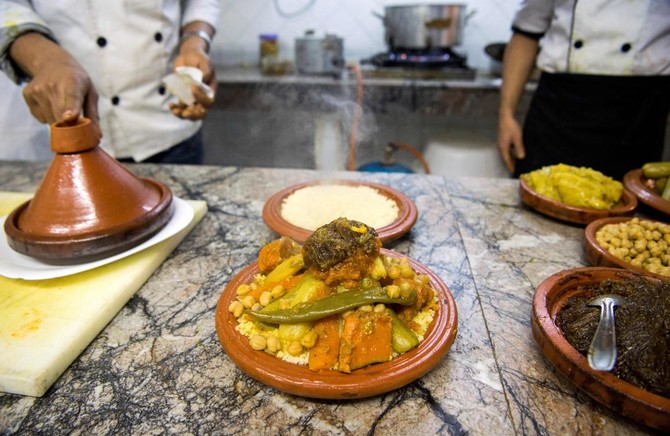
A Moroccan chef prepares a traditional couscous dish in a restaurant in the capital Rabat. (AFP)
2 / 3
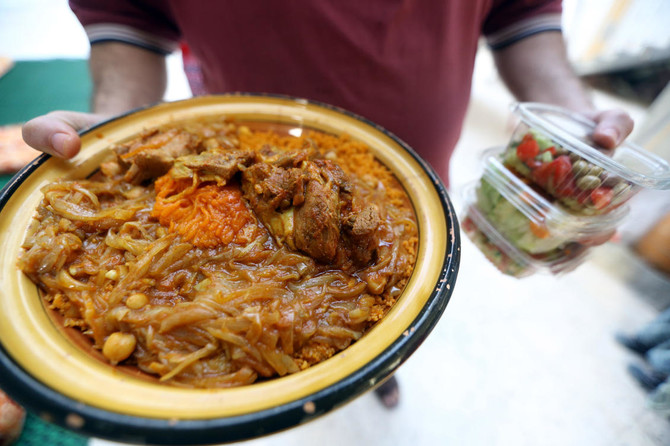
A Libyan family prepares to eat a freshly cooked traditional couscous dish, with lamb, onions, chickpeas, and pumpkin, in a home in the capital Tripoli. (AFP)
3 / 3
A freshly prepared traditional couscous dish, with lamb, onions, chickpeas, and pumpkin, being served in a home in the Libyan capital Tripoli. (AFP)
Updated 13 February 2018
Follow

Couscous, a dish beloved far beyond North Africa

PARIS: Couscous may be the signature dish of North Africa, but steaming plates of the stew-topped semolina are also served up in West Africa and around the Mediterranean.
Since 1998 the Italian island of Sicily has been the unlikely host of the couscous-making world championship known as Cous Cous Fest, which bills itself as a “festival of cultural integration.”
Each September chefs convene on Sicily, whose Mediterranean location opposite Tunisia has made it a cultural crossroads throughout history, battling to be crowned couscous king or queen.
Palestinian chefs George Suheil Srour and Elias Bassous won the competition last year, with a couscous topped with grilled sea bream, pomegranate and fennel crumble.
In France, from the mid-20th century an influx of North African laborers from colonial territories and French expats returning after decolonization helped popularise the dish.
But here too, couscous already had a history.
In his 1534 novel “Gargantua,” the French writer Francois Rabelais described banquets on tables featuring meats of all kinds, accompanied by soups and couscous.
The 1938 version of the Larousse Gastronomique, France’s hallowed food bible, featured an entire chapter on the dish.
Spain also has long been gobbling couscous, not least due to centuries of Muslim rule on the Iberian peninsula.
“From the 10th century durum wheat was cultivated in Spain and couscous landed on the tables of the working classes,” write Hadjira Mouhoub and Claudine Rabaa in their book “The Adventures Of Couscous.”
But the local aristocracy was rather partial too, they added — as related in the 13th-century cookbook “The Excellences of the Table,” by Andalusian gastronome Ibn Razin Al Tujibi.


Ramadan recipes: a taste of southern Italy with Linguine alla Nerano

Updated 04 March 2026
Follow

Ramadan recipes: a taste of southern Italy with Linguine alla Nerano

DUBAI: Chef Francesco Cortorillo, head chef at Dubai’s Scalini, shares a signature interpretation of the iconic southern Italian dish Linguine alla Nerano, celebrating the seasonality of zucchini and the subtle, elegant flavors of Provolone del Monaco DOP.

“Linguine alla Nerano is a dish that captures the elegance of Italian simplicity. When prepared with care, it delivers extraordinary depth from just a handful of ingredients,” he said.

Ingredients (serves 4) 


400g linguine.

700g zucchini.

120g Provolone del Monaco DOP.

40g Parmigiano Reggiano, finely grated.

Extra virgin olive oil, as needed.

Fresh basil leaves.

Salt, freshly ground black pepper.

Method 

Prepare the zucchini

Wash the zucchini and slice thinly, about 2 to 3 millimeters thick.

Heat a generous amount of extra virgin olive oil in a wide pan and fry the zucchini in batches until golden and lightly crisp.

Remove and drain on paper towels. Season lightly with salt while still warm.

Once cooled, set aside with a few fresh basil leaves.

This resting time is essential, allowing the zucchini to release their aroma into the oil.

Cook the pasta

Bring a large pot of well-salted water to the boil. Cook the linguine until very al dente. Reserve plenty of the pasta cooking water before draining.

Build the sauce

In a large pan, gently warm a small amount of the zucchini frying oil, lightly crushed. Add the fried zucchini and a ladle of pasta water to create a light base. Add the linguine and finish cooking directly in the pan, stirring gently.

Cream the pasta

Remove the pan from the heat. Gradually add the Provolone del Monaco and Parmigiano Reggiano, stirring continuously. Add pasta water slowly until a smooth, creamy sauce forms.

The sauce should coat the pasta without becoming heavy or stringy. Finish with fresh basil and, if desired, a touch of black pepper.