LAHORE: Maryam Nawaz, the daughter of Pakistan’s former prime minister Nawaz Sharif, has been tipped to succeed him as leader of the ruling Pakistan Muslim League-Nawaz (PML-N).
Nawaz Sharif, Pakistan's three-times premier, was barred from public office by the Supreme Court in July 2017. With his political future hanging in balance, political pundits have tipped his daughter, Maryam Nawaz, to succeed him as party leader.
The Supreme Court ruled that Nawaz Sharif had been “dishonest” in not disclosing his earnings from a Dubai-based company in his nomination papers for the 2013 general election. As a result of the ruling, Mr Sharif not only lost his position as prime
minister, but also as leader of the party.
Soon after the verdict, political pundits were reporting that PML-N was in trouble as there was no clear successor. Sharif's two sons, Hasan Nawaz and Hussain Nawaz, have shown no interest in politics, but daughter Maryam Nawaz has been politically active.
But the idea of her inheriting office has some prominent opponents, among them Chaudhary Nisar Ali Khan, who when he was minister for interior, spoke out against her ‘political heirship’. He is on record as having said: “Kids are kids and kids are apolitical. Maryam is a daughter, not political leader”, in a televised interview.
Another parliamentarian, Riaz Pirzada, suggested Shahbaz Sharif, Chief Minister of Punjab province, should be put in charge, but this suggestion has not won party backing.
With large numbers of PML-N leaders and workers faithful to the Sharif family, and not allied to another potential leader, Maryam Nawaz has been seen as the only choice for Sharif loyalists.
“Since Shahbaz Sharif is the Chief Minister of the Punjab, Maryam Nawaz remains the only choice to lead the party at national level,” said Pervaiz Aslam, an old party worker.
Against her is the fact that she has no experience of parliamentary politics — she has never belonged to any elected body such as senate, national or provincial assembly.
However, her supporters urge that she has led the prime minister’s youth program and worked with a large number of legislators.
She led the successful campaign for the election of her mother Kulsoom Nawaz to her father's Lahore seat after he was disqualified from office.
Maryam Nawaz, 44, was made chair of the family philanthropic trust, the Sharif Trust, in 1997. The mother of three joined her father’s political party in 2011 becoming chair of the Prime Minister Youth Programme in 2013. The BBC has listed her as one of the 100 most influential women in the world.
In 2012, Newsweek Pakistan described her as Nawaz Sharif’s “heir apparent” and the “presumed future leader” of PML-N.
She came to prominence in publicity over leaks revealed in an article in English-language newspaper Dawn, in October 2016. The controversial article reported the army's reluctance to crack down on some militant groups allegedly involved in attacks against neighboring India and Afghanistan.
Maryam's critics called her the mastermind of this political fiasco for the Nawaz Sharif government. Despite this, she was not named in the Dawn leaks investigation.
Chaudhary Khadim Hussain, Editor Political Affairs in Urdu newspaper Daily Pakistan, said that the family was in hot water: “[The] Nawaz family, including Maryam, is facing trial, but still PML-N finds Maryam Nawaz the alternative of Nawaz Sharif.
Maryam is active on social media where she has defended her father’s policies and contested the allegations against her father and brothers. In speaking up for Nawaz Sharif, and explaining his position, she sometimes apparently takes a different line from the party leadership.
Along with her husband, father and brothers, she also faces the Accountability Court.
Her staunch defense against the action has boosted her image with party workers. It is said that she is facing a bad situation bravely.
“The person who is giving the ‘Nawaz narrative’ is Maryam Nawaz. She is fighting the case of her father and people loyal to Nawaz Sharif in the PML-N look to her,” Mujibur Rehman Shami, a senior editor and Nawaz Sharif family confidant, told Arab News.
“One thing should be clear to all that the forthcoming election is not hers. She has to wait for a few years to regain the power of her father,” he added.


![]()
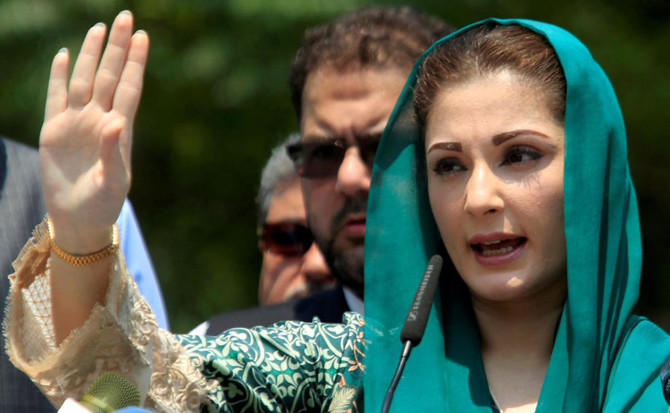
Will Maryam Nawaz emerge as the new PML-N leader?
Will Maryam Nawaz emerge as the new PML-N leader?
Latest updates


© 2026 SAUDI RESEARCH & PUBLISHING COMPANY, All Rights Reserved And subject to Terms of Use Agreement.