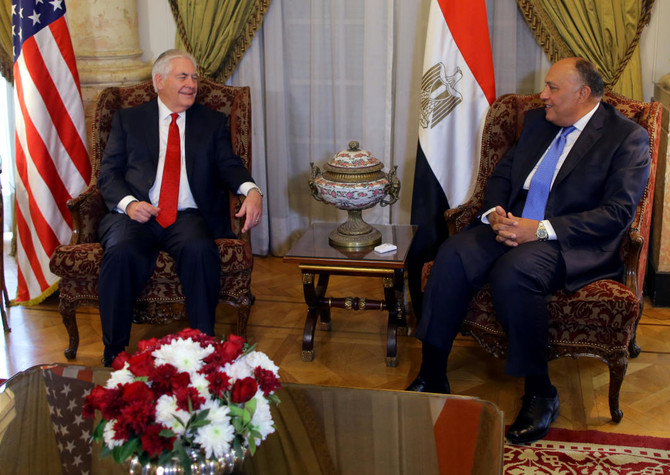
CAIRO: The United States and Egypt on Monday reaffirmed their commitment to battle militants in the Middle East as US Secretary of State Rex Tillerson held talks with Egyptian officials in Cairo at the start of his week-long trip to the region.
Tillerson and his Egyptian counterpart, Sameh Shoukry, cited productive discussions on regional security and the struggle against the Daesh group, whose Egyptian affiliate, based in the Sinai Peninsula, has struck military and civilian targets across the Arab world’s most populous country.
At a joint news conference with Shoukry, Tillerson said Egypt was an important part of the anti-Daesh coalition and that Washington was “committed to strengthening this partnership in the years to come.”
“We agreed that we would continue our close cooperation on counterterrorism measures, including our joint commitment to the defeat of Daesh,” Tillerson said.
“We highly value the support the US gives us in this war,” Shoukry said.
The visit comes as Egypt is undertaking a major military operation in Sinai, where militants have been leading an insurgency for years, and in remote areas of the mainland where extremists have attacked security forces and civilians.
The campaign also comes ahead of March elections in which President Abdel-Fattah el-Sisi faces no serious competitors, after authorities sidelined his opponents using a variety of charges and disqualifications, leaving only a little-known supporter to run against him. El-Sisi, who will hold talks with Tillerson later in the day, says he is the only one who can bring stability to the country. Militant attacks, however, have surged under his leadership.
Washington, which gives Egypt some $1.3 billion in annual military assistance and hundreds of millions more in civilian aid, withheld some of the funding last summer, ostensibly over new Egyptian legislation that blocks much foreign funding of non-governmental organizations, especially those involved in human rights research.
Asked about his country’s view of the upcoming vote, Tillerson said the US always advocates for free and fair elections and would continue to do so. He did not specifically mention el-Sisi’s virtually uncontested election, or the aid being withheld.
“We have always advocated for free and fair elections, transparent elections, not just for Egypt but any country,” Tillerson said.
After his talks with el-Sisi, Tillerson is traveling on to Kuwait, Jordan, Lebanon and Turkey, where he will meet local officails as well as Saudi, Emirati, Iraqi and Syrian delegations.


![]()
US and Egypt say they are steadfast in fight against Daesh
US and Egypt say they are steadfast in fight against Daesh
Latest updates





© 2026 SAUDI RESEARCH & PUBLISHING COMPANY, All Rights Reserved And subject to Terms of Use Agreement.