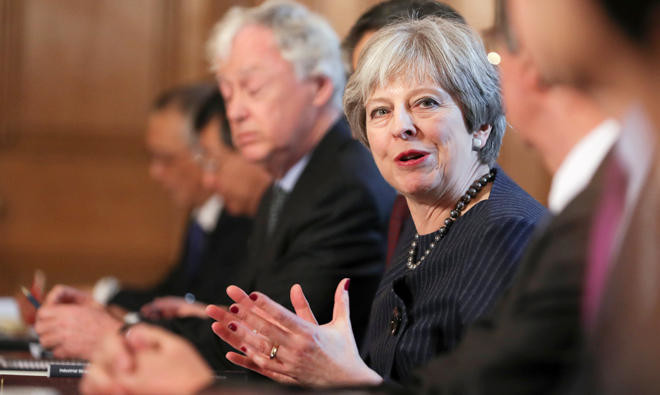
LONDON: British Prime Minister Theresa May will make two speeches on Brexit in the coming weeks to provide more details setting out the country’s path to leaving the EU.
Britain is hoping to seal a transition deal next month to smooth its exit from the EU, and reach agreement on a long-term trade deal later this year. However, Brussels said last week a transition deal was not a certainty and that London needed to clarify what it wanted from the EU.
May’s government will aim to address that in a series of six speeches by the prime minister and other senior ministers in the next few weeks, which her office dubbed “The Road to Brexit.”
“Brexit is a defining moment in the history of our nation,” a source in May’s office said.
“As we move along the road to that future, we will set out more detail so people can see how this new relationship will benefit communities in every part of our country.”
May’s first speech, to be delivered at a conference in Munich next Saturday, will set out the security relationship Britain wants with the EU. She will deliver another setting out Britain’s future partnership, although a date for that has yet to be confirmed.
Foreign Minister Boris Johnson, a leading Brexit advocate, will begin the “Road to Brexit” series with a speech on Wednesday, described by May’s office as a “rallying cry to those on both sides of the Brexit debate.”
Brexit Minister David Davis will outline how Britain’s businesses can maintain their global reputation after Brexit in an as yet unscheduled speech. Trade Minister Liam Fox and Cabinet Minister David Lidington will also give speeches.
Finance Minister Philip Hammond, seen as the most pro-EU member of May’s Cabinet, will not give a speech.
British Aid Minister Penny Mordaunt said on Sunday she believed the government would be able to strike a transitional Brexit deal with the EU.
“It’s in our interests and it’s in the EU’s interests. I think common sense will prevail,” Mordaunt said when asked if she thought a deal would be reached.

British PM to set out ‘Road to Brexit’ in speech
Germany scrambles to rescue thousands of stranded tourists
BERLIN: Germany said Monday it would send civilian planes to Saudi Arabia and Oman as part of efforts to evacuate thousands of tourists stranded by the Middle East war.
Some 30,000 Germans are stuck in the region, according to the German Travel Association, since the United States and Israel first attacked Iran on Saturday, sparking a wave of Iranian strikes across the region and beyond.
Foreign Minister Johann Wadephul said Germany would soon send planes to Saudi Arabia and Oman, where the airspace remained open, to start evacuating some of the most vulnerable tourists.
“We will send aircraft to Riyadh and Muscat as quickly as possible for particularly vulnerable groups,” he said, adding that he was in talks with national carrier Lufthansa to arrange the flights.
“The safety of our citizens is our top priority,” said Wadephul.
Crisis teams had been sent to Muscat, Doha and Dubai to explore the possibility of evacuating Germans from these locations, including overland, he added.
A team from the German embassy in Cairo was assisting with border crossings from Israel, he said.
Around 5,000 passengers are stuck on two TUI cruise ships in the United Arab Emirates and Qatar, according to German media, with reports of crying children and a general mood of fear.
“We were not allowed to leave the ship,” one female tourist, a police officer, told the NTV broadcaster.
“We are well looked after, but I don’t feel safe.”
TUI Cruises said in a statement that “due to the continuing dynamic situation in the region and limited flight connections, we are in close contact with the airlines to enable reliable planning of return journeys.”
Some 30,000 Germans are stuck in the region, according to the German Travel Association, since the United States and Israel first attacked Iran on Saturday, sparking a wave of Iranian strikes across the region and beyond.
Foreign Minister Johann Wadephul said Germany would soon send planes to Saudi Arabia and Oman, where the airspace remained open, to start evacuating some of the most vulnerable tourists.
“We will send aircraft to Riyadh and Muscat as quickly as possible for particularly vulnerable groups,” he said, adding that he was in talks with national carrier Lufthansa to arrange the flights.
“The safety of our citizens is our top priority,” said Wadephul.
Crisis teams had been sent to Muscat, Doha and Dubai to explore the possibility of evacuating Germans from these locations, including overland, he added.
A team from the German embassy in Cairo was assisting with border crossings from Israel, he said.
Around 5,000 passengers are stuck on two TUI cruise ships in the United Arab Emirates and Qatar, according to German media, with reports of crying children and a general mood of fear.
“We were not allowed to leave the ship,” one female tourist, a police officer, told the NTV broadcaster.
“We are well looked after, but I don’t feel safe.”
TUI Cruises said in a statement that “due to the continuing dynamic situation in the region and limited flight connections, we are in close contact with the airlines to enable reliable planning of return journeys.”
© 2026 SAUDI RESEARCH & PUBLISHING COMPANY, All Rights Reserved And subject to Terms of Use Agreement.