WASHINGTON: The Senate will open up a rare, open-ended debate on immigration and the fate of the “Dreamer” immigrants on Monday. But the most influential voice in the conversation may be on the other side of Pennsylvania Avenue.
If the aim is to pass a legislative solution soon, President Donald Trump remains a crucial player. His ultimate support will be vital if Congress is to overcome election-year pressures against compromise. No deal crafted in the Senate is likely to see the light of day in the more conservative House, without the president’s blessing. Trump, thus far, has balked on that front.
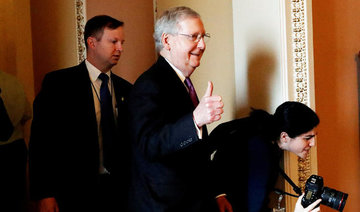
Senate Majority Leader Mitch McConnell, R-Ky., scheduled an initial procedural vote for Monday evening to commence debate. It is expected to succeed easily, and then the Senate will spend days or weeks — no one knows how long — sorting through proposals.
Democrats and some Republicans say they want to help the “Dreamers,” young immigrants who have lived in the US illegally since they were children and have only temporarily been protected from deportation by an Obama-era program. Trump has said he wants to aid them and has even proposed a path to citizenship for 1.8 million, but in exchange wants $25 billion for his proposed US-Mexico border wall plus significant curbs to legal immigration.
McConnell agreed to the open-ended debate, a Senate rarity in recent years, after Democrats forced a government shutdown last month and would supply enough votes to reopen agencies with a promise of a debate and votes on immigration. They had initially demanded a deal toward helping Dreamers, not a simple promise of votes.
What is certain is that to prevail, any plan will need 60 votes, meaning substantial support from both parties is mandatory. Republicans control the chamber 51-49 but GOP Sen. John McCain of Arizona has been home for weeks battling brain cancer. It is unclear who will offer what.
Some version of Trump’s plan and a bipartisan proposal to give Dreamers a chance at citizenship — with no border security money or legal immigration restrictions — seem likely to surface. Both are considered certain to fail.
A rejection of Trump’s plan, which may not even attract all GOP votes, would be a black eye for the White House. For Democrats, perhaps its most radioactive proposal is barring legal immigrants from sponsoring their parents or siblings to live in the US.
Votes are also possible on a compromise by a small bipartisan group led by Sens. Dick Durbin, D-Ill., and Lindsey Graham, R-S.C. It would provide possible citizenship for hundreds of thousands of Dreamers, $2.7 billion for border security and some changes in legal immigration rules. McCain and Sen. Chris Coons, D-Del., would offer legal status but not necessarily citizenship, and require tougher border security without promising wall money.
Trump has rejected both proposals.
Some senators have discussed a bare-bones plan to protect Dreamers for a year in exchange for a year’s worth of security money. Flake has said he is working on a three-year version of that.
Underscoring how hard it has been for lawmakers to find an immigration compromise, around 24 moderates from both parties have met for weeks to seek common ground. So have the No. 2 Democratic and GOP House and Senate leaders. Neither group has come forward with a deal.
In January, Trump invited 24 lawmakers from both parties to the White House in what became a nearly hour-long immigration negotiating session. He asked them to craft a “bill of love.”
At another White House session days later, he told Durbin and Graham he was rejecting their bipartisan offer.
Last September Trump said he was ending the Deferred Action for Childhood Arrivals program, or DACA, which lets Dreamers temporarily live and work in the US. Trump said President Barack Obama had lacked the legal power to create DACA.
Trump gave Congress until March 5 to somehow replace it, though a federal court has forced him to continue its protections.
The court’s blunting of the deadline has made congressional action even less likely. Lawmakers rarely take difficult votes without a forcing mechanism — particularly in an election year. That has raised the prospect that the Senate debate launching Monday will largely serve to frame a larger fight over the issue on the campaign trail.
Trump seemed to acknowledge that in a tweet Saturday: “Republicans want to fix DACA far more than the Democrats do. The Dems had all three branches of government back in 2008-2011, and they decided not to do anything about DACA. They only want to use it as a campaign issue. Vote Republican!”


![]()

US Senate set to debate fate of ‘Dreamer’ immigrants
US Senate set to debate fate of ‘Dreamer’ immigrants

Latest updates


© 2026 SAUDI RESEARCH & PUBLISHING COMPANY, All Rights Reserved And subject to Terms of Use Agreement.