BEIRUT: Officials in Lebanon closely followed the recent military developments between Israel and Syria, and noted the fall of fragments from rockets used in the confrontation in the Bekaa and southern Lebanon areas.
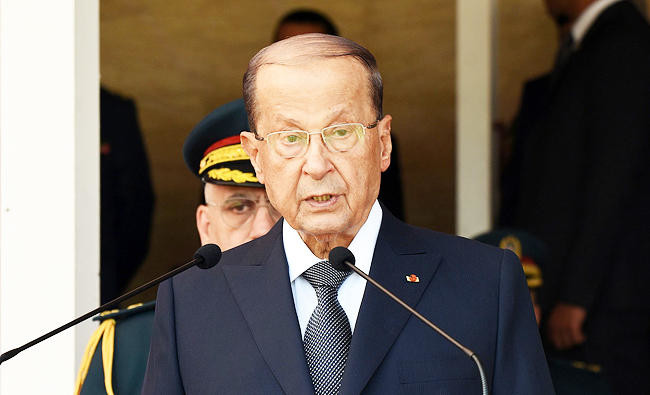
President Michel Aoun consulted with Parliament Speaker Nabih Berri and Prime Minister Saad Hariri, who is outside Lebanon, about the position to be taken in this regard.
Lebanese Defense Minister Yacoub Sarraf called the UNIFIL commander, General Michael Perry, and conveyed to him “Lebanon’s rejection of the continuous Israeli violations that took place on Saturday in the form of mock raids carried out by Israeli warplanes above villages and towns in the south.”
Sarraf’s press office stressed “Lebanon’s rejection and condemnation of the use of Lebanese airspace by Israel to carry out its raids,” describing the incident as a “blatant violation of Lebanese sovereignty.”
The Lebanese Foreign Ministry in a statement condemned “the raids on Syria” and stressed the right of “legitimate self-defense against any Israeli aggression.” The statement added that “this aggressive policy practiced by Israel threatens stability in the region,” calling on “the countries concerned to rein in Israel to stop its aggression.”
It said: “Foreign Minister Gebran Bassil gave his instructions last Thursday to the Permanent Mission of Lebanon to the United Nations in New York to file a complaint with the Security Council against Israel, calling for the condemnation of Israel and warning it against using Lebanese airspace to launch attacks against Syria.”
In New York, Lebanon called on the UN Secretary-General Antonio Guterres and the Security Council to pressure Israel to immediately stop its violations of Lebanese airspace to launch airstrikes on Syrian territory.
“Israeli violations of Lebanese sovereignty are continuing by land, sea and air without any respect for international law or any consideration of Resolution 1701,” Lebanese Ambassador to the UN Amal Mudallali said in a complaint to the UN chief and the presidency of the UN Security Council.
Mudallali pointed out that Lebanon “had informed the Security Council in a previous complaint last year about Israel’s violation of Lebanese airspace in its raid on Syrian territory on Sept. 7, 2017,” asserting that these violations “paint a very dangerous pattern in addition to the patterns of daily violations of Lebanese sovereignty and constitute a new cycle of destabilization of regional security and peace by Israel.”
Mudallali reiterated Lebanon’s commitment to Resolution 1701 and called on the Security Council and the international community to “exert the necessary and effective pressure on Israel to ensure full compliance with the provisions of the resolution and its full implementation without delay, including the cessation of all violations of Lebanese airspace and sovereignty.”

Lebanon asks UN Security Council to pressure Israel after ‘airspace violation’
Hezbollah chief accuses Israel of ignoring ceasefire agreement
- Naim Qassem says moves to disarm his group in Lebanon are an 'Israeli-American plan'
- Lebanese military is expected to complete Hezbollah’s disarmament south of Litani River as oart of ceasefire
BEIRUT: Hezbollah leader Naim Qassem on Sunday said moves to disarm the group in Lebanon are an “Israeli-American plan,” accusing Israel of failing to abide by a ceasefire agreement sealed last year.
Under heavy US pressure and fears of expanded Israeli strikes, the Lebanese military is expected to complete Hezbollah’s disarmament south of the Litani River — located about 30 kilometers (19 miles) from the border with Israel — by the end of the year.
It will then tackle disarming the Iran-backed movement in the rest of the country.
“Disarmament is an Israeli-American plan,” Qassem said.
“To demand exclusive arms control while Israel is committing aggression and America is imposing its will on Lebanon, stripping it of its power, means that you are not working in Lebanon’s interest, but rather in the interest of what Israel wants.”
Despite a November 2024 ceasefire that was supposed to end more than a year of hostilities between Israel and the Iran-backed Hezbollah group, Israel has kept up strikes on Lebanon and has maintained troops in five areas it deems strategic.
According to the agreement, Hezbollah was required to pull its forces north of the Litani River and have its military infrastructure in the vacated area dismantled.
Israel has questioned the Lebanese military’s effectiveness and has accused Hezbollah of rearming, while the group itself has rejected calls to surrender its weapons.
“The deployment of the Lebanese army south of the Litani River was required only if Israel had adhered to its commitments... to halting the aggression, withdrawing, releasing prisoners, and having reconstruction commence,” Qassem said in a televised address.
“With the Israeli enemy not implementing any of the steps of the agreement... Lebanon is no longer required to take any action on any level before the Israelis commit to what they are obligated to do.”
Lebanese army chief Rodolphe Haykal told a military meeting on Tuesday “the army is in the process of finishing the first phase of its plan.”
He said the army is carefully planning “for the subsequent phases” of disarmament.
Under heavy US pressure and fears of expanded Israeli strikes, the Lebanese military is expected to complete Hezbollah’s disarmament south of the Litani River — located about 30 kilometers (19 miles) from the border with Israel — by the end of the year.
It will then tackle disarming the Iran-backed movement in the rest of the country.
“Disarmament is an Israeli-American plan,” Qassem said.
“To demand exclusive arms control while Israel is committing aggression and America is imposing its will on Lebanon, stripping it of its power, means that you are not working in Lebanon’s interest, but rather in the interest of what Israel wants.”
Despite a November 2024 ceasefire that was supposed to end more than a year of hostilities between Israel and the Iran-backed Hezbollah group, Israel has kept up strikes on Lebanon and has maintained troops in five areas it deems strategic.
According to the agreement, Hezbollah was required to pull its forces north of the Litani River and have its military infrastructure in the vacated area dismantled.
Israel has questioned the Lebanese military’s effectiveness and has accused Hezbollah of rearming, while the group itself has rejected calls to surrender its weapons.
“The deployment of the Lebanese army south of the Litani River was required only if Israel had adhered to its commitments... to halting the aggression, withdrawing, releasing prisoners, and having reconstruction commence,” Qassem said in a televised address.
“With the Israeli enemy not implementing any of the steps of the agreement... Lebanon is no longer required to take any action on any level before the Israelis commit to what they are obligated to do.”
Lebanese army chief Rodolphe Haykal told a military meeting on Tuesday “the army is in the process of finishing the first phase of its plan.”
He said the army is carefully planning “for the subsequent phases” of disarmament.
© 2025 SAUDI RESEARCH & PUBLISHING COMPANY, All Rights Reserved And subject to Terms of Use Agreement.