

Lebanon joins hunt for energy riches in Levant Basin

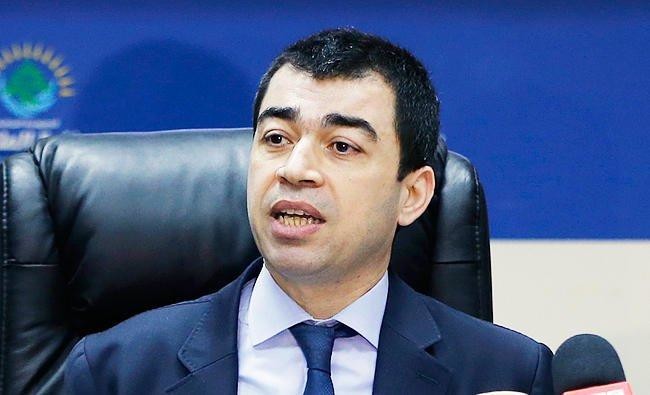
Cesar Abi Khalil, Lebanon’s Minister for Energy and Water. (AP)
Updated 11 February 2018
Follow

Lebanon joins hunt for energy riches in Levant Basin

LONDON: Lebanon has pledged to go ahead with oil and gas exploration near its disputed maritime border with Israel, despite Israel’s Defense Minister describing the move as “very provocative”.
Defense Minister Avigdor Lieberman was quoted by Reuters as saying: “When they issue a tender on a gas field, including Block 9, which by any standard is ours ... this is very, very challenging and provocative conduct here.”
Lebanon was quick to respond: “We consider this statement as an aggression on Lebanon’s sovereignty to practice its natural right to explore our oil resources,” said Cesar Abi Khalil, Minister for Energy and Water.”
The United States Geological Survey (USGS) published an explanation of the dispute in 2016. It said: “The 1949 Israel-Lebanon armistice line serves as the de facto land border between the two countries, and Lebanon claims roughly 330 square miles of waters that overlap with areas claimed by Israel based in part on differences in interpretation of relative points on the armistice line.”
Lebanon passed two oil and gas decrees in 2017 in a sign that Beirut intended to progress on major projects and restore confidence to the policymaking machinery.
The decrees defined the blocks and specified the conditions for production and exploration tenders.
The Lebanese energy ministry said in December that Lebanon’s council of ministers approved the awards of two exclusive petroleum licenses for exploration and production in blocks 4 and 9 for the consortium. Block 4 covers 1,911 sq km while Block 9 covers 1,742 sq km.
The consortium submitted uncontested bids for two of the five blocks on offer, and will have five years to conduct exploration activities.

Doubts were raised over the government’s ability to sign off on exploration licenses after Lebanon’s Prime Minister Saad Hariri resigned and then changed his mind in a series of dramatic political developments in November.

Lebanon has no oil or gas production but its waters are estimated to hold 15 trillion cubic feet of recoverable gas, according to the the US Geological Survey (USGS). The body estimates that the eastern Mediterranean Levant basin, which spans waters off Lebanon, Israel and Cyprus holds about 122 Tcf of recoverable gas and 1.7 billion barrels of oil.

There are over 800 square kilometers (300 square miles) of waters claimed by the two countries, which are technically in a state of conflict. Israel and Hezbollah fought a month-long war in 2006.

Arab News reported on Feb. 8 that Israel offered to accept US mediation in the latest spat with Lebanon. As tension rises over the issue, David Satterfield, principal deputy assistant secretary for the Bureau of Near Eastern Affairs at the US State Department, made a surprise visit to Lebanon last week for talks with senior government officials, and US Secretary of State Rex Tillerson is expected to visit on February 15.

Israeli Energy Minister Yuval Steinitz was quoted as saying: “We are willing to accept American mediation to resolve the issue diplomatically. There was international mediation on the matter in the past. We were close to reaching a compromise in 2013, but the whole thing collapsed at the 11th hour.”

There is also growing unease over Israeli plans to build a cement wall on its border with Lebanon. Construction work has already begun at the Ras Al-Naqoura border crossing.

Talks designed to resolve the issue took place at Ras Al-Naqoura on Wednesday between representatives of the Lebanese and Israeli armies, brokered by the UN Interim Force in Lebanon (UNIFIL).
Foreign buying of Saudi stocks hits $1.33bn ahead of Feb rule change 

Updated 4 sec ago
Follow

Foreign buying of Saudi stocks hits $1.33bn ahead of Feb rule change 

RIYADH: Foreign investors made net purchases of around SR5 billion ($1.33 billion) in Saudi stocks during January, coinciding with the announcement that the market would be opened to all categories of non-resident foreign investors — individuals and institutions from around the world — directly and without conditions. 

According to the Financial Analysis Unit at Al-Eqtisadiah, January’s foreign buying represents the largest monthly purchases since 2022, excluding June 2024, when Aramco held a secondary offering, and September 2025, following a Bloomberg report that the Saudi Capital Market Authority, or CMA, would allow foreigners to hold majority stakes in listed companies. 

Since the market-opening announcement on Jan. 6, Saudi stocks rose by about 10.6 percent by the end of the month. These results were accompanied by a rally in the banking sector, which is expected to benefit most from the lifting of ownership restrictions and strong fourth-quarter results. 

Rising oil prices also supported increases in Aramco, the largest stock by weight on the Tadawul All Share Index, alongside gains in Maaden following new discoveries and higher gold prices, as well as SABIC, after news of asset sales in Europe and the Americas that had previously caused losses for the company. 

The new amendments removed the regulatory framework for swap agreements, which had been used to allow non-resident foreign investors to gain only the economic benefits of listed securities and to enable direct investment in stocks listed on the main market. 

Foreign purchases in January reflected buying by foreign investors who were already in the market ahead of the decision’s implementation in early February. 

Foreign buying last month was likely driven by active funds. With the easing of restrictions, the market’s weight in emerging-market indices is expected to rise later, which could in turn attract additional inflows from passive funds that follow market and company weights in these indices. 

The largest impact is expected on TASI’s weight in emerging-market indices, following the proposed increase in foreign ownership caps for listed companies, pending CMA approval. 

Foreign investors accounted for around 41.7 percent of total market purchases in January, compared with just 5.6 percent in 2018, before joining emerging-market indices, highlighting their growing influence in the market. 

With the market rally and foreign buying in January, the value of foreign investors’ holdings rose to SR465.5 billion, representing 4.87 percent of the total market and 12.67 percent of free-floating shares. Their influence also increased in terms of free-floating shares, rising from 11.01 percent at the end of 2024 to 12.4 percent by year-end. 

The latest regulatory decision is expected to improve market liquidity over the long term, make stock valuations fairer, expand the investor base, deepen the market, and enhance overall efficiency. 

Foreign investment rules in Saudi stocks 

Foreign investments in Saudi stocks are currently subject to several restrictions, including that non-resident foreign investors, excluding strategic foreign investors, may not own 10 percent or more of the shares of any listed company or its convertible debt instruments. 

Foreign investors — all categories, resident or non-resident, except strategic foreign investors — may not collectively hold more than 49 percent of any listed company’s shares or convertible debt. 

These limits are in addition to any restrictions set out in companies’ bylaws, other statutory regulations, or instructions issued by the relevant authorities that apply to listed companies.