Muslim singer forced to quit French show ‘The Voice’ amid backlash

Mennel Ibtissem
Updated 10 February 2018
Follow

Muslim singer forced to quit French show ‘The Voice’ amid backlash

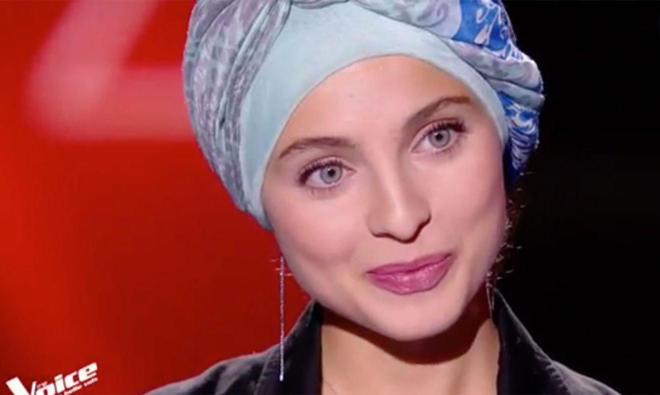
PARIS: A French Muslim singer who became an overnight star after dazzling judges on a TV talent show quit the contest Friday after coming under fire for past Facebook comments about terror attacks.
Mennel Ibtissem, a 22-year-old student who wears a head wrap, was one of the top contestants on “The Voice,” where her English and Arabic version of Leonard Cohen’s “Hallelujah” caused a sensation.
But within days of Saturday’s performance she was under pressure to bow out over old Facebook messages that appeared to question the terrorist nature of attacks that claimed scores of lives in France in 2016.
The posts have been deleted but screen grabs of the remarks have been circulated on far-right websites.
The singer had apologized over the remarks but the apology failed to quell the controversy.
With private broadcaster TF1 under pressure to pull her out of the competition, including from relatives of the victims of the Nice attack, she quit on Friday.
“I never meant to hurt anyone and the mere thought that my remarks hurt others hurts me, so I have taken the decision to quit this adventure,” she said in a Facebook video that has been viewed more than over 860,000 times.
The production company behind The Voice, ITV Studios France, said that despite her earlier apology the atmosphere on the show had become “too heavy” and hoped her decision to withdraw would “soothe tensions.”
But some of her fans expressed disappointment, amid allegations of anti-Muslim bias.
On Ibtissem’s Facebook page, Jihene Ferchiou wrote: “We must not delude ourselves. Your turban, your religion, your origins were the obstacle.
“Clearly we have reached an unprecedented level of racism in France. It’s a disgrace.”


EU designates Iran's Iran’s Revolutionary Guard as ‘terrorist organization’

Updated 5 sec ago
Follow

EU designates Iran's Iran’s Revolutionary Guard as ‘terrorist organization’

BRUSSELS: The European Union agreed Thursday to designate Iran’s Revolutionary Guard a “terrorist organization” over a deadly crackdown on mass protests, sending a powerful message of condemnation to Tehran.
“This was long overdue,” EU chief Ursula von der Leyen posted online after foreign ministers from the bloc took the decision.
“’Terrorist’ is indeed how you call a regime that crushes its own people’s protests in blood.”
Though largely symbolic, the EU move has already drawn a warning from Tehran it would have “destructive consequences.”
The 27-nation bloc meanwhile also adopted visa bans and asset freezes on 21 state entities and Iranian officials — including the interior minister, prosecutor general and regional IRGC commanders — over the repression.
Iranian authorities acknowledge that thousands were killed during the protests, giving a toll of over 3,000 people, but say the majority were members of the security forces or bystanders killed by “rioters.”
Rights groups say the toll is far higher, potentially in the tens of thousands, and note that protesters were killed by security forces including the Revolutionary Guards (IRGC) directly firing on them.

France, Italy shift

The IRGC is the ideological arm of Tehran’s military and was created after the 1979 revolution to protect the clerical leadership. The Guards control or own companies across the Iranian economy, including major strategic sectors.
“The estimate is that still the diplomatic channels will remain open even after the listing of the Revolutionary Guards,” the EU’s top diplomat Kaja Kallas said earlier Thursday.
The EU action against the IRGC comes after France announced Wednesday it backed the move, following a similar shift from Italy.
Hailed by Iran’s arch-foe Israel as a “historic decision,” the step matches similar classification enacted by the United States, Canada and Australia.
Paris had widely been seen as reluctant to act against the IRGC due to fears over the impact on Europeans detained in the country and a wish to keep diplomatic ties open.
“There can be no impunity for the crimes committed,” French Foreign Minister Jean-Noel Barrot told reporters on arrival in Brussels.
“This decision is also an appeal by France to the Iranian authorities to release the prisoners thrown by thousands into the regime’s prisons, to end the executions that are perpetuating the most violent repression in Iran’s modern history,” he said.
Barrot urged Tehran to end an Internet blackout and “give back to the Iranian people the capacity to choose their own future.”
The EU has already sanctioned several hundred Iranian officials and entities over crackdowns on previous protest movements and over Tehran’s support for Russia’s war on Ukraine.
The IRGC as a whole and senior commanders are already under EU sanctions, meaning that adding them to the terror blacklist is expected to have little practical impact on the organization.