KABUL: Chief spokesman of Afghan President Ashraf Ghani said on Saturday that he hopes the protest by group of tribesmen in Islamabad will turn into a “civil move” against extremism which has become a stumbling block against development because the region has fallen victim to terrorism.
“The world, media, and civil society need to back this historical move,” Shah Hussein Murtazawi told Arab News.
Afghan President Ashraf Ghani, on Friday voiced his support in favor of a protest in Pakistan by ethnic Pashtuns.
The protest began over 10 days ago following the murder of a young Pashtun man, Naqeebullah Mehsud, in a gunfight with Karachi police last month who accused him of being a Taliban militant.
His killing prompted protests comprising thousands of people from various parts of Pakistan, with many joining from the tribal areas adjacent to Afghanistan.
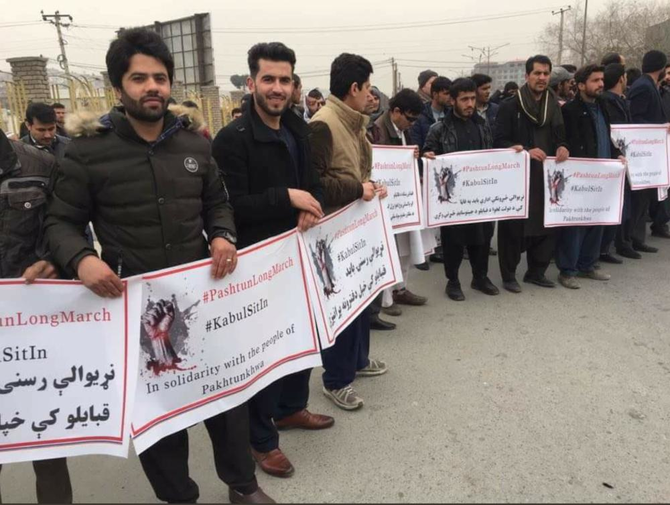
The social-media-savvy group of young Pashtuns organized a sit-in in Islamabad, creating the hashtag #PashtunLongMarch.
“I fully support the historical #PashtunLongMarch in Pakistan. The main purpose of which is to mobilize citizens against fundamentalism and terrorism in the region,” Ghani said in a tweet.
“I hope #PashtunLongMarch would also succeed in uprooting and eradicating terrorism from their region. The historical importance of this march traces back to the great proponent of non-violence, Bacha Khan, whose philosophy was based on the non-violent ideology,” he added.
Late Khan was a national hero of Pashtuns and pushed for the reunion of millions of people of the ethnic group, separated by British colonialists from ancient Afghanistan under a deal with a former Afghan ruler.
Ghani urged the media to help the protesters present their demands, calling the march as “a wake-up call against fundamentalism.”
A number of protests have also been held in various parts of Afghanistan by Pashtuns in recent days in support of the march in Pakistan.

Afghanistan backs ethnic “Pashtuns Long March” in Pakistan

Pakistan, ADB sign $730 loan agreements to boost SOE reforms, energy infrastructure
- Both sign $330 million Power Transmission Strengthening Project and $400 million SOE Transformation Program loan agreements
- Economic Affairs Division official says Transmission Project will secure Pakistan’s energy future by strengthening national grid’s backbone
KARACHI: Pakistan and the Asian Development Bank (ADB) on Thursday signed two loan agreements totaling $730 million to boost reforms in state-owned enterprises (SOEs) and energy infrastructure in the country, the bank said.
The first of the two agreements pertains to the SOE Transformation Program worth $400 million while the second loan, worth $330 million, is for a Power Transmission Strengthening Project, the lender said.
The agreements were signed by ADB Country Director for Pakistan Emma Fan and Pakistan’s Secretary of Economic Affairs Division Humair Karim.
“The agreements demonstrate ADB’s enduring commitment to supporting sustainable and inclusive economic growth in Pakistan,” the ADB said.
Pakistan’s SOEs have incurred losses worth billions of dollars over the years due to financial mismanagement and corruption. These entities, including the country’s national airline Pakistan International Airlines, which was sold to a private group this week, have relied on subsequent government bailouts over the years to operate.
The ADB approved the $400 million loan for SOE reforms on Dec. 12. It said the program seeks to improve governance and optimize the performance of Pakistan’s commercial SOEs.
Karim highlighted that the Power Transmission Strengthening Project will enable reliable evacuation of 2,300 MW from Pakistan’s upcoming hydropower projects, relieve overloading of existing transmission lines and enhance resilience under contingency conditions, the Press Information Department (PID) said.
“The Secretary emphasized that both initiatives are transformative in nature as the Transmission Project will secure Pakistan’s energy future by strengthening the backbone of the national grid whereas the SOE Program will enhance transparency, efficiency and sustainability of state-owned enterprises nationwide,” the PID said.
The ADB has supported reforms by Pakistan to strengthen its public finance and social protection systems. It has also undertaken programs in the country to help with post-flood reconstruction, improve food security and social and human capital.
To date, ADB says it has committed 764 public sector loans, grants and technical assistance totaling $43.4 billion to Pakistan.