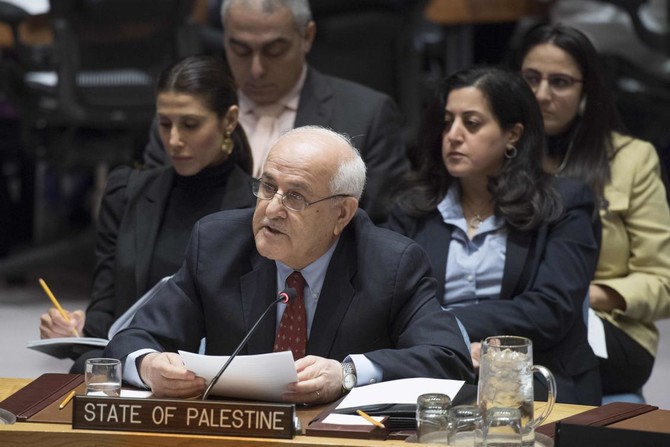
UNITED NATIONS: A collective Middle East peace process could be led by the UN Security Council, a “Quartet” expanded to include China and Arab states or an international conference, the Palestinian UN envoy said on Thursday, all options involving the United States.
Palestinian UN envoy Riyad Mansour laid out the possibilities after Palestinian President Mahmoud Abbas last month said he would only accept a broad, internationally backed panel to broker peace talks with Israel.
“We’re saying a collective approach involving several players at minimum would have a better chance of succeeding than the approach of only one country that is so close to Israel,” Mansour told reporters.
The Palestinians are furious at US President Donald Trump’s recognition of Jerusalem as Israel’s capital in December and cut to US funding for the UN agency that helps Palestinian refugees (UNRWA).
Mansour said a collective peace process could “be in the format of the (UN) Security Council, that would be something that we will look at seriously.”
“The Quartet plus China plus the League of Arab States plus maybe others ... we could also look at that. Or the collective process might be of the nature of the French Paris conference or international conference,” he said.
The so-called Quartet sponsoring the stalled peace process comprises the United Nations, the United States, Russia and the European Union, while in January last year France invited dozens of countries to Paris to show support for a peace process.
Russian President Vladimir Putin and Abbas plan to discuss a possible new mediation mechanism to replace the Middle East Quartet when they meet next week, the Interfax news agency said on Wednesday, citing a Palestinian diplomat in Russia.
Abbas is due to address the United Nations Security Council on Feb. 20 during the body’s monthly meeting on the Middle East.
Trump has said his administration had a peace proposal in the works. Mansour said the United States had given no indication of what the peace plan might be.
“But of course if they started with Jerusalem is off the table and punishing UNRWA ... what is left on the table?” Mansour said. “They lost the neutrality that is required of any broker that helps two parties to reach a peace treaty.”
“The old approach failed, and we’re looking for a new approach,” he said.


![]()
Several options to kick-start Mideast peace talks: Palestinian UN envoy
Several options to kick-start Mideast peace talks: Palestinian UN envoy
Latest updates


© 2026 SAUDI RESEARCH & PUBLISHING COMPANY, All Rights Reserved And subject to Terms of Use Agreement.