CAIRO: The Arab League Council, chaired by Djibouti Foreign Minister, Mahmoud Ali Yusuf, held an emergency meeting in Cairo to discuss the US decision to recognize Jerusalem as the capital of Israel.
The meeting was attended by Arab League Secretary-General Ahmed Aboul Gheit and Arab foreign ministers or their representatives, with the Saudi Arabian delegation led by Foreign Minister Adel Al-Jubair.
The meeting aimed to discuss the repercussions of President Donald Trump’s decision to relocate the US embassy to Jerusalem and implement the Arab League’s ministerial resolution on Sept. 9, 2017, which stipulated that the council should be resumed within a month to evaluate the situation and agree on future measures.
In his address to the opening session, Aboul Gheit warned that the attack on the city of Jerusalem would not be accepted by Arabs, Muslims or Christians, and would push the region into an abyss of religious conflict, violence and terrorism.
“Our meeting today, a few weeks after our last meeting, is a message that will reach those who are interested in the Arab position and will show that we stand united in the face of any attempt to liquidate the Palestinian cause with the final status issues,” the Arab League secretary-general said.
He added: “This message will show that we have a unified voice and that our common Arab position on the issue of Jerusalem has become clear to all. It was included in resolution 8221, issued on Dec. 9 last year.”
Aboul Gheit said that the meeting represented an opportunity to re-evaluate the situation. He also shed light on the international momentum achieved, starting with the 128-member vote to reject the US decision at the UN General Assembly and more recently the positive European position announced on Jan. 22.
He said this represented a platform that “can and should be built upon by expanding the circle of countries that reject Trump’s decision, developing their positions and mobilizing them to support the recognition of the Palestinian state with East Jerusalem as its capital.”
Aboul Gheit said that there were indications that this was not about the Jerusalem file alone, but about the US position on all the final-status issues and on its commitment to the two-state solution as a formula for ending the conflict between Israelis and Palestinians.
“We have followed with great concern the US decision to reduce its annual funding toward United Nations Relief and Works Agency for Palestine Refugees (UNRWA) budget by $65 million. The US share represents one third of the agency’s budget, which represents a threat to the refugee issue.”
Aboul Gheit said that the refugee issue, like the Jerusalem issue, had been agreed as part of the final-status issues that could not be forfeited, fragmented or liquidated, adding that international moral responsibility for the tragedy of the Palestinian refugees has been established since 1948 and there was no possibility of disengaging from their obligations.
The Foreign Minister of Djibouti called on Arab countries to take decisive steps at this critical juncture in the Palestinian issue and to confront situations that threatened the rights of the Palestinian situation regarding Jerusalem.
“The Arab League Council is mandated to carry out its historical responsibilities in the face of this challenge that threatens the existence of a Palestinian state,” he said, stressing that the US decision to transfer the embassy to Jerusalem and recognize it as the capital of Israel violated international resolutions.
He said that the US administration was determined to proceed with its blatant bias toward the occupation, not only through its decision to announce the transfer of the embassy before the end of next year to Jerusalem, but by announcing a series of other punitive measures against the Palestinian Authority and by reducing its contribution to the UNRWA budget.
Ministers also discussed the possibility of holding an extraordinary Arab summit in Jordan.


![]()
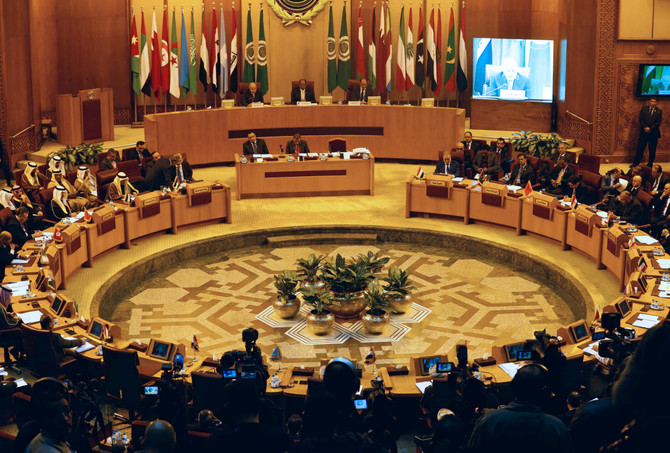
Arab FMs meet to discuss US decision to recognize Jerusalem as capital of Israel
Arab FMs meet to discuss US decision to recognize Jerusalem as capital of Israel


Latest updates


Recommended


© 2026 SAUDI RESEARCH & PUBLISHING COMPANY, All Rights Reserved And subject to Terms of Use Agreement.