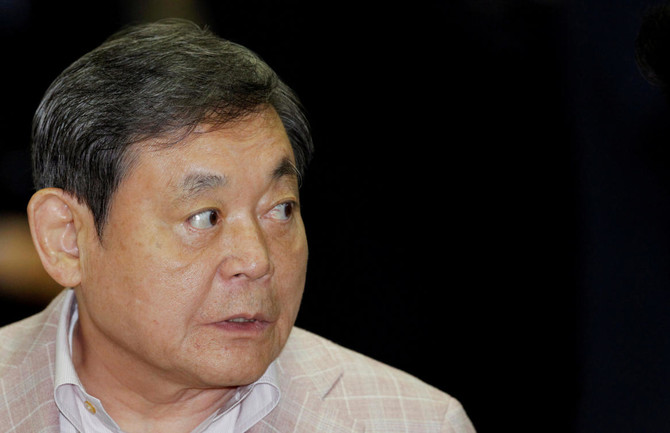
SEOUL: Samsung Electronics’ ailing chairman, Lee Kun-hee, has been named by South Korean police as a suspect in an 8.2 billion won ($7.5 million) tax evasion case that involved the use of bank accounts held by employees.
A series of scandals has dogged the family of Samsung, the country’s biggest business empire.
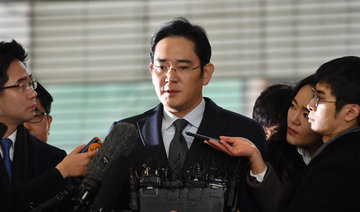
The chairman’s son, Jay Y. Lee, heir to the Samsung Group, was released from detention earlier this week after an appeals court halved his sentence for bribery and corruption to two-and-half years and suspended it for four years.
Following a heart attack in 2014, the elder Lee, 76, has remained hospitalized in Seoul’s Samsung Medical Center and is difficult to commuicate with having shown little sign of recovery. Until his imprisonment Jay Y. Lee had been regarded as the de facto head of the group.
Police said the elder Lee could not be questioned due to his physical condition and Samsung declined comment.
“Samsung chairman Lee Kun-hee and a Samsung executive managed funds in 260 bank accounts under names of 72 executives, suspected of evading taxes worth 8.2 billion won,” the Korean National Police Agency said announcing plans to send the case to prosecutors.
Police added that the accounts, holding about 400 billion won, were found in the course of their probe into alleged improper payments for the renovation of Lee’s family residence.
The investigation into tax evasion harks back to the late payment of 130 billion won in tax in 2011, though only 8.2 billion of that sum falls within the statute of limitations, according to police.
The corruption case that led to the younger Lee’s arrest last year and brought down the former president Park Geun-hye prompted Samsung to vow to improve transparency in corporate governance and grant heads of the group’s affiliates more autonomy from the Lee family.
The group dismantled its corporate strategy office in late 2017.
The new liberal government led by President Moon Jae-in elected after the corruption scandal promised to put family-run conglomerates under stronger scrutiny and end the practice of pardoning corporate tycoons convicted of white-collar crimes.
Jay Y. Lee has not been seen back at the office since his release on Feb. 5, but members of the Korean business community expect him to take up the reins once again, and invest more in the business to create jobs that might help soothe public anger.
Returning home from prison, the younger Lee apologized for not showing his best side and said he would do what he could, but did not give specifics on his business plans.
While he spent a year behind bars, Samsung Electronics, the world’s top semiconductors maker, earned record profit as it benefited from a memory chip “super cycle.”
It is not the first time the elder Lee has been investigated for tax evasion. He was convicted in 2009 and later pardoned for the same offense after being embroiled in a scandal that also involved the use of accounts held by trusted employees.
Police say they have since identified more such accounts.
Shares in Samsung Electronics rose 1.1 percent compared with a 0.5 percent rise in the wider market. Blue chip tech stocks bounced after recent falls as investors saw current valuations as attractive, analysts said.

Samsung’s beleaguered chairman named as suspect in $7.5m tax evasion case
Saudi-Pakistan defense pact rooted in ‘brotherly ties and strategic alignment,’ Pakistan’s ambassador to the UN tells Arab News
- Asim Iftikhar Ahmad calls deepening defense and economic ties between the two countries as central to regional stability
- Says his government will confront domestic security challenges firmly while continuing to expand cooperation with the Kingdom
NEW YORK CITY: Asim Iftikhar Ahmad, Pakistan’s permanent representative to the UN, has praised his country’s strategic partnership with Saudi Arabia, describing their recently signed defense cooperation pact as both historic and central to regional security at a time of heightened militant violence.
“This agreement is very significant, but it should be seen as a continuation and solidification of decades of cooperation and a strong strategic alliance between Saudi Arabia and Pakistan,” Ahmad said in a wide-ranging interview with Arab News at the UN Headquarters in New York.
Rooted in “brotherly ties and strategic alignment on regional and global issues,” the partnership has now been placed “into concrete shape,” he said.
Pakistan and Saudi Arabia signed a Strategic Mutual Defense Agreement on Sept. 17 last year, pledging that aggression against one country would be treated as an attack on both, enhancing joint deterrence and formalizing decades of military and security cooperation.
The pact was signed during Prime Minister Shehbaz Sharif’s state visit to Riyadh, where he met Crown Prince Mohammed bin Salman at Al-Yamamah Palace.
The pact, Ahmad said, was soon complemented by an economic cooperation framework, reflecting a comprehensive engagement. “Saudi Arabia is a major economic partner for Pakistan,” he said, pointing to expanding investment, trade, and development cooperation.
He underlined the deep public and spiritual bond between the two countries, citing the Kingdom’s custodianship of Islam’s holiest sites. “It’s not just government-to-government relations. The people of Pakistan have great respect for Saudi Arabia,” he said.
The strengthening of ties with Riyadh comes as Pakistan confronts a renewed wave of militant attacks aimed at undermining the country’s stability and progress, said Ahmad.
“These terrorist incidents are a continued attempt to undermine Pakistan’s peace and stability,” he said, stressing that they are also aimed at reversing Pakistan’s economic recovery and its growing profile on the world stage. “But we will tackle them effectively.”
Ahmad said the attacks, particularly those along Pakistan’s western border, must be seen in the context of Pakistan’s long-running success against militant groups.
“Over the years, Pakistan has very successfully countered the terrorist and militant presence in the country,” he said, identifying the Tehreek-e-Taliban Pakistan (TTP) and the Balochistan Liberation Army (BLA) as the two main groups seeking to “create instability and chaos through terrorist activities.”
He said the security environment shifted after the Taliban’s return to power in Afghanistan in August 2021.
“What has changed recently is that, ever since the Taliban authorities took over in Kabul, the space in which these groups can operate, regroup, train and recruit has unfortunately increased,” he said. “They are using that space to organize attacks across the border into Pakistan.”
Pakistan, he added, has raised the issue bilaterally and at multilateral forums, including the UN Security Council, citing UN monitoring reports that “clearly identify the large presence of the TTP and the permissive environment in Afghanistan.”
Pakistan’s response, he said, has been firm and ongoing. “We have the capability to address this threat. We have neutralized many of these elements already,” he said. “We will root them out. We know who is supporting them.”
Ahmad also pointed to the large volume of advanced weaponry left behind in Afghanistan following the withdrawal of US and other Western forces. “Billions of dollars’ worth of military equipment abandoned by international forces fell into the hands of the Taliban and eventually these terrorist groups,” he said.
Ahmad said Pakistan’s economic trajectory has improved significantly due to reforms undertaken in recent years.
“There is a whole exercise of economic reform that has been undertaken, including measures linked to the International Monetary Fund program and engagement with bilateral partners,” he said.
According to him, macroeconomic indicators “are pointing in the right direction,” while the government is actively improving the investment climate.
“It’s not just one or two countries showing interest,” he said. “China remains deeply engaged through the China-Pakistan Economic Corridor, Saudi Arabia is exploring major investment opportunities, and we are expanding economic relations with the UAE, Qatar, Turkiye, and the US.”
He linked these gains directly to the timing of the recent terror attacks.
“That is why we see these incidents as a deliberate attempt to undermine Pakistan’s economic progress, its growing role at the UN, and the enhanced profile Pakistan gained after the recent conflict with India,” he said.
On Gaza, Ahmad reiterated Pakistan’s firm condemnation of Israel’s repeated violations of the ceasefire and international law.
“Our position has been very clearly stated in the Security Council, the General Assembly, and by our leadership,” he said. “We are deeply concerned by these continuing violations.”
He recalled Pakistan’s role, alongside the Organization of Islamic Cooperation and Arab partners, in supporting US President Donald Trump’s 20-point Gaza peace plan and in securing the adoption of UN Security Council Resolution 2803 to implement it.
“Our collective expectation, together with partners like Saudi Arabia, Qatar and Turkiye, is that this plan be implemented fully and in good faith,” he said. “First, to achieve a permanent ceasefire, then to enable reconstruction.”
Ultimately, he stressed, the objective is political. “There has to be movement on the political track that leads to the establishment of an independent Palestinian state,” he said. “That is our principle and our ultimate objective.”
Ahmad said Pakistan is using its renewed diplomatic prominence to reinforce its long-standing approach to international peace and security. “We attach equal importance to all Security Council agendas,” he said, highlighting Pakistan’s contributions to UN peacekeeping, peacebuilding, and its advocacy for preventive diplomacy.
Regionally, he said, Pakistan seeks “a peaceful and stable Afghanistan,” supports a diplomatic solution to the Iranian nuclear issue, and maintains strong relations with China.
“At the UN, Pakistan works actively through the OIC, G77, the Non-Aligned Movement and other forums to strengthen multilateral cooperation,” he added.
Addressing concerns about the UN’s financial strain and calls for reform, Ahmad rejected the notion of an impending collapse. “The UN is there to stay,” he said. “The vast majority of member states still have great faith in multilateralism.”
Reform, he said, is necessary — but must aim to make the UN “stronger, more effective, and more responsive” to the priorities of its membership.
He stressed that the organization’s financial problems stem largely from unpaid member contributions. “The problem is not the UN itself, but member states not fulfilling their obligations,” he said.
While calling for greater efficiency, oversight, and accountability within the UN system, he said: “There is no viable alternative to the UN. Our commitment to multilateralism remains strong.”