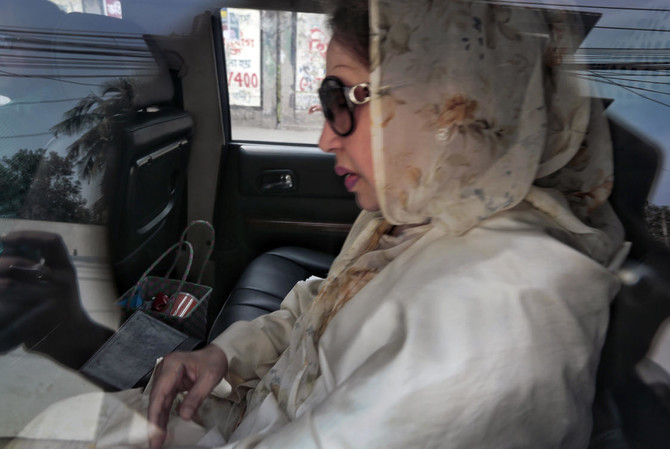
DHAKA: A Bangladesh court sentenced former Prime Minister Khaleda Zia on Thursday to five years in prison on corruption charges. The conviction means that Zia, the archrival of the current prime minister, could be barred from running in December national elections.
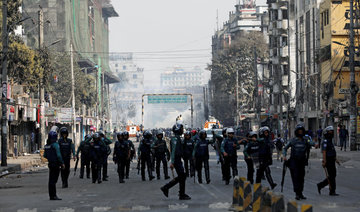
Zia was taken to a Dhaka prison under heavy security. In a country riven by dynastic politics, security forces fearing clashes had poured into the streets ahead of the verdict, along with supporters of both major political parties.
Defense lawyer Mahbubuddin Khokan said Zia ordered him to appeal. “This is unbelievable,” he said. “I am confident she will come out of jail.”
Zia was convicted of embezzling some $250,000 in donations meant for an orphanage trust established when she first became prime minister in 1991. Judge Mohammed Akhtaruzzaman, who announced the verdict in a courtroom in Dhaka’s Old City, also sentenced Zia’s son Tarique Rahman and four others to 10 years in prison for involvement in the case. All can appeal their convictions.
Bangladesh law says anyone imprisoned for more than two years cannot run for office for the next five years, but Law Minister Anisul Huq said the final decision rests with the courts.
“It’s up to the appeals court to decide whether she will be eligible to run,” he said after the verdict.
Ruhul Kabir Rizvi, a close Zia aide, rejected the verdict, saying the government of Prime Minister Sheikh Hasina was looking for a way to weaken Zia politically. The opposition has accused the government of arresting hundreds of supporters ahead of the verdict.
A few scattered protests broke out Thursday, with police firing tear gas at Zia supporters. Her party called for nationwide demonstrations Friday to protest the verdict.
Zia faced a maximum sentence of life in prison, but the judge said he took into consideration the 72-year-old’s health and her “social status,” an apparent reference to her time as prime minister.
Zia faces more than 30 other charges, ranging from corruption to sedition. Rahman, her son and heir-apparent, lives in London. He was tried in absentia, along with two other people.
Bangladesh politics are deeply fractious, with rivals Hasina and Zia ruling the country alternately since 1991, when democracy was restored.
Both women emerged from political dynasties. Zia is the widow of Ziaur Rahman, a general-turned-president who was assassinated in 1981. Hasina is the daughter of Sheikh Mujibur Rahman, the country’s first president who was assassinated in 1975.
In the last election in 2014, Zia’s party and its political allies boycotted the race, allowing Hasina to return to power with a landslide victory.

Bangladesh court sends former leader Khaleda Zia to prison
Australia bans a citizen with alleged links to militant Daesh group from returning from Syria
- The woman was planning to join another 33 Australians and fly on Monday from Damascus to Australia, Burke said
- “These are horrific situations that have been brought on those children by actions of their parents”
MELBOURNE: Australia’s government banned an Australian citizen with alleged ties to the militant Daesh group from returning home from a detention camp in Syria, the latest development in the case of fraught repatriation of families of Daesh fighters.
The woman was planning to join another 33 Australians — 10 women and 23 children — and fly on Monday from Damascus, Syria, to Australia, Home Affairs Minister Tony Burke said Wednesday.
But the group was turned back by Syrian authorities to the Roj detention camp, due to unspecified procedural problems.
The Australian government had acted on news that the group planned to leave Syria, Burke said. He said the woman, whom he did not identify, had been issued with a temporary exclusion order on Monday and her lawyers had been provided with the paperwork on Wednesday.
She was an immigrant who left Australia for Syria sometime between 2013 and 2015, Burke said, declining to elaborate on whether she had children — though he generally blamed the parents for the predicaments of their offspring stranded in Syria.
“These are horrific situations that have been brought on those children by actions of their parents. They are terrible situations. But they have been brought on entirely by horrific decisions that their parents made,” Burke told Australian Broadcasting Corp.
Burke has the power to use temporary exclusion orders to prevent high-risk citizens from returning to Australia for up to two years.
The laws were were introduced to in 2019 to prevent defeated Daesh fighters from returning to Australia. There are no public reports of an order being issued before.
Burke said security agencies had not advised that any of the other Australians in the group warranted an exclusion order. Such orders can’t be made against children younger than 14.
Confusing messages at a cramped camp
At the Roj camp, tucked in Syria’s northeastern corner near the border with Iraq, the Australian women who had expected to travel home refused to speak to The Associated Press on Wednesday.
One of the women, Zeinab Ahmad, said they had been advised by an attorney not to talk to journalists.
A security official at the camp, Chavrê Rojava, said that family members of the detainees — who she said were Australians of Lebanese origin — had traveled to Syria to arrange their return. They brought temporary passports that had been issued for the would-be returnees, Rojava said.
“We have no contact with the Australian government regarding this matter, as we are not part of the process,” she said. “We have left it to the families to resolve.”
Rojava said that after the group had departed the camp to travel to Damascus, they were contacted by a Syrian government official and warned to turn back. The families were “very disappointed” upon returning to the camp, she said.
“We recently requested that all countries and families come and take back their citizens,” Rojava said.
She added that Syrian authorities do not want to see a “repeat of what happened in Al-Hol camp” — a much larger camp, also in northeastern Syria that once housed tens of thousands of people, mostly women and children, with alleged ties to Daesh.
Last month, during fighting between Syrian government forces and the Kurdish-led Syrian Democratic Forces, which had controlled Al-Hol, guards abandoned their posts and many of the camp’s residents fled.
That raised concerns that Daesh members would regroup and stage new attacks in Syria.
The Syrian government then established control of Al-Hol and has begun moving its remaining residents to another camp in Aleppo province. The Kurdish-led force remains in control of Roj camp and a ceasefire is now in place.
The thorny issue of repatriating Daesh-linked foreign citizens
Former Daesh fighters from multiple countries, their wives and children have been detained in camps since the militant group lost control of its territory in Syria in 2019. Though defeated, the group still has sleeper cells that carry out deadly attacks in both Syria and Iraq.
Australian governments have repatriated Australian women and children from Syrian detention camps on two occasions. Other Australians have also returned without government assistance.
Australia’s Prime Minister Anthony Albanese on Wednesday reiterated his position announced a day earlier that his government would not help repatriate the latest group.
“These are people who chose to go overseas to align themselves with an ideology which is the caliphate, which is a brutal, reactionary ideology and that seeks to undermine and destroy our way of life,” Albanese told reporters.
He was referring to the militants’ capture of wide swaths of land more than a decade ago that stretched across Syria and Iraq, territory where Daesh established its so-called caliphate. Militant from foreign countries traveled to Syria at the time to join the Daesh. Over the years, they had families and raised children there.
“We are doing nothing to repatriate or to assist these people. I think it’s unfortunate that children are caught up in this, that’s not their decision, but it’s the decision of their parents or their mother,” Albanese added.