Human smugglers in Libya have links to security services: UN report

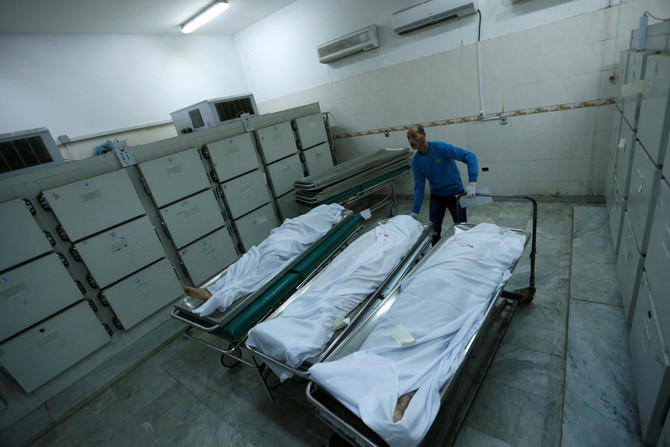
Bodies of Pakistani migrants who died when a boat sank off Libya's western coast, are seen in Tripoli Central Hospital in Tripoli, Libya. (Reuters)
Updated 08 February 2018
Follow

Human smugglers in Libya have links to security services: UN report

UNITED NATIONS: Most armed groups involved in human smuggling and trafficking in Libya have links to the country’s official security institutions, sanctions experts said in a confidential report to a UN Security Council committee seen by Reuters on Wednesday.
People smugglers operating with impunity in Libya have sent hundreds of thousands of migrants to Europe, mainly Italy, by sea since 2014. Thousands have died during the voyages.
“Armed groups, which were party to larger poltical-military coalitions, have specialized in illegal smuggling activities, notably human smuggling and trafficking,” experts reported to the 15-member Security Council committee. They said most of these armed groups “were nominally affiliated to official security institutions.”
The experts were reporting on an arms embargo and targeted sanctions that the UN Security Council imposed on Libya in 2011 when former leader Muammar Qaddafi’s forces cracked down on pro-democracy protesters.
Eritrean migrants told the sanctions monitors they had been arrested by the Special Deterrence Force (SDF), which is an armed group affiliated with the internationally recognized Government of National Accord’s Ministry of Interior, the report said.
The migrants said the Special Deterrence Force handed them to various smuggling rings. “The panel is assessing whether the SDF’s leadership was aware of collusion and trafficking being conducted within its ranks,” the sanctions monitors wrote.
They also noted: “The panel is concerned over the possible use of state facilities and state funds by armed groups and traffickers to enhance their control of migration routes.”
The SDF denied the allegations. The force “has nothing to do with smuggling,” SDF spokesman Ahmad Bin Salem told Reuters in a written statement. “It is fighting illegal immigration and has arrested many smugglers,” he said.
International agencies told the sanctions monitors that Libya’s Directorate Combating Illegal Migration had no control over its 24 detention centers. Migrants told the UN monitors that local armed groups controlled the centers they stayed in.
So far this year, just over 3,500 migrants are recorded to have crossed from Libya to Italy, about 60 percent fewer than during the same period last year, according the Italian Interior Ministry.
Libya descended into chaos after a NATO-backed uprising in 2011 led to the overthrow and killing of Qaddafi, with two competing governments backed by militias scrambling for control of the oil-producing country.
“Foreign fighters and armed groups, moving in and out of Libya, exploit the uncontrolled proliferation of arms and related material in Libya resulting in regular violations of the (UN) arms embargo,” the sanctions monitors said.


UN nuclear watchdog says it’s unable to verify whether Iran has suspended all uranium enrichment

Updated 3 sec ago
Follow

UN nuclear watchdog says it’s unable to verify whether Iran has suspended all uranium enrichment

VIENNA: Iran has not allowed the United Nations nuclear watchdog to access nuclear facilities affected by the 12-day war in June, according to a confidential report by the watchdog circulated to member states and seen Friday by The Associated Press.
The report from the International Atomic Energy Agency stressed that therefore it “cannot verify whether Iran has suspended all enrichment-related activities,” or the “size of Iran’s uranium stockpile at the affected nuclear facilities.”
The IAEA report on Friday warned that due to the continued lack of access to any of Iran’s four declared enrichment facilities, the agency “cannot provide any information on the current size, composition or whereabouts of the stockpile of enriched uranium in Iran.”
The report stressed that the “loss of continuity of knowledge over all previously declared nuclear material at affected facilities in Iran needs to be addressed with the utmost urgency.”
Iran long has insisted its program is peaceful, but the IAEA and Western nations say Tehran had an organized nuclear weapons program up until 2003.
Highly enriched material should be verified regularly
According to the IAEA, Iran maintains a stockpile of 440.9 kilograms (972 pounds) of uranium enriched up to 60 percent purity — a short, technical step away from weapons-grade levels of 90 percent.
That stockpile could allow Iran to build as many as 10 nuclear bombs, should it decide to weaponize its program, IAEA director general Rafael Grossi warned in a recent interview with the AP. He added that it doesn’t mean that Iran has such a weapon.
Such highly enriched nuclear material should normally be verified every month, according to the IAEA’s guidelines.
The IAEA also reported that it had observed, through the analysis of commercially available satellite imagery, “regular vehicular activity around the entrance to the tunnel complex at Isfahan.”
The facility in Isfahan, some 350 kilometers (215 miles) southeast of Tehran, was mainly known for producing the uranium gas that is fed into centrifuges to be spun and purified.
Israel has struck buildings at the Isfahan nuclear site, among them a uranium conversion facility. The US also struck Isfahan with missiles during the war last June.
The IAEA also reported that through the analysis of commercially available satellite imagery, it has observed “activities being conducted at some of the affected nuclear facilities, including the enrichment facilities at Natanz and Fordow,” but it added that “without access to these facilities it is not possible for the Agency to confirm the nature and the purpose of the activities.”
The confidential IAEA report also said Friday that Iran did provide access to IAEA inspectors “to each of the unaffected nuclear facilities at least once since the military attacks of June 2025, with the exception of Karun Nuclear Power Plan, which is in the early stages of construction and does not contain nuclear material.”
IAEA joined Geneva talks between Iran and US
The IAEA reported on Friday that Grossi attended negotiations between the US and Iran on Feb. 17 and Feb. 26 in Geneva at which he “provided advice on issues relevant to the verification of Iran’s nuclear program.” The report said that those negotiations are “ongoing.”
The Trump administration has held three rounds of nuclear talks this year with Iran under Omani mediation. Thursday’s round of talks in Geneva ended without a deal, leaving the danger of another Mideast war on the table as the US has gathered a massive fleet of aircraft and warships in the region.
Oman’s Foreign Minister Badr Al-Busaidi said technical talks involving lower-level representatives would continue next week in Vienna, the home of the IAEA. The agency is likely to be critical in any deal.
The US is seeking a deal to limit Iran’s nuclear program and ensure it does not develop nuclear weapons.
Iran says it is not pursuing weapons and has so far resisted demands that it halt uranium enrichment on its soil or hand over its stockpile of highly enriched uranium.
Similar talks last year between the US and Iran about Iran’s nuclear program broke down after Israel launched what became a 12-day war on Iran, that included the US bombing Iranian nuclear sites.
Before the June war, Iran had been enriching uranium up to 60 percent purity.