LONDON: Britain cannot tell businesses for certain what its relationship with the European Union will be after Brexit, business minister Greg Clark said on Wednesday, as ministers met to discuss the government’s approach.
Businesses want more clarity from the government over what Britain’s trade and customs arrangements with the European Union will look like after it leaves the bloc in 2019 so they can take investment decisions with some certainty.
Prime Minister Theresa May, who is meeting senior ministers to discuss the government’s strategy, is under pressure to offer a detailed vision for future ties with the EU, but she is not expected to come up with a firm decision this week.
In an interview with the BBC, Clark said he could not offer any details of the end-state Britain was seeking while the two sides were still negotiating.
“This is a negotiation which is about to happen. We can’t guarantee an end-state until it has been agreed by both sides,” Clark told BBC radio.
Britain has agreed in principle with the EU to have a status quo transition period, which is expected to be finalized in March.
But a European Commission document showed the EU wants the power to restrict British access to the single market during the transition if it violates agreed rules, prompting an outcry from some Brexit campaigners who said it was an “EU threat.”
Stefaan De Rynck, an aide to EU negotiator Michel Barnier, said the measure was only to be expected. “Foreseeing possibility of sanctions for foul play is of course part of any agreement,” he said on Twitter.
May also called on parliament to disregard the “noise” surrounding the talks to unravel more than 40 years of union, saying she would be robust in her arguments with the EU.
“As I’ve said right from the very beginning ... we will hear all sorts of things being said about positions that are being taken. What matters are the positions that we take in the negotiations,” she said.
But May is under pressure to show more of her hand, with the British Chambers of Commerce saying continued ambiguity would hinder firms as they make investment and hiring decisions.
“Clear UK negotiating objectives are crucial to both business and public confidence,” the BCC said in an open letter to the government.
Many businesses fear Britain could face a disorderly Brexit that would weaken the West, disrupt the peace in Northern Ireland, imperil Britain’s $2.7 trillion economy and undermine London’s position as the only financial center to rival New York.
Meanwhile, May and Chancellor of the Exchequer Philip Hammond will meet representatives from major Japanese businesses on Thursday as concerns about Brexit grow among some of the world's biggest foreign investors.
Japanese firms have spent billions of pounds in Britain, encouraged by successive governments promising a business-friendly base from which to trade across the continent.
Carmakers Nissan, Toyota and Honda began operating in Britain from as early as the 1980s and now build nearly half of all of Britain's 1.67 million cars, the vast majority of which were exported.
Thursday's meeting comes amid intense debate inside May's government about how closely Britain should remain aligned with the EU and its customs union after Brexit.
"The meeting will be tomorrow afternoon and the attendees will cover the most significant investors in the UK in such areas as banking, life sciences, technology and the manufacturing sector," a spokesman at May's Downing Street office said.
Many Japanese drug companies have made Britain their European base in recent years and are worried, like their peers, about the future of drug regulations, with any divergence with the European Union likely to pose regulatory challenges.
Banks Nomura, Daiwa Securities and Sumitomo Mitsui Financial Group have London bases but have already decided to set up operations in Europe to retain access to the single market as they await clarity on future trading arrangements.
Nomura's Executive Chairman in Europe, the Middle East and Africa Yasuo Kashiwagi will attend the meeting, a spokesman at the bank said.
Nissan, which runs Britain's single biggest car factory in Sunderland, northern England, will also be among the companies represented.
The company announced in 2016 that it would build two new models at the site after what a source said was a government promise of extra support in the event that Brexit hits the competitiveness of the plant.
"Nissan Europe Chairman Paul Willcox will join representatives from other Japanese companies in meeting the Prime Minister and Chancellor on Thursday to discuss our operations and investments in the UK," the firm said in a statement.
Many businesses fear Britain could face a disorderly Brexit that would weaken the West, imperil Britain’s $2.7 trillion economy and undermine London’s position as the only financial centre to rival New York.


![]()
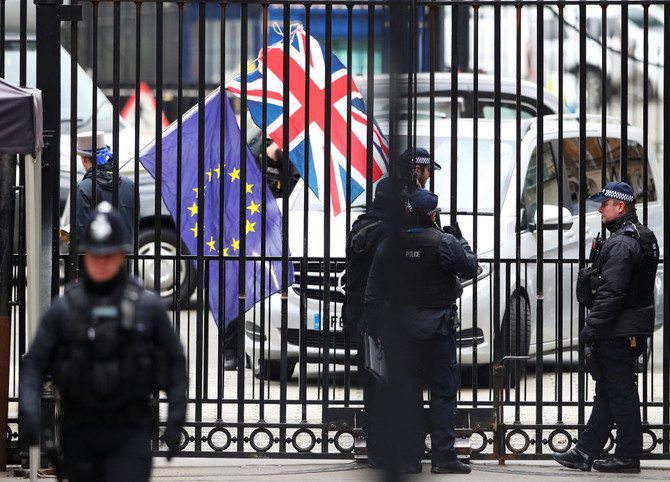
Britain tells businesses: ‘We cannot guarantee your Brexit future’
Britain tells businesses: ‘We cannot guarantee your Brexit future’


Latest updates




© 2026 SAUDI RESEARCH & PUBLISHING COMPANY, All Rights Reserved And subject to Terms of Use Agreement.