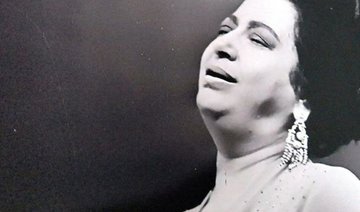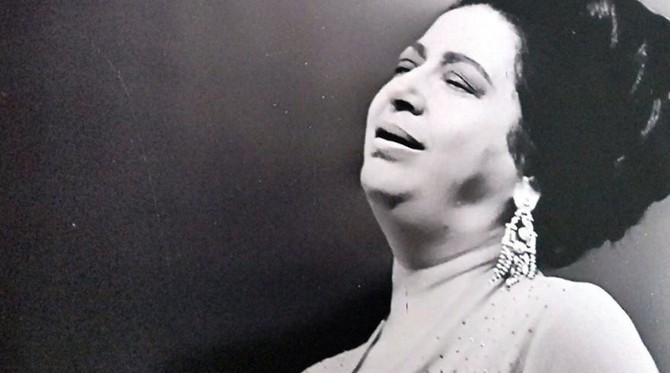
CAIRO: Fans across the Arab world are this month marking 43 years since the death of the renowned Egyptian singer Umm Kulthum.
Known as the “Star of the Orient” and the “Grand dame of Arab singing,” Umm Kulthum was one of the greatest performers ever to emerge from the Arab world. But her fame went far beyond the Middle East and Arab culture.
The great opera diva Maria Callas called her “the incomparable voice.”
Led Zeppelin singer Robert Plant and U2 frontman Bono were among the many Western musicians who admired Umm Kulthum.
The singer-songwriter and Nobel laureate Bob Dylan said of her, “She’s great, she really is. Really great.”
To Charles de Gaulle, the president of France, she was simply “the Lady.”
She was also popular in Israel with Jews and Arabs alike and in 2015 a street in Jerusalem was named after her.
Her 40-year career included starring in musical films during the golden age of Egyptian cinema and her monthly concerts broadcast from Cairo attracted huge audiences.
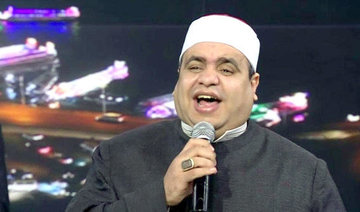
Since her death, her legacy as the essence of Egyptian and wider Arab culture has continued down the generations, giving her a near mythical status.
Early Life
Yet her origins were humble. She was born Fatima Ibrahim as-Sayyid Al-Biltagi into a poor family in Tammay Al-Zahayra in the Nile Delta. Her birthdate is uncertain and is variously given as Dec. 31, 1898 or May 4, 1904.
She was the youngest child of Sheik Ibrahim Al-Sayyid Al-Baltagi, the imam of a local mosque, and learned to sing by listening to her father teach her older brother. Her father taught her to recite the Qur’an and she is said to have memorized the entire holy book.
Her father also noticed her vocal talent and when she was 12, she joined the family ensemble performing at weddings and religious functions, but dressed as a boy to avoid public disapproval.
Moving to the city
After several trips to Cairo, in 1923 Umm Kulthum moved to the capital permanently where the well-known singer and composer Shaykh Abu Al-Aila Muhammad became her teacher and mentor.
It was not only her vibrant contralto voice that got her noticed. Umm Kulthum also wore traditional clothing, which earned her the nickname “the Bedouin.” Throughout her career she remained true to her humble rural origins.
She signed her first recording contract in 1926 and began to put together her own ensemble of musicians, or takht. As she mixed in Cairo’s cultural milieu, she met poets — most notably Ahmad Rami, who wrote the lyrics to 137 songs for her.
The virtuoso oud player and composer Mohamed El Qasabgi introduced to the Arabic Theatre Palace, where she had her first big success. In 1932, she embarked on her first major tour of the Middle East which took in Damascus, Baghdad, Beirut, Tunis and Tripoli, and in 1934, she sang at the inaugural broadcast of Radio Cairo
Legacy lives on
By the 1940s, Umm Kulthum was known as “the voice of Egypt,” through her radio broadcasts and regular concerts. She also performed privately for the Egyptian royal family and King Farouk I awarded her the Nissan El-Kamal, the nation’s highest order and one usually reserved for members of the royal family and politicians.
After the revolution of 1952, her friendship with the deposed king saw her ejected from the Egyptian musicians’ guild. When President Gamel Adel Nasser discovered Umm Kulthum songs were banned from the radio, he said, “What, are they crazy? Do you want Egypt to turn against us?” and insisted the musicians’ guild take her back.
He also took advantage of Umm Kultum’s fame, broadcasting his speeches immediately after her radio concerts. One of her songs, Wallahi Zaman, Ya Silahi (It’s Been a Long Time, O Weapon of Mine) was even adopted as Egypt’s national anthem from 1960 to1970 until President Anwar Sadat changed it to the less militant Bilady, Bilady, Bildady, which remains the national anthem today.
By 1975, Umm Kulthum’s health was of sufficient national concern to warrant daily updates in the Egyptian press. On February 3, 1975 she died of heart failure. She was 77.
Her funeral was a state occasion, with four million grief-stricken Egyptians lining the streets to catch a glimpse of her funeral cortege.
Her biographer Virginia Danielson summed her up thus: “Imagine a singer with the virtuosity of Joan Sutherland or Ella Fitzgerald, the public persona of Eleanor Roosevelt and the audience of Elvis and you have Umm Kulthum.”