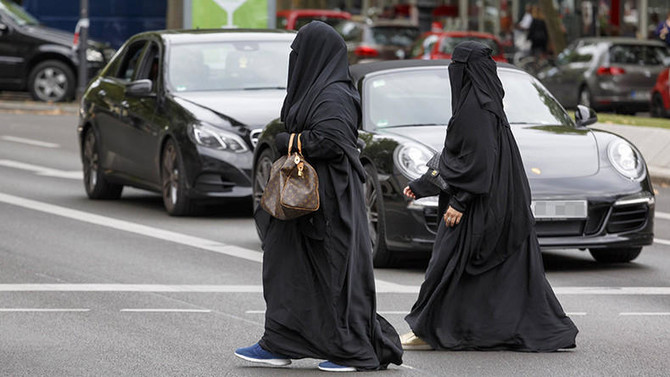
STOCKHOLM: The Danish government on Tuesday proposed a ban on Islamic full-face veils such as the niqab and burqa in public spaces, making it likely to become the next European country to restrict the wearing of the religious garment.
“It is incompatible with the values in Danish society and disrespectful to the community to keep one’s face hidden when meeting each other in public spaces,” Justice Minister Soren Pape Poulsen said in a statement.
“With a ban on covering the face, we are drawing a line in the sand and underlining that in Denmark we show each other trust and respect by meeting face to face,” he added.
The niqab is a full veil with a small slit for the eyes, while the burqa is a full veil that covers the head and body with a mesh screen over the eyes.
The proposal is to be assessed by non-governmental human rights organizations and possibly re-written to take their remarks into consideration.
The center-right government is expected to present a bill to parliament in the spring.
With the support of the country’s second largest party, the anti-immigration Danish People’s Party, the proposed legislation is likely to be adopted.
A violation of the ban would lead to a fine of 1,000 kroner (€134).
Repeated violations would be fined up to 10,000 kroner.
The proposed ban says the “burqa, niqab and balaclavas where only eyes and mouth are visible are examples of clothes that hide the face.”
But covering the face in a recognizable manner, such as wearing winter clothing, sports gear and masks for festivities, are exempted.
It is not known how many women wear the niqab and burqa in Denmark.
“I don’t think there are many who wear the burqa here in Denmark. But if you do, you should be punished with a fine,” Poulsen told reporters, according to news agency Ritzau.
The full-face veil is a hot-button issue across Europe.
The European Court of Human Rights last year upheld a Belgian ban on wearing it in public.
France was the first European country to ban the niqab in public places with a law that took effect in 2011.
Spain’s highest court annulled in 2013 a ban on the full-face veil in public buildings that had been brought in three years earlier by the northeastern region of Catalonia.


![]()
Denmark proposes ban on Islamic full-face veil in public
Denmark proposes ban on Islamic full-face veil in public


Latest updates


Recommended


© 2026 SAUDI RESEARCH & PUBLISHING COMPANY, All Rights Reserved And subject to Terms of Use Agreement.