Indonesian militant jailed over Philippines arms smuggling

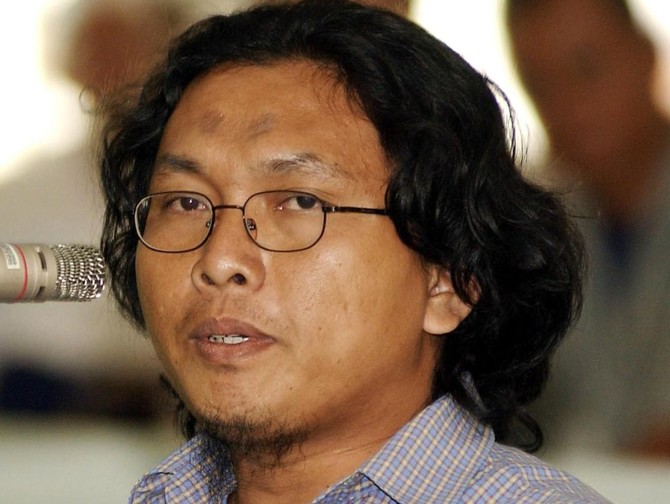
South Sulawesi bombings suspect Suryadi Mas’ud testifies during Abu Bakar Bashir’s trial in Jakarta, 17 June 2003. (AFP /Bay Ismoyo)
Updated 06 February 2018
Follow

Indonesian militant jailed over Philippines arms smuggling

JAKARTA: An Indonesian court on Tuesday jailed a militant for ten years for buying a cache of firearms from the Philippines’ biggest rebel group for attacks on home soil.
Suryadi Mas’ud, 45, was found guilty of a range of offenses — including planning a terrorist act and procuring weapons — by a panel of three judges at the West Jakarta district court.
The sentencing has highlighted the strong links between militants in Indonesia and the Philippines and comes amid heightened fears about Daesh inspired attacks in Southeast Asia.
Suryadi — who accepted the verdict — raised one finger into the air and shouted “Allah-u Akbar”
He was ordered to pay a fine of Rp 50 million ($3,700) on top of a ten-year prison sentence.
Suryadi first traveled to the Philippines from Indonesia in 2015 at the request of death-row inmate Iwan Darmawan, who is awaiting execution for his part in the 2004 bombing of the Australian embassy in Jakarta, the court heard.
While there, Suryadi met with members of the Moro Islamic Liberation Front (MILF) in the city of Davao, where he paid $30,000 via a Western Union account for 18 assault rifles and five handguns.
Just under a year later, he bought another 12 M-16 rifles from the group, again at the request of Darmawan, the court heard.
The weapons were then used in attacks in Indonesia, prosecutors said.
Authorities in Indonesia have been on heightened alert following a wave of recent IS-inspired attacks and plots.


Cuba says a 5th person died after people on a Florida-flagged speedboat opened fire on soldiers

Updated 07 March 2026
Follow

Cuba says a 5th person died after people on a Florida-flagged speedboat opened fire on soldiers

  • Authorities in Cuba said that on Feb. 26 Cuban soldiers confronted a speedboat carrying 10 people as the vessel approached the island and opened fire on the troops
  • The shooting threatened to increase tensions between US President Donald Trump and Cuban authorities

HAVANA: Cuba said a fifth person has died as a consequence of a fatal shootout last month involving a Florida-flagged speedboat that allegedly opened fire on soldiers in waters off the island nation’s north coast.
The island’s interior ministry said late Thursday in a statement that Roberto Álvarez Ávila died on March 4 as a result of his injuries. It added that the remaining injured detainees “continue to receive specialized medical care according to their health status.”
Authorities in Cuba said that on Feb. 26 Cuban soldiers confronted a speedboat carrying 10 people as the vessel approached the island and opened fire on the troops. They said the passengers were armed Cubans living in the US who were trying to infiltrate the island and “unleash terrorism”. Cuba said its soldiers killed four people and wounded six others.
“The statements made by the detainees themselves, together with a series of investigative procedures, reinforce the evidence against them,” the Cuban interior ministry said in its statement, adding that “new elements are being obtained that establish the involvement of other individuals based in the US”
Earlier this week, Cuba said it had filed terrorism charges against six suspects that were on the speedboat. The government unveiled items said to have been found on the boat, including a dozen high-powered weapons, more than 12,800 pieces of ammunition and 11 pistols.
Cuban authorities have provided few details about the shooting, but said the boat was roughly 1.6 kilometers (1 mile) northeast of Cayo Falcones, off the country’s north coast. They also provided the boat’s registration number, but The Associated Press was unable to readily verify the details because boat registrations are not public in the state of Florida.
The shooting threatened to increase tensions between US President Donald Trump and Cuban authorities. The island’s economy was until recently largely kept economically afloat by Venezuela’s oil, which is now in doubt after a US military operation deposed then-Venezuelan President Nicolás Maduro.