STRASBOURG/BRUSSELS: The European Union sought on Tuesday to reinvigorate the membership ambitions of six Balkan states and reclaim the region as its own amid growing Russian and Chinese influence, setting 2025 as a goal for Serbia and Montenegro to join.
Partly symbolic to breathe life into the bloc as Britain prepares to leave, the European Commission set out a strategy to bring Western Balkan nations into the fold if they meet required reforms, marking a change after years of fading interest.
“If countries are willing, then this is possible, but it is ambitious,” Johannes Hahn, the bloc’s enlargement commissioner, said in Brussels before unveiling the plan at the European Parliament in Strasbourg.
“We will not repeat the mistakes of the past,” he told reporters, in a veiled reference to what most EU officials believe was the rushed accession of Romania and Bulgaria in 2007 and the poorly managed migration of eastern European workers to Britain, which turned many Britons against the European project.
The 2009-2013 euro zone crisis, rising euroskepticism and public EU fatigue with enlargement appeared to diminish Balkan hopes then. Commission President Jean-Claude Juncker had played down enlargement at the start of his five-year term in 2014.
Left wondering if they would ever join, Macedonia has been an EU candidate country since 2005. Montenegro, where Russia is accused of backing a failed coup, has been one since 2010. Serbia, where Russian media is a growing source of news, has been since 2012. Albania won candidate country status in 2014.
Meanwhile, Chinese investment in the region, though welcomed by governments, is seen as undermining EU standards because it does not come with the same stringent requirements as EU aid.
But in a change of tone, top EU officials now insist there is no alternative but for Albania, Bosnia, Kosovo, Macedonia, Montenegro and Serbia to join the European Union.
Their inclusion in the EU is being held up as an EU ideal that is long overdue since the end of the Cold War and the break-up of Yugoslavia in the 1990s. Hahn told Reuters last month it was “time to finish the work of 1989.”
The Balkan strategy drawn up in Brussels aims to show the region that membership is certain if countries meet EU demands including establishing independent courts, a free press and breaking up crime rings that have badly weakened governments.
Albania and Montenegro are already members of the U.S-led NATO alliance and Macedonia is likely to be offered NATO membership, often seen as a springboard to EU membership, if it can overcome a dispute over its name with Greece.
The Commission has set 2025 as the target date for the first new entrants to the bloc, eventually taking the total number of EU members to 33, with Britain out as expected in March 2019.
EU leaders will embrace the 2025 promise at a special Western Balkans summit in May in Sofia, diplomats said.
Serbia and Montenegro are the most advanced in the so-called accession process but Hahn said that could easily change.
“We will only accept a new member state if it has resolved its conflicts with its neighbors,” Hahn said.
Serbia does not recognize the independence of Kosovo, its former province. Belgrade’s ally Russia and five EU states have also refused to recognize Kosovo, including Spain, which is trying to contain its own separatists in Catalonia.


EU throws open door to Balkans with 2025 target for membership
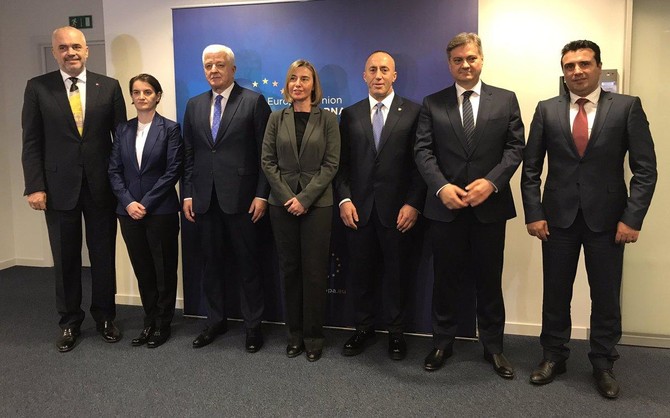
EU throws open door to Balkans with 2025 target for membership

Top Australian writers’ festival canceled after Palestinian author barred
- 180 authors boycotted the event and its director resigned after a Palestinian author was disinvited
SYDNEY: One of Australia’s top writers’ festivals was canceled on Tuesday, after 180 authors boycotted the event and its director resigned saying she could not be party to silencing a Palestinian author and warned moves to ban protests and slogans after the Bondi Beach mass shooting threatened free speech.
Louise Adler, the Jewish daughter of Holocaust survivors, said on Tuesday she was quitting her role at the Adelaide Writers’ Week in February, following a decision by the festival’s board to disinvite a Palestinian-Australian author.
The novelist and academic Randa Abdel-Fattah said the move to bar her was “a blatant and shameless act of anti-Palestinian racism and censorship.”
Prime Minister Anthony Albanese on Tuesday announced a national day of mourning would be held on January 22 to remember the 15 people killed in last month’s shooting at a Jewish Hanukkah celebration on Bondi Beach.
Police say the alleged gunmen were inspired by the Islamic State militant group, and the incident sparked nationwide calls to tackle antisemitism, and prompted state and federal government moves to tighten hate speech laws.
The Adelaide Festival board said on Tuesday its decision last week to disinvite Abdel-Fattah, on the grounds it would not be culturally sensitive for her to appear at the literary event “so soon after Bondi,” was made “out of respect for a community experiencing the pain from a devastating event.”
“Instead, this decision has created more division and for that we express our sincere apologies,” the board said in a statement.
The event would not go ahead and remaining board members will step down, it added.
Former New Zealand Prime Minister Jacinda Ardern, British author Zadie Smith, Australian author Kathy Lette, Pulitzer Prize-winning American Percival Everett and former Greek finance minister Yanis Varoufakis are among the authors who said they would no longer appear at the festival in South Australia state, Australian media reported.
The festival board on Tuesday apologized to Abdel-Fattah for “how the decision was represented.”
“This is not about identity or dissent but rather a continuing rapid shift in the national discourse around the breadth of freedom of expression in our nation following Australia’s worst terror attack in history,” it added.
Abdel-Fattah wrote on social media that she did not accept the apology, saying she had nothing to do with the Bondi attack, “nor did any Palestinian.”
Adler earlier wrote in The Guardian that the board’s decision to disinvite Abdel-Fattah “weakens freedom of speech and is the harbinger of a less free nation, where lobbying and political pressure determine who gets to speak and who doesn’t.”
The South Australian state government has appointed a new festival board.


