Israeli killed in West Bank

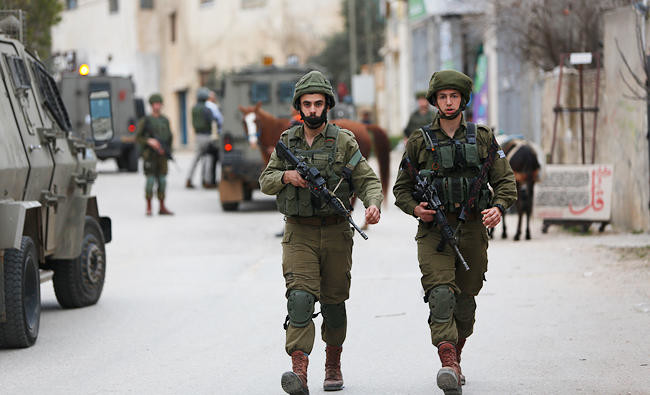
Israeli soldiers search for Palestinian attacker in the village of Kifl Haris near Ariel settlement, on Monday. (AP)
Updated 06 February 2018
Follow

Israeli killed in West Bank

JERUSALEM: A Palestinian stabbed and killed an Israeli man on Monday in a Jewish settlement in the occupied West Bank, Israeli officials said.
The incident occurred in Ariel, one of the largest Israeli settlements in the territory. An army officer who spotted the assailant hit him with his vehicle, but the Palestinian escaped and troops launched a search, the military said.
Prime Minister Benjamin Netanyahu said the Israeli had died of his wounds, making the announcement at a weekly meeting of legislators from his right-wing Likud party.
Tensions have risen in the West Bank since US President Donald Trump recognized Jerusalem as the capital of Israel on Dec. 6, breaking with decades of US policy that the city’s status must be decided in peace negotiations between Israel and the Palestinians.
East Jerusalem was captured by Israel in a 1967 war, and Palestinians want it for the capital of a future state. Israel considers all of Jerusalem its eternal and indivisible capital, a claim that is not recognized internationally.
Separately, Israel on Sunday said it plans to legalize an isolated West Bank outpost in response to the murder of one of its residents in a shooting attack last month.
Netanyahu told his weekly Cabinet meeting that his government will legalize Havat Gilad to “allow the continuing of normal life there.”
“Whoever thought that through the reprehensible murder of a resident of Havat Gilad, a father of six, that our spirit can be broken and we can be weakened, is making a bitter mistake,” Netanyahu said.


Taiwan says reached ‘general consensus’ with US on trade deal

Updated 6 sec ago
Follow

Taiwan says reached ‘general consensus’ with US on trade deal

  • Taiwan has reached a “general consensus” with the United Sates on a trade deal, the democratic island’s negotiators said Tuesday, after months of talks
TAIPEI: Taiwan has reached a “general consensus” with the United Sates on a trade deal, the democratic island’s negotiators said Tuesday, after months of talks.
Taiwan and the United States began negotiations in April to hash out a trade deal after US President Donald Trump slapped a 32 percent tariff on Taiwanese exports, which was later lowered to 20 percent, as part of his sweep of measures against dozens of trade partners.
Taiwanese President Lai Ching-te has pledged to boost investment in the United States and increase defense spending as his government tries to further reduce the levy on its shipments, as well as avoid a toll on its semiconductor chip exports.
“The goal of the US-Taiwan tariff negotiations has always been to seek reciprocal tariff reductions without stacking tariffs, and to obtain preferential treatment under Section 232 for semiconductors, semiconductor derivatives, and other items,” the Office of Trade Negotiations said in a statement, adding there was a “general consensus” on these issues.
Section 232 refers to part of the US Trade Expansion Act that allows tariffs to be imposed when national security is found to be at risk.
“Both sides are currently discussing the schedule for a concluding meeting, and an announcement will be made once it is confirmed,” the statement said.
Taiwan’s trade officials also vowed to provide “a complete explanation of the negotiations and the agreement” to the opposition-controlled parliament and the public.
American soil
Taiwan is a powerhouse in the manufacturing of semiconductor chips, which are the lifeblood of the global economy, as well as other electronics.
Trump has previously accused Taiwan of stealing the US chip industry and his administration had made clear it wants more of the critical technology made on American soil.
The US government launched investigations under Section 232 into semiconductors and chip-making equipment last year.
Taiwan’s trade surplus with the United States was the seventh highest of any country in 2024, reaching $73.9 billion.
More than half of its exports to the United States are information and communications technology products, including semiconductors.
Lai has been at pains to find favor with Trump, vowing to raise defense spending to more than three percent of GDP this year and five percent by 2030.
TSMC, which is the world’s largest contract chip maker, also has pledged to invest an additional $100 billion in the United States.
But Taiwanese Deputy Foreign Minister Francois Chih-chung Wu told AFP recently that Taiwan planned to keep making the “most advanced” chips on home soil.