Police: Extreme-right gunman shoots 6 Africans in Italy

1 / 2
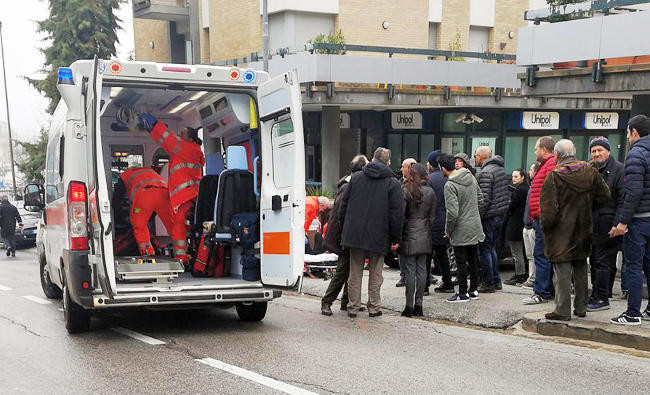
Paramedics, background center, attend a wounded man after a shooting broke out in Macerata, Italy, on Saturday. (AP)
2 / 2
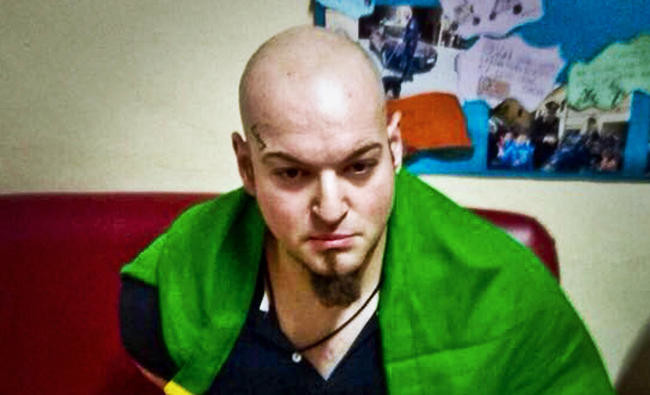
A photo showing a man identified by the Italian Carabinieri, paramilitary police, as Luca Traini, who is accused of having shot with a firearm to several people in Macerata, Italy, on Saturday. (AP)
Updated 04 February 2018
Follow

Police: Extreme-right gunman shoots 6 Africans in Italy

MILAN: An Italian gunman with extreme right-wing sympathies shot and wounded six African immigrants Saturday in a two-hour drive-by shooting spree, authorities said, terrorizing a small Italian city where a Nigerian man had been arrested days earlier in a teenager’s gruesome killing.
Police photos showed the shooting suspect with a neo-Nazi tattoo prominently on his forehead as he sat in custody and an Italian flag tied around his neck as he was arrested in the central Italian city of Macerata,. Authorities identified him as Luca Traini, a 28-year-old Italian with no previous record.
Traini had run for town council on the anti-migrant Northern League’s list in a local election last year in Corridonia, the party confirmed, but its mayoral candidate lost the race. The news agency ANSA quoted friends of his as saying that Traini had previously been affiliated with Italian extremist parties like the neo-fascist Forza Nuova and CasaPound.
The shooting spree came days after the slaying of 18-year-old Pamela Mastropietro and amid a heated electoral campaign in Italy where anti-foreigner sentiment has become a key theme. Italy has struggled with the arrival of hundreds of thousands of migrants in the last few years coming across the Mediterranean Sea in smugglers’ boats.
After the attack, Premier Paolo Gentiloni warned in Rome that “the state will be particularly severe against whoever thinks of feeding the spiral of violence.”
In Macerata, Interior Minister Marco Minniti said the gunman had been motivated “by racial hatred,” and had “a background of right-wing extremism with clear references to fascism and Nazism.”
“What happened appears to be a completely random armed retaliation raid,” Minniti said, adding that evidence indicated that while the gunman had planned the attack, he had acted alone. “In a democracy, it is not permitted for individuals to seek justice alone, even if in this case, there is nothing that recalls a notion of justice.”
Authorities said the six wounded — five men and one woman — appeared to be random targets in various parts of the city of 43,000 in Italy’s central Marche region. Italian news reports indicated that the gunman’s trajectory included the area where the Italian murder victim was found and where the prime suspect in her slaying lived.
The identities and nationalities of the shooting victims remained unknown. Hospital officials said late Saturday that one had been treated and released, while the others had either undergone surgery or were facing operations for their injuries. One of them remained in intensive care.
As the violent attack unfolded, police told residents to stay inside and ordered a halt to public transport to limit the casualties. Such violent shootings are rare in Italy, and usually associated with the southern Italian mafia.
A video posted by the il Resto di Carlino newspaper showed the suspect with an Italian flag draped over his shoulders being arrested by armed Carabinieri officers in the city center, near where he apparently fled his car on foot. Italian news reports said a registered gun was found inside the car and the suspect did a fascist salute as he was arrested, but no salute was visible in the video.
The tattoo on Traini’s forehead was that of the Wolfangel, an ancient runic symbol that according to the Anti-Defamation League was appropriated by Nazi Germany and later adopted by neo-Nazis in Europe and the United States.
Macerata Mayor Romano Carancini confirmed that all six victims were black Africans.
“They were all of color, this is obviously a grave fact. As was grave what happened to Pamela. The closeness of the two events makes you imagine there could be a connection,” Carancini said.
Mastropietro’s dismembered remains were found Wednesday in two suitcases two days after she walked away from a drug rehab community. A judge on Saturday confirmed the arrest of the main suspect, identified as 29-year-old Innocent Oseghale.
Italy is heading into a general election on March 4 and the head of the rebranded League party, Matteo Salvini, had capitalized on the teen’s killing in campaign appearances even before the shooting Saturday.
Salvini is pledging to deport 150,000 migrants in his first year in office if his party wins control of parliament and he is named premier. That has drawn sharp rebukes that Salvini is using the migrant crisis to foment xenophobia for political gain.
Salvini’s League, which dropped “northern” from its name in a bid for a national following, has joined a center-right coalition with Silvio Berlusconi’s Forza Italia and Giorgia Meloni’s much smaller Brothers of Italy. They are running against Matteo Renzi’s much-splintered center-left Democratic Party and the populist 5-Star Movement.
Salvini told reporters Saturday at a campaign stop in Bologna that he would bring security to Italy.
“Whoever shoots is a delinquent, no matter the skin color. It is clear that out-of-control immigration ... brings social conflict,” he said.
Senate president Pietro Grasso of the small liberal party Free and Equal chastised Salvini for using the tragedies to gain votes.
“Whoever, like Salvini, exploits news events and tragedies for electoral purposes is among those responsible for the spiral of hatred and violence that we must stop as soon as possible,” Grasso said.


Cuba’s president says no current talks with the US following Trump’s threats

Updated 11 sec ago
Follow

Cuba’s president says no current talks with the US following Trump’s threats

  • Cuba was receiving an estimated 35,000 barrels a day from Venezuela before the US attacked, along with some 5,500 barrels daily from Mexico and roughly 7,500 from Russia, according to Jorge Piñón of the Energy Institute

HAVANA: Cuban President Miguel Díaz-Canel said Monday that his administration is not in talks with the US government, a day after President Donald Trump threatened the Caribbean island in the wake of the US attack on Venezuela.
Díaz-Canel posted a flurry of brief statements on X after Trump suggested that Cuba “make a deal, BEFORE IT IS TOO LATE.” He did not say what kind of deal.
Díaz-Canel wrote that for “relations between the US and Cuba to progress, they must be based on international law rather than hostility, threats, and economic coercion.”
He added: “We have always been willing to hold a serious and responsible dialogue with the various US governments, including the current one, on the basis of sovereign equality, mutual respect, principles of International Law, and mutual benefit without interference in internal affairs and with full respect for our independence.”
His statements were reposted by Cuban Foreign Minister Bruno Rodríguez on X.
A key lifeline severed
On Sunday, Trump wrote that Cuba would no longer live off oil and money from Venezuela, which the US attacked on Jan. 3 in a stunning operation that killed 32 Cuban officers and led to the arrest of President Nicolás Maduro.
Cuba was receiving an estimated 35,000 barrels a day from Venezuela before the US attacked, along with some 5,500 barrels daily from Mexico and roughly 7,500 from Russia, according to Jorge Piñón of the Energy Institute at the University of Texas at Austin, who tracks the shipments.
On Monday, Mexican President Claudia Sheinbaum once again declined to provide data on current oil shipments or say whether such shipments would increase when Venezuelan supplies end. She insisted that the aid “has been ongoing for a long time; it’s not new.”
Sheinbaum said Mexico’s fuel supply to Cuba is not a concern for her country because “there is enough oil” — even though production of state-owned oil company Petróleos Mexicanos is steadily declining. She reiterated that her government is willing to facilitate dialogue between the US and Cuba if both agree.
Even with oil shipments from Venezuela, widespread blackouts have persisted across Cuba given fuel shortages and a crumbling electric grid. Experts worry a lack of petroleum would only deepen the island’s multiple crises that stem from an economic paralysis during the COVID-19 pandemic and a radical increase in US sanctions following the first Trump administration, which aim to force a change in Cuba’s political model.
The communist government has said US sanctions cost the country more than $7.5 billion between March 2024 and February 2025, a staggering sum for an island whose tourism revenue reached some $3 billion annually at its peak in the previous decade.
The crisis also has triggered a large wave of migration primarily to the United States, where Cubans enjoyed immigration privileges as exiles. Those privileges were curtailed before Trump closed US borders.
‘They didn’t even bring Cuban coffee’
The situation between the US and Cuba is “very sad and concerning,” said Andy S. Gómez, retired dean of the School of International Studies and senior fellow in Cuban Studies at the University of Miami.
He said he sees Díaz-Canel’s latest comments “as a way to try and buy a little bit of time for the inner circle to decide what steps it’s going to take.”
Gómez said he doesn’t visualize Cuba reaching out to US officials right now.
“They had every opportunity when President (Barack) Obama opened up US diplomatic relations, and yet they didn’t even bring Cuban coffee to the table,” Gómez said. “Of course, these are desperate times for Cuba.”
Michael Galant, senior research and outreach associate at the Center for Economic and Policy Research in Washington, D.C., said he believes Cuba might be willing to negotiate.
“Cuba has been interested in finding ways to ease sanctions,” he said. “It’s not that Cuba is uncooperative.”
Galant said topics for discussion could include migration and security, adding that he believes Trump is not in a hurry.
“Trump is hoping to deepen the economic crisis on the island, and there are few costs to Trump to try and wait that out,” he said. “I don’t think it’s likely that there will be any dramatic action in the coming days because there is no rush to come to the table.”
Cuba’s president stressed on X that “there are no talks with the US government, except for technical contacts in the area of ​​migration.”
As tensions remained heightened, life went on as usual for many Cubans, although some were more concerned than others.
Oreidy Guzmán, a 32- year-old food delivery person, said he doesn’t want anything bad to happen to Cubans, “but if something has to happen, the people deserve change.”
Meanwhile, 37-year-old homemaker Meilyn Gómez said that while she doesn’t believe the US would invade Cuba, she was preparing for any possible outcome under Trump: “He’ll find entertainment anywhere.”
The current situation is dominating chatter among Cubans on the island and beyond.
“Cuban people talk and talk,” said 57-year-old bartender Rubén Benítez, “but to be honest, eleven, eight or nine million will take to the streets to defend what little we have left.”