BEIRUT: Ancient sculptures that were missing for decades after being stolen during Lebanon’s civil war are to go on display in Beirut, thanks to a global fight against antiquities smuggling that has been stepped up since wartime looting in Iraq and Syria.
The five marble statues were among a haul of hundreds that Lebanese militiamen took from a storehouse in 1981, some of which are only now emerging onto the shadowy global arts market and even into the world’s greatest museums.
Three of the five sculptures unveiled at a ceremony in Beirut on Friday were spotted in New York’s Metropolitan Museum — where they were on loan from a private collector — by a curator who identified them using Art Loss, an online register of stolen artifacts.
One of the people instrumental in getting them sent back to Lebanon was Manhattan Assistant District Attorney Matthew Bogdanos, an Iraq war veteran who led the investigation into looting at the national museum in Baghdad during the chaos of the US-led invasion to topple Saddam Hussein.
Outrage at looting there and in Syria, and fear that art trafficking was funding militant groups, has driven countries to work together to stop it, said Bogdanos, who was in Beirut on Friday for a ceremony to unveil the statues.
“It has resulted in greater attention, greater scrutiny and greater resources, all of which we desperately need in order to fight such an entrenched global network,” Bogdanos, whose office has recovered thousands of stolen antiquities in recent years, told Reuters at the ceremony at Beirut’s National Museum.
One of the other statues was identified last year by a gallery in Germany, which noticed it on the Art Loss register. The fifth was seized in a container entering Lebanon’s port of Tripoli last month.
Archaeologists excavated all the statues in the 1960s and 1970s in Sidon at the Temple of Eshmoun, a god of healing.
They were carved between the sixth and fourth centuries BC, when Lebanon’s Phoenician civilization was ruled by the Persian empire but influenced by Greek art and culture.
One of the statues, a bull’s head, was from the capital of a pillar in the temple. The other statues, of youths and children, included one dedicated to the temple by fond relatives in thanks for the recovery from illness of their child.
They will be added to the Beirut museum’s display of Eshmoun sculptures, which include a complete capital with bull heads facing in each direction and marble statues of babies and children.
Only a handful of more than 500 Eshmoun statues pillaged from the storerooms of Byblos citadel in 1981 have been identified and returned to Lebanon.
“We will put every resource that we have to recover any piece wherever it is and whoever thinks it belongs to him. Our heritage is not for sale,” said Lebanon’s Culture Minister Ghattas Khoury.
Like these pieces, items smuggled from Iraq and Syria may stay hidden for decades before traffickers start selling them to collectors. “It is rare that we would see anything on the market for 10 or 20 or even 30 years, because they do have the patience. They stockpile these pieces,” said Bogdanos.
The international nature of the trade makes it hard to trace them.
“If you would follow the pieces which we have here, there was a kind of ping-pong between Europe, America, Europe again ... it’s a globalization,” said Rolf Stucky, a Swiss archaeologist who registered many of the looted Eshmoun statues on Art Loss in the 1990s, allowing them to be identified now.
But countries now share information and help train authorities, both in the main markets for stolen artefacts and in the regions from which they come.
Lebanon itself has stopped many foreign pieces from being shipped through Beirut, said Ghattas. As a neighbor of Syria, it is a major route for items looted from there.


![]()
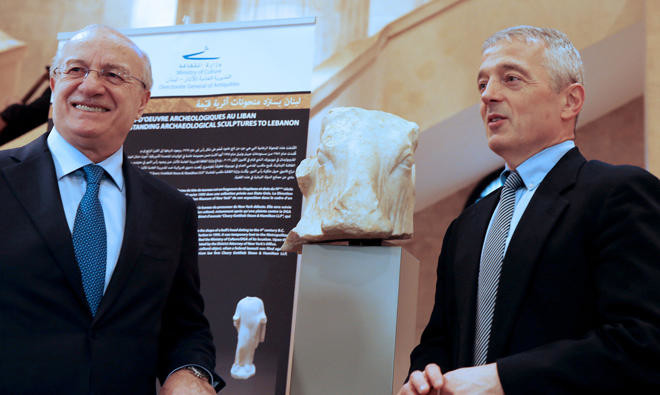

Ancient statues return to Lebanon as war on smuggling intensifies
Ancient statues return to Lebanon as war on smuggling intensifies
Islamic State kills four security personnel in Syria, state news agency says
- The assault on a checkpoint west of Raqqa city underlined an escalation in attacks by the jihadist group against President Ahmed Al-Sharaa’s government
CAIRO: Daesh militants killed four Syrian government security personnel in northern Syria on Monday, the Syrian state news agency reported, in what would be the group’s deadliest attack on government forces since the ouster of President Bashar Assad.
The assault on a checkpoint west of Raqqa city underlined an escalation in attacks by the jihadist group against President Ahmed Al-Sharaa’s government, two days after the jihadist group declared “a new phase of operations” against it. Islamic State issued no immediate claim of responsibility for Monday’s attack. On Saturday, the group claimed two attacks targeting Syrian army personnel in northern and eastern Syria, in which a Syrian soldier and a civilian were killed.
The Syrian state news agency said forces foiled Monday’s attack and killed one of the militants. It quoted a security source as saying Islamic State carried out the attack. Separately, one soldier was killed after unknown gunmen attacked the army headquarters in the city of Mayadin in Deir Ezzor in eastern Syria, the Syrian state news agency reported on the early hours of Tuesday.
There was no immediate claim of responsibility for the attack, which occurred in the same city where the Islamic State carried out an attack days earlier.
The Syrian government joined the US-led coalition to combat Islamic State last year. In January, government forces seized control of Raqqa from the Kurdish-led Syrian Democratic Forces, along with much of the surrounding territory in northern and eastern Syria.
Meanwhile, US forces on Monday began withdrawing from their largest military base in the northeast, according to three Syrian military and security sources — part of a broader pullout of US troops who deployed to Syria a decade ago to fight Islamic State.
The assault on a checkpoint west of Raqqa city underlined an escalation in attacks by the jihadist group against President Ahmed Al-Sharaa’s government, two days after the jihadist group declared “a new phase of operations” against it. Islamic State issued no immediate claim of responsibility for Monday’s attack. On Saturday, the group claimed two attacks targeting Syrian army personnel in northern and eastern Syria, in which a Syrian soldier and a civilian were killed.
The Syrian state news agency said forces foiled Monday’s attack and killed one of the militants. It quoted a security source as saying Islamic State carried out the attack. Separately, one soldier was killed after unknown gunmen attacked the army headquarters in the city of Mayadin in Deir Ezzor in eastern Syria, the Syrian state news agency reported on the early hours of Tuesday.
There was no immediate claim of responsibility for the attack, which occurred in the same city where the Islamic State carried out an attack days earlier.
The Syrian government joined the US-led coalition to combat Islamic State last year. In January, government forces seized control of Raqqa from the Kurdish-led Syrian Democratic Forces, along with much of the surrounding territory in northern and eastern Syria.
Meanwhile, US forces on Monday began withdrawing from their largest military base in the northeast, according to three Syrian military and security sources — part of a broader pullout of US troops who deployed to Syria a decade ago to fight Islamic State.
Latest updates


© 2026 SAUDI RESEARCH & PUBLISHING COMPANY, All Rights Reserved And subject to Terms of Use Agreement.