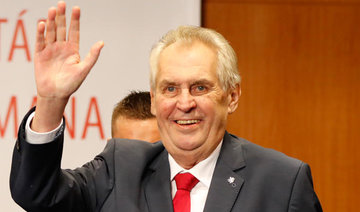
PRAGUE: Czech Prime Minister Andrej Babis said on Saturday that early elections could be a last resort if he fails to win support for a new government after his minority cabinet lost a confidence vote last month.
The billionaire businessman's anti-establishment ANO party won a parliamentary election last October but lacks a majority.
With a booming economy and rising wages, ANO appealed to voters with its pledge to fight corruption, streamline government, fix outdated roads and cut taxes.
Babis faces allegations that he fraudulently claimed European Union subsidies worth 2 million euros a decade ago and other parties decline to work with him. He denies wrongdoing and ANO refuses to nominate another candidate for prime minister.
"If we don't reach agreement (with other parties) then maybe the only solution will be early elections," he said in an interview with daily Pravo, adding it was "a last resort" he did not want. His ally President Milos Zeman also opposes the idea.
Babis said he would seek support by the end of this month and then ask parliament for a confidence vote.
He views single-party government as the best option and said he would continue talks on gaining support from the far-left Communist party and far-right, anti-EU SPD party.
His Foreign Minister Martin Stropnicky, said in an interview with Mlada Fronta Dnes, that he and other ANO members would have a problem relying on support from the SPD.
Babis would also wait for the Social Democrat party to elect new leadership at a Feb. 18 congress before holding more talks with his former ruling partners.
ANO has 78 lawmakers in the 200-seat lower chamber of parliament. Babis's minority cabinet remains in power until a new administration is formed.
Zeman has tasked Babis with forming a new government and promised to give him plenty of time after his own re-election last weekend, in a victory speech where the leaders of the Social Democrats and SPD stood behind him.
Under the constitution, Zeman could dissolve parliament if three confidence votes fail, giving him a strong hand in talks. Given ANO's popularity, other parties oppose new elections.
Zeman, a prominent figure in Czech politics, has been criticized for his warmth towards the far-right and ties to Russia. He has called for an end to EU sanctions against Moscow.

Czech PM raises prospect of early election if no deal on new government

World not ready for rise in extreme heat, scientists say
- In a new study, they looked at different global warming scenarios to project how often people in the future might experience temperatures considered uncomfortably hot or cold
PARIS: Nearly 3.8 billion people could face extreme heat by 2050, and while tropical countries will bear the brunt, cooler regions will also need to adapt, scientists said Monday.
Demand for cooling will “drastically” increase in large countries like Brazil, Indonesia, and Nigeria, where hundreds of millions of people lack air conditioning or other means to beat the heat.
But even a moderate increase in hotter days could have a “severe impact” in nations not accustomed to such conditions, such as Canada, Russia, and Finland, said scientists from the University of Oxford.
In a new study, they looked at different global warming scenarios to project how often people in the future might experience temperatures considered uncomfortably hot or cold.
They found “that the population experiencing extreme heat conditions is projected to nearly double” by 2050 if global average temperatures rise 2°C above preindustrial times.
But most of the impact would be felt this decade as the world fast approaches the 1.5°C mark, said the study’s lead author Jesus Lizana.
“The key takeaway from this is that the need for adaptation to extreme heat is more urgent than previously known,” said Lizana, an environmental scientist.
“New infrastructure, such as sustainable air conditioning or passive cooling, needs to be built out within the next few years to ensure people can cope with dangerous heat.”
Prolonged exposure to extreme heat can overwhelm the body’s natural cooling systems, causing symptoms ranging from dizziness and headaches to organ failure and death.
It is often called a silent killer because most heat deaths occur gradually as high temperatures and other environmental factors work together to undermine the body’s internal thermostat.
Climate change is making heatwaves longer and stronger, and access to cooling — especially air conditioning — will be vital in the future.
The study, published in the journal Nature Sustainability, projected that 3.79 billion people worldwide could be exposed to extreme heat by mid century.
This would “drastically” increase energy demand for cooling in developing nations where the gravest health consequences would be felt. India, the Philippines, and Bangladesh would be among the countries with the largest populations affected.
The most significant change in “cooling degree days” — temperatures hot enough to require cooling, such as air conditioning or fans — was projected in tropical or equatorial countries, particularly in Africa.
Central African Republic, Nigeria, South Sudan, Laos, and Brazil saw the biggest rise in dangerously hot temperatures.
“Put simply, the most disadvantaged people are the ones who will bear the brunt of this trend, our study shows for ever hotter days,” said urban climate scientist and research co-author Radhika Khosla.
But wealthier countries in traditionally cooler climates also “face a major problem — even if many do not realize it yet,” she added.
Countries like Canada, Russia, and Finland may experience steep drops in “heating degree days” — temperatures low enough to require indoor heating — under a 2°C scenario.
But even a moderate rise in hotter temperatures would be felt more acutely in countries not designed to withstand heat, the authors said.
In these countries, homes and buildings are usually built to maximize sunlight and minimize ventilation, and public transport runs without air conditioning.
Some cold-climate nations may see a drop in heating bills, Lizana said, but over time these savings would likely be replaced by cooling costs, including in Europe, where air conditioning is still rare.
“Wealthier countries cannot sit back and assume they will be OK — in many cases, they are dangerously underprepared for the heat that is coming over the next few years,” he said.