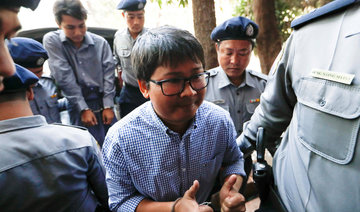
GENEVA: The United Nations human rights office called on Friday on Myanmar authorities to release two detained Reuters journalists, a day after they were denied bail.
“We repeat the calls for their immediate release and for the charges to be dropped,” UN human rights spokesman Rupert Colville told a Geneva news briefing. “We are alarmed at the serious erosion of freedom of expression in Myanmar.”
A Myanmar court on Thursday denied bail to two Reuters journalists charged under a secrecy act that could see them face up to 14 years in jail, in a case that has sparked outcry over shrinking media freedom.
Myanmar nationals Wa Lone, 31, and Kyaw Soe Oo, 27, are accused of possessing classified documents thought to relate to the violent military crackdown on the Rohingya Muslim minority.
The crackdown in northern Rakhine state has forced nearly 700,000 Rohingya Muslims over the border into Bangladesh since August, many carrying allegations of rape, mass murder and arson at the hands of Myanmar’s army.

UN calls for release of Reuters journalists in Myanmar
OpenAI’s Altman says world ‘urgently’ needs AI regulation
- Sam Altman, head of ChatGPT maker OpenAI, told a global artificial intelligence conference on Thursday that the world “urgently” needs to regulate the fast-evolving technology
NEW DELHI: Sam Altman, head of ChatGPT maker OpenAI, told a global artificial intelligence conference on Thursday that the world “urgently” needs to regulate the fast-evolving technology.
An organization could be set up to coordinate these efforts, similar to the International Atomic Energy Agency (IAEA), he said.
Altman is one of a host of top tech CEOs in New Delhi for the AI Impact Summit, the fourth annual global meeting on how to handle advanced computing power.
“Democratization of AI is the best way to ensure humanity flourishes,” he said on stage, adding that “centralization of this technology in one company or country could lead to ruin.”
“This is not to suggest that we won’t need any regulation or safeguards,” Altman said.
“We obviously do, urgently, like we have for other powerful technologies.”
Many researchers and campaigners believe stronger action is needed to combat emerging issues, ranging from job disruption to sexualized deepfakes and AI-enabled online scams.
“We expect the world may need something like the IAEA for international coordination of AI,” with the ability to “rapidly respond to changing circumstances,” Altman said.
“The next few years will test global society as this technology continues to improve at a rapid pace. We can choose to either empower people or concentrate power,” he added.
“Technology always disrupts jobs; we always find new and better things to do.”
Generative AI chatbot ChatGPT has 100 million weekly users in India, more than a third of whom are students, he said.
Earlier on Thursday, OpenAI announced with Indian IT giant Tata Consultancy Services (TCS) a plan to build data center infrastructure in the South Asian country.


