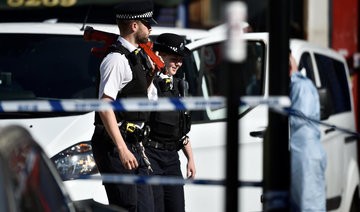
LONDON: A representative from the London Mosque where a far-right sympathizer crashed his van into people gathered outside, said his conviction is a reminder of the challenges in countering all forms of extremism.
Khalid Omar, secretary trustee of Finsbury Park Mosque told Arab News that they welcomed the verdict on Thursday.
“It does highlight that there is extremism of different forms which need to be faced up … but gives us no extra pleasure knowing there are these type of people in society,” he said.
Discussing the rise in hate crimes against Muslim communities in the UK he said: “I don’t think there is a magic solution,” but emphasized the need to “work together.
“We need to have a clearer plan in place on how we can make sure balanced views are heard and the voice of every community is included.”
The attack was the fourth incident blamed on terrorists in Britain in the space of three months.
Darren Osborne, 48, drove the hired vehicle into a group of Muslims gathered around father-of-six Makram Ali, 51, who had collapsed near his home after leaving late-night Ramadan prayers in Finsbury Park.
He killed Ali and injured 12 others, two seriously.
Osborne was found guilty of murder and attempted murder at Woolwich Crown Court on Thursday.
The court heard how Osborne, a father of four, had not previously expressed any extremist views but become “brainwashed” by far-right material online after watching the BBC program “Three Girls,” a drama broadcast last May about events in Rochdale, northern England, where white girls were abused by gangs of mainly British Pakistani men.

Finsbury Park mosque welcomes guilty verdict for far-right terrorist
China to support ‘reunification forces’ in Taiwan, go after ‘separatists’
BEIJING: China will offer firm support for “patriotic pro-reunification forces” in Taiwan and strike hard against “separatists,” the top Chinese official in charge of policy toward the democratically-governed island said in comments published on Tuesday.
China, which views Taiwan as its own territory despite the objections of the government in Taipei, has ramped up its military and political pressure against the island as Beijing seeks to assert its sovereignty claims.
Addressing this year’s annual “Taiwan Work Conference,” the ruling communist party’s fourth-ranked leader Wang Huning said officials must advance the “great cause of national reunification,” the official state-run Xinhua news agency said.
It is necessary to “firmly support the patriotic pro-unification forces on the island, resolutely strike against ‘Taiwan independence’ separatist forces, oppose interference by external forces, and safeguard peace and stability in the Taiwan Strait,” Xinhua paraphrased him as saying.
The Beijing meeting was also attended by Foreign Minister Wang Yi, underscoring how China sees Taiwan as an issue it needs to promote on the international stage.
China has long offered Taiwan a Hong Kong-style “one country, two systems” model of autonomy, though no major Taiwanese political party supports that.
Taiwan’s government says Beijing’s rule in the former British colony has only brought repression, with Taiwan President Lai Ching-te on Tuesday citing the sentencing of
Hong Kong tycoon Jimmy Lai
to 20 years prison the previous day.
“Jimmy Lai’s sentencing exposes the Hong Kong national security law for what it is — a tool of political persecution under China’s ‘one country, two systems’ that tramples human rights & freedom of press,” Lai wrote on X.
There was no immediate response to Wang Huning’s comments from Taiwan’s government, which says only the island’s people can decide their future.
Beijing has repeatedly warned other countries including the US against meddling in Taiwan issue, which it said is its internal affair.
In a call with US President Donald Trump last week, China’s President Xi Jinping said the Taiwan issue is the most important issue in China-US relations and Washington must handle the issue of arms sales to Taiwan with prudence.
China refuses to speak to Taiwan’s president and has rebuffed his repeated offers of talks, saying he is a “separatist” who must accept that Taiwan is part of China.
Wang was speaking just a week after meeting a delegation from Taiwan’s largest opposition party, the Kuomintang (KMT), who were in Beijing for a meeting of party think-tanks.
Speaking to reporters earlier on Tuesday in Taipei, KMT Vice Chairman Hsiao Hsu-tsen, who led the delegation to Beijing, said there had been no discussion of political issues when they met Wang, as the trip there was to discuss topics like tourism and AI.
China, which views Taiwan as its own territory despite the objections of the government in Taipei, has ramped up its military and political pressure against the island as Beijing seeks to assert its sovereignty claims.
Addressing this year’s annual “Taiwan Work Conference,” the ruling communist party’s fourth-ranked leader Wang Huning said officials must advance the “great cause of national reunification,” the official state-run Xinhua news agency said.
It is necessary to “firmly support the patriotic pro-unification forces on the island, resolutely strike against ‘Taiwan independence’ separatist forces, oppose interference by external forces, and safeguard peace and stability in the Taiwan Strait,” Xinhua paraphrased him as saying.
The Beijing meeting was also attended by Foreign Minister Wang Yi, underscoring how China sees Taiwan as an issue it needs to promote on the international stage.
China has long offered Taiwan a Hong Kong-style “one country, two systems” model of autonomy, though no major Taiwanese political party supports that.
Taiwan’s government says Beijing’s rule in the former British colony has only brought repression, with Taiwan President Lai Ching-te on Tuesday citing the sentencing of
Hong Kong tycoon Jimmy Lai
to 20 years prison the previous day.
“Jimmy Lai’s sentencing exposes the Hong Kong national security law for what it is — a tool of political persecution under China’s ‘one country, two systems’ that tramples human rights & freedom of press,” Lai wrote on X.
There was no immediate response to Wang Huning’s comments from Taiwan’s government, which says only the island’s people can decide their future.
Beijing has repeatedly warned other countries including the US against meddling in Taiwan issue, which it said is its internal affair.
In a call with US President Donald Trump last week, China’s President Xi Jinping said the Taiwan issue is the most important issue in China-US relations and Washington must handle the issue of arms sales to Taiwan with prudence.
China refuses to speak to Taiwan’s president and has rebuffed his repeated offers of talks, saying he is a “separatist” who must accept that Taiwan is part of China.
Wang was speaking just a week after meeting a delegation from Taiwan’s largest opposition party, the Kuomintang (KMT), who were in Beijing for a meeting of party think-tanks.
Speaking to reporters earlier on Tuesday in Taipei, KMT Vice Chairman Hsiao Hsu-tsen, who led the delegation to Beijing, said there had been no discussion of political issues when they met Wang, as the trip there was to discuss topics like tourism and AI.
© 2026 SAUDI RESEARCH & PUBLISHING COMPANY, All Rights Reserved And subject to Terms of Use Agreement.