Trump comments ‘bad news’ for North Korea, say analysts

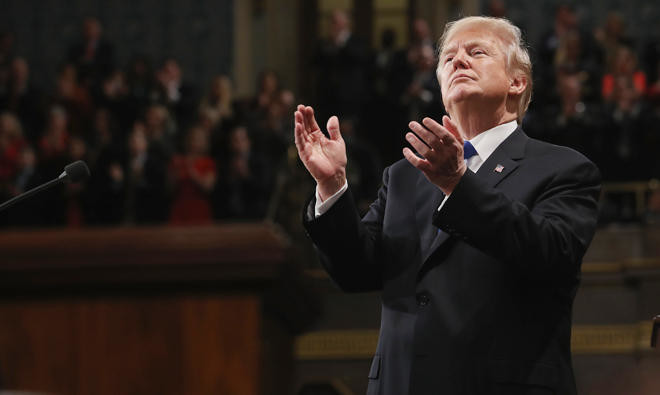
US President Donald Trump claps during the State of the Union address in the chamber of the US House of Representatives in Washington, DC, on Tuesday. (AFP)
Updated 31 January 2018
Follow

Trump comments ‘bad news’ for North Korea, say analysts

SEOUL: President Donald Trump’s fiery comments on North Korea reflected confidence that his campaign of pressure and sanctions on the country is working, South Korean analysts said Wednesday.
The experts said it also means Washington will continue to deny Pyongyang meaningful dialogue unless it is willing to discuss serious changes to its nuclear weapons program and human rights conditions.
In his first State of the Union address, Trump warned that North Korea would “very soon” threaten the US with nuclear-tipped missiles.
He also warned of the dangers from other “rogue regimes,” like Iran, terrorist groups, like the Daesh, and “rivals” like China and Russia “that challenge our interests, our economy and our values.” Calling on Congress to lift budgetary caps and boost spending on the military, Trump said that “unmatched power is the surest means of our defense.”
Du Hyeogn Cha, a visiting scholar at Seoul’s Asan Institute for Policy Studies, said that for North Korea, it has to hurt that Trump declared the country as a regime that cannot co-exist with the founding values of the US.
“He made it clear that his ‘maximum pressure and engagement’ policy will continue to be the only way going forward,” he said. “It was probably the worst message he could deliver to the North without issuing a direct military threat.”
Koh Yu-hwan, a North Korea expert at Seoul’s Dongguk University and a security adviser to South Korea’s presidential office, says Trump likely saw North Korea’s outreach over the Pyeongchang Winter Olympics as a clear sign that pressure and sanctions are working.
News of the speech was not immediately broadcast in North Korea on Wednesday, which is not unusual. It often takes a day or more before the North responds officially and few North Koreans were likely even aware that Trump was to make a major address before the nation and the world.
The North’s state-run media has, however, amped up its anti-US rhetoric lately, accusing Washington of trying to create tensions ahead of the Pyeongchang Winter Olympics. Pyongyang has also stepped up its warnings that the US is preparing for a possible war by sending aircraft carrier battle groups and advanced stealth bombers and fighters to the region.
In Beijing, China called on the US to drop what it terms a “Cold War mentality and zero-sum ideology.”
Foreign Ministry spokeswoman Hua Chuying said that common interests outweigh differences between the sides and the US should view the relationship “correctly.”
China’s $275 billion trade surplus with the US has been a constant source of tension, alongside their growing rivalry for military supremacy in Asia and accusations of intellectual property theft.
In the Philippines, Defense Secretary Delfin Lorenzana told The Associated Press that it did not really matter that Trump failed to mention US policy on the South China Sea disputes involving China, the Philippines and four other governments, but that Manila would lend its support to fighting terrorism whenever the efforts of the two nations coincide.
“If our efforts against terrorists coincide, well and good, we cooperate,” he said. “But in reality, each country will be addressing its own security problems by any legal means at its disposal.”
The US deployed surveillance aircraft to help Philippine forces quell an Daesh group-linked siege in southern Marawi city last year.


More than 200 political prisoners in Venezuela launch hunger strike

Updated 3 sec ago
Follow

More than 200 political prisoners in Venezuela launch hunger strike

GUATIRE: More than 200 Venezuelan political prisoners were on hunger strike Sunday to demand their release under a new amnesty law that excludes many of them.
The inmates at the Rodeo I prison, about 40 kilometers (25 miles) east of capital Caracas, shouted to their loved ones as part of the protest, an AFP journalist witnessed.
“Freedom!,” “release us all!” and “Rodeo I on strike” were among the cries from the prisoners that were audible from outside the facility.
The amnesty law was approved by Venezuela’s congress on Thursday as part of a wave of reforms encouraged by the United States after it ousted and captured former president Nicolas Maduro on January 3.
The hunger strike, which began Friday night, came about after inmates complained they would not benefit from the law because it excludes cases involving the military, which are the most common ones at that facility.
“Approximately 214 people in total, including Venezuelans and foreigners, are on hunger strike,” said Yalitza Garcia, mother-in-law of a prisoner named Nahuel Agustin Gallo.
Gallo, an Argentine police officer, is accused of terrorism, another category that is excluded.
“They decided Friday to go on hunger strike because of the scope of the amnesty law, which excludes many of them,” said Shakira Ibarreto, the daughter of a policeman arrested in 2024.
On Sunday, a team from the International Committee of the Red Cross (ICRC) visited the Rodeo I prison.
“This is the first time they have allowed us to approach that prison,” Filippo Gatti, the ICRC’s health coordinator for Venezuela, told family members. “It’s a first step, and I think we’re on the right track.”
Not all the inmates at the prison were joining the hunger strike, the relatives said.

- Amnesty law criticized -

The amnesty law was engineered by interim leader Delcy Rodriguez under pressure from Washington after US commandos attacked Venezuela on January 3, snatched Maduro and his wife and took them to the United States for trial on drug trafficking charges.
Opposition figures have criticized the new legislation, which appears to include carve-outs for some offenses previously used by authorities to target Maduro’s political opponents.
The law also excludes members of the security forces convicted of activities related to what the government considered terrorism.
But the amnesty extends to 11,000 political prisoners who, over nearly three decades, were paroled or placed under house arrest.
More than 1,500 political prisoners in Venezuela have already applied for amnesty under the bill, the head of the country’s legislature said Saturday.
Hundreds of others had already been released by Rodriguez’s government before the amnesty bill was approved.
On Sunday, a handful of inmates were released from Rodeo I, carrying release papers in their hands. They were greeted with applause.
“I’m out, I love you so much, my queen! I’m doing well,” Robin Colina, one of the freed prisoners, said excitedly into a mobile phone.
Armando Fusil, another released prisoner, told AFP: “Right now there are quite a few people on hunger strike because they want to get out.”
The 55-year-old police commissioner from the western state of Maracaibo said he was “arrested for no reason” in October 2024.
He said loved ones came to visit him every Friday since his arrest, taking a nearly 40-hour trip just for a little bit of face time each week.
Now, they’re coming to pick him up for good.
“We all help each other,” Fusil said about his fellow detainees. “It’s created a beautiful brotherhood.”
The NGO Foro Penal, dedicated to the defense of political prisoners, reported 23 releases on Sunday.
Maduro ruled Venezuela between March 2013 and January 2026, silencing opposition and activists under his harsh leftist rule.
Maduro and his wife are in US custody awaiting trial. Maduro, 63, has pleaded not guilty to drug trafficking charges and declared that he is a prisoner of war.