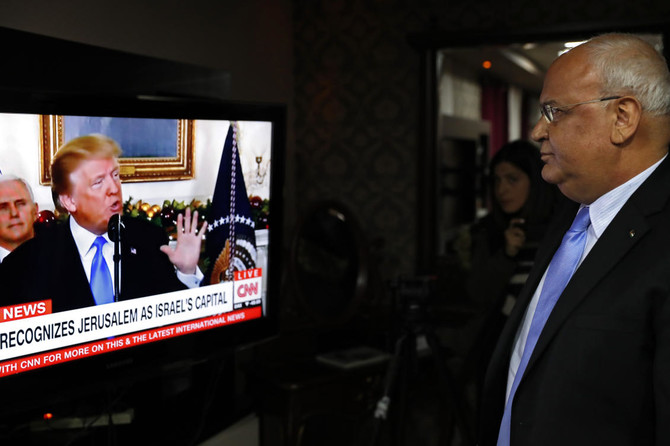
RAMALLAH: The Palestinians’ top negotiator said Tuesday there could be no discussions with US President Donald Trump’s administration until his recognition of Jerusalem as Israel’s capital is reversed.
Saeb Erekat, secretary-general of the Palestine Liberation Organization and the Palestinians’ longtime chief negotiator, told AFP in an interview the decision was “part of a new American era of moving from negotiation to dictation.”
Trump’s December 6 recognition of Jerusalem as Israel’s capital set off protests among Palestinians, who consider the city to be their capital as well.
Erekat’s comments come with rhetoric further sharpening between Trump’s White House and the Palestinians, who have said the United States can no longer mediate in the Middle East conflict and boycotted a recent visit by US Vice President Mike Pence.
Last week, Trump accused the Palestinians of disrespecting the United States and threatened to withhold hundreds of millions of dollars in aid until they returned to the negotiating table.
Provoking Palestinian outrage, he reaffirmed his Jerusalem decision and said the disputed city had been taken “off the table,” despite having previously said his recognition did not preclude later negotiations on its borders.
Trump made the comments in Davos, Switzerland, while seated next to Israeli Prime Minister Benjamin Netanyahu.
According to Erekat, the Palestinians — faced with what they see as a blatantly biased US administration — are aiming to convene an international conference in an effort to show global support for a two-state solution to the conflict.
Asked whether there can be any contact with the Trump administration if the Jerusalem decision is not reversed, Erekat said: “How can you?“
“You heard what President Trump said in Davos. He said: ‘We took Jerusalem off the table’.”
“The minute any Palestinian goes and meets with American officials, it is an acceptance of their decision. Now they are threatening us with money, with aid,” he said.
“They promised not to impose any solution, and now they want the meeting for the sake of the meeting.”
Erekat said it was as if they were telling the Palestinians, “Come here boy, we know what’s good for you.”
Jerusalem’s status is perhaps the most sensitive issue in the Israeli-Palestinian conflict.
Israel sees the entire city as its undivided capital, while the Palestinians want the eastern sector as the capital of their future state.
Israel occupied east Jerusalem in the 1967 Six-Day War and later annexed it, a move never recognized by the international community.
Trump’s unilateral recognition broke with decades of international consensus that the city’s status must be negotiated between the two sides.
The US leader says he still intends to reach what he has called the “ultimate deal” — Israeli-Palestinian peace — but Palestinian president Mahmud Abbas has called his efforts the “slap of the century.”
The Trump administration also hit out at Abbas last week, with UN ambassador Nikki Haley saying he lacked the courage needed for a peace deal.
Erekat likened her comments to a call for a “coup d’etat.”


![]()
No talks with US until Jerusalem move reversed: Palestinian official
No talks with US until Jerusalem move reversed: Palestinian official


Latest updates




© 2026 SAUDI RESEARCH & PUBLISHING COMPANY, All Rights Reserved And subject to Terms of Use Agreement.