Angered by Trump, Palestinian protesters disrupt business seminar US helped organize

A Palestinian activist kicks a vehicle transporting members of an American economic delegation that are meeting with the Head of the Bethlehem Chamber for Commerce and Industry alongside Palestinian businessmen in the West Bank town. (AFP)
Updated 30 January 2018
Follow

Angered by Trump, Palestinian protesters disrupt business seminar US helped organize

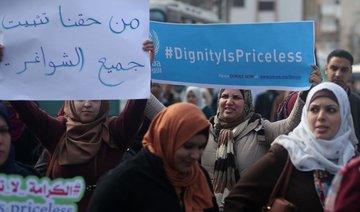
BETHLEHEM, West Bank: Palestinians protesting against US President Donald Trump’s policy on Jerusalem halted a US-coordinated Palestinian marketing workshop in the occupied West Bank on Tuesday, damaging an American diplomatic vehicle as it sped away.
Protesters threw tomatoes at the sports utility vehicle, which had US consular license plates. They also kicked one of its doors and ripped the plastic casing off a side mirror as it drove off under Palestinian police escort from the Bethlehem Chamber of Commerce.
Samir Hazboun, the chamber’s director, told Reuters that a digital marketing workshop, which the US Consulate in Jerusalem helped to organize, was under way when about five protesters barged in.
“We hosted an American expert on this issue. Some people who have been trying to express their point of view and protest (against) the American decision regarding Jerusalem and the political situation ... interrupted the workshop and we stopped the workshop,” Hazboun said.
Commenting on the incident, a State Department spokesperson said: “The United States opposes the use of violence and intimidation to express political views. This non-political program was one part of long-term US engagement to create economic opportunities for Palestinians.”
The US-based lecturer was not a consular staff member. He was accompanied by consular security personnel and some of its Palestinian employees, organizers said.
Trump’s Dec. 6 announcement recognizing Jerusalem as Israel’s capital overturned decades of US policy that its status should be decided in Israeli-Palestinian negotiations.
His declaration drew universal condemnation from Arab leaders, stirred Palestinian street protests and drew widespread international criticism.
On a visit to Israel last week, US Vice President Mike Pence said that Trump’s promised relocation of the US Embassy from Tel Aviv to Jerusalem would take place by the end of 2019. Palestinians boycotted Pence’s visit.
Israel’s government regards Jerusalem as the eternal and indivisible capital of the country, although that is not recognized internationally. Palestinians say East Jerusalem, captured by Israel in a 1967 war, must be the capital of a state they seek in the West Bank and Gaza Strip.
In the Aida refugee camp near Bethlehem on Saturday, effigies of Trump and Pence were hanged and burned in a protest attended by about 30 Palestinians.


Virtual museum preserves Sudan’s plundered heritage

Updated 6 sec ago
Follow

Virtual museum preserves Sudan’s plundered heritage

CAIRO: Destroyed and looted in the early months of Sudan’s war, the national museum in Khartoum is now welcoming visitors virtually after months of painstaking effort to digitally recreate its collection.
At the museum itself, almost nothing remains of the 100,000 artefacts it had stored since its construction in the 1950s. Only the pieces too heavy for looters to haul off, like the massive granite statue of the Kush Pharaoh Taharqa and frescoes relocated from temples during the building of the Aswan Dam, are still present on site.
“The virtual museum is the only viable option to ensure continuity,” government antiquities official Ikhlass Abdel Latif said during a recent presentation of the project, carried out by the French Archaeological Unit for Sudanese Antiquities (SFDAS) with support from the Louvre and Britain’s Durham University.
When the museum was plundered following the outbreak of the war between the regular army and the paramilitary Rapid Support Forces (RSF) in April 2023, satellite images showed trucks loaded with relics heading toward Darfur, the western region now totally controlled by the RSF.
Since then, searches for the missing artefacts aided by Interpol have only yielded meagre results.
“The Khartoum museum was the cornerstone of Sudanese cultural preservation — the damage is astronomical,” said SFDAS researcher Faiza Drici, but “the virtual version lets us recreate the lost collections and keep a clear record.”
Drici worked for more than a year to reconstruct the lost holdings in a database, working from fragments of official lists, studies published by researchers and photos taken during excavation missions.
Then graphic designer Marcel Perrin created a computer model that mimicked the museum’s atmosphere — its architecture, its lighting and the arrangement of its displays.
Online since January 1, the virtual museum now gives visitors a facsimile of the experience of walking through the institution’s galleries — reconstructed from photographs and the original plans — and viewing more than 1,000 pieces inherited from the ancient Kingdom of Kush.
It will take until the end of 2026, however, for the project to upload its recreation of the museum’s famed “Gold Room,” which had housed solid-gold royal jewelry, figurines and ceremonial objects stolen by looters.
In addition to the virtual museum’s documentary value, the catalogue reconstructed by SFDAS is expected to bolster Interpol’s efforts to thwart the trafficking of Sudan’s stolen heritage.