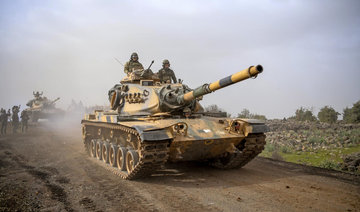
ANKARA: A female Kurdish suicide bomber targeted Turkish troops on Sunday in Syria’s northwest region of Afrin, but caused no casualties, said the Turkish military.
The attacker, Avesta Khabur, was part of the Women’s Protection Units (YPJ), the female component of the Kurdish People’s Protection Units (YPG).
“The attack was from a long distance, so the tank that was carrying soldiers wasn’t damaged,” Abdullah Agar, a security expert and retired special warfare and commando officer, told Arab News. “Ankara is showing great determination in continuing its operation.”
The New York Times said the attack “puts the US in the awkward position of allying with suicide bombers.”
Since the start of Turkey’s Operation Olive Branch in Afrin on Jan. 20, 597 Kurdish fighters have been “neutralized” — surrendered, killed or captured — said the Turkish military.
On Sunday, following heavy clashes, Turkish troops and the Free Syrian Army (FSA) captured the strategic Mount Bursaya in northern Syria.
Mount Bursaya was used by the YPG to strike the Turkish border town of Kilis and the Syrian city of Azaz with artillery, mortars and missiles.
On the fourth day of Operation Olive Branch, a YPG rocket hit a mosque in Kilis, killing two civilians. So far, seven Turkish soldiers and 13 FSA fighters have been killed in the campaign.
“It was known for a long time that the YPG was making preparations to conduct a suicide bombing,” Sertac Canalp Korkmaz, a researcher on security studies at ORSAM, a think tank in Ankara, told Arab News.
“Last week, weather conditions in Afrin were severe. On the battlefield, foggy weather allows terrorists to carry out suicide attacks,” he said. “But countermeasures by the Turkish military will help prevent such attacks.”
Korkmaz underlined Turkey’s significant combat experience against suicide bombing attempts.
“During last year’s Operation Euphrates Shield in northern Syria, the Turkish Army faced several suicide attacks by Daesh against military outposts,” he said.
Daesh and the Kurdistan Workers’ Party (PKK) have also carried out suicide attacks in Turkey, targeting civilians, including foreigners, and police officers.
On Monday, Turkish law-enforcement officials caught a Daesh suspect, Demet Tasar, who was wanted by Interpol. She and 19 other suspects were allegedly plotting suicide attacks in Turkey.
Last week, 1,166 people were detained throughout the country for suspected ties to the PKK, while 34 people were arrested for suspected links to Daesh.


![]()

Turkish troops targeted in Afrin suicide attack
Turkish troops targeted in Afrin suicide attack


Latest updates


© 2026 SAUDI RESEARCH & PUBLISHING COMPANY, All Rights Reserved And subject to Terms of Use Agreement.