LONDON: Brazilian winger Caio has one aim: Helping end Al-Ain’s AFC Champions League heartache.
The pain of losing the 2016 final still lingers for the UAE club, who are desperate to add a second continental title after winning the inaugural edition of the tournament back in 2003.
Fortune has already favored Al-Ain. Shabab Al-Ahli’s ineligibility for this year’s edition has gifted the club a spot in today’s playoff against Bahraini champions Malkiya. The pain of the defeat to South Korea’s Jeonbul Hyundai in the 2016 final still lingers for many and Caio is all too aware of the need to go far in this year’s competition.
“It is really important,” Caio told Arab News.
“(It’s) a great championship, and we’ve been always there. We want to show our strength and win this title.
“(The defeat to Jeonbul Hyundai) makes us sad. We did a great job to get there, and at the end we didn’t get what we wanted.
“We’re focused now and
we’re going to fight to do well
in the year’s competition.”
Born in Araçatuba, near Sao Paulo, Caio moved to Japan when he was only 17, having been spotted by Chiba Kokusai High School during a trial in his native Brazil.
Helping the school to a historic fourth place at the national high school tournament, a prestigious annual event in Japan, Caio caught the eye of one of Japan’s most successful clubs, Kashima Antlers, and was soon strutting his stuff in the J.League.
Along the way he collected the J.League Rookie of the Year in 2014, becoming the first, and so far only, foreigner to receive the award.
Having lived in Japan since 2011, and impressing as he did, before long there was talk of the winger being naturalized and playing for the Samurai Blue.
“I would accept it, without any doubt,” he told JSoccer Magazine in 2014. “This country has helped me a lot, I turned professional here. I think I owe a lot to Japan.”
But in 2016, and nearing five years in Japan that would make him eligible for naturalization under FIFA’s rules, an offer came from Al-Ain.
“It was really hard to leave Kashima,” Caio explained.
“I was playing very well
and scoring, but it was my choice
to be in another place, with
new challenges.”
Eighteen months on and Caio has no regrets over his decision to move and also give up the opportunity to represent Japan, which he says is now behind him.
“I like here very much,” he said. “(The UAE) is a great country to live in. Here you can live with joy and peace. I really like it here.
“There’s no chance of (playing for Japan). There was before when I was playing in Japan, but I needed to be there one more year. It’s in the past now, it’s not going to happen anymore.”
With Japan widely regarded as the leading nation in Asian football, Caio is uniquely positioned to compare football in the Emirates to that in the Land of the Rising Sun.
“Japanese football is a bit faster, more dynamic,” he said.
“Here is more about fighting, giving it all on the pitch, (a bit) slower. But I have no doubt that here or in Japanese football there are many good games to watch, excellent matches.”
Having eased ahead of Al-Wasl on the table since the resumption of the league in early January, Al-Ain are on track for their first league title since 2015.
“I’m very satisfied with the level of our work and our intensity,” he said. “We’re really focused on our goal, and that is to be champions.”
While his own personal output may have dropped when it comes to goals scored, scoring just once in 12 matches, compared to the 12 goals he scored last season, the 23-year-old is happy to put team success first.
“I haven’t scored many goals this year, but I believe I’ve been really useful for the team,” he said.
“Scoring is important, but at the end the tittle is what really counts. I’ve worked and given my best, so, no doubt, goals are going to come.”
With speculation mounting over the future of Al-Wasl’s Brazilian striker Fabio de Lima, who has been linked with a move to Europe at the end of the season, Caio says that while he too has dreams of playing in Europe, he is happy to repay the faith shown in him by Al-Ain.
“Every single player dreams of playing in Europe or to even win the Champions League,” he explained.
“(But) at this moment, I’m just focused on helping Al Ain to win titles here, and give them back all they have been giving me.”


![]()
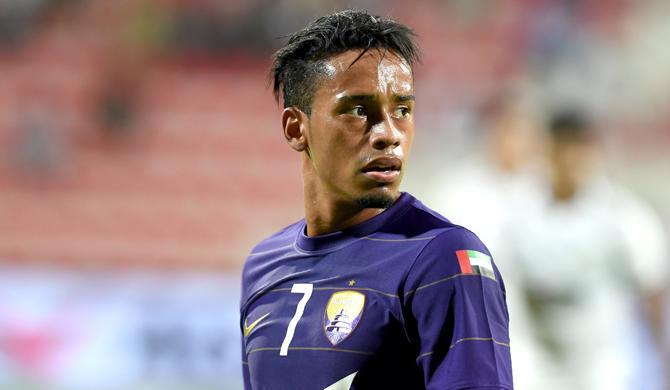
Caio focused on AFC Champions League glory with Al-Ain
Caio focused on AFC Champions League glory with Al-Ain
Related

Latest updates




© 2026 SAUDI RESEARCH & PUBLISHING COMPANY, All Rights Reserved And subject to Terms of Use Agreement.