Saudi billionaire’s daughter tweets joy after his release

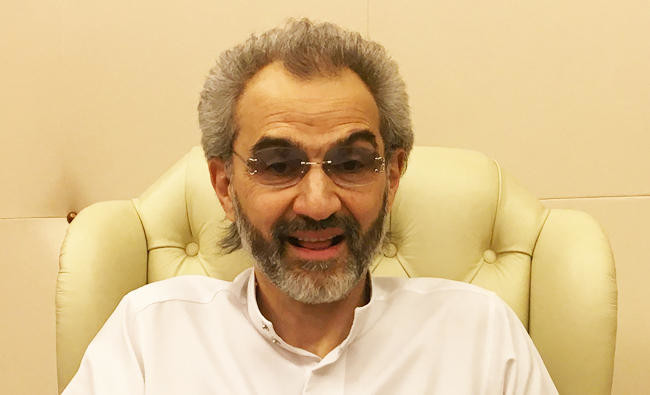
Saudi Arabian billionaire Prince Alwaleed bin Talal sits for an interview with Reuters in the office of the suite where he has been detained at the Ritz-Carlton in Riyadh, Saudi Arabia, in this January 27, 2018 photo. (REUTERS)
Updated 29 January 2018
Follow

Saudi billionaire’s daughter tweets joy after his release

RIYADH: The daughter of Saudi billionaire Prince Al-Waleed bin Talal on Sunday tweeted a picture of her father, expressing happiness at his release from detention, in the first reaction from a family member.
“You’ve lit up the world, you are my world,” Reem bint Al-Waleed tweeted, posting a picture of her father sporting a beard.

Prince Al-Waleed, dubbed the Warren Buffett of Saudi Arabia, was the most high-profile detainee among 350 suspects rounded up since November 4, including business tycoons and ministers, who were held in Riyadh’s luxury Ritz-Carlton hotel.
Detained for nearly three months, he was released on Saturday after striking an undisclosed financial agreement with the authorities, a government source said.
“The attorney general this morning approved the settlement with Prince Al-Waleed bin Talal,” paving the way for his release, a government source told AFP on Saturday, without disclosing figures.
The prince is ranked among the richest people in the world, with Forbes once estimating his fortune to be worth $18.7 billion.



‘Camel bird’ returns to Saudi desert after nearly a century 

Updated 4 sec ago
Follow

‘Camel bird’ returns to Saudi desert after nearly a century 

  • The red-necked ostrich, known historically as the “camel bird,” was reintroduced by the Prince Mohammed bin Salman Royal Reserve

JEDDAH: In a milestone achievement for Saudi Arabia’s ReWild Arabia initiative, a critically endangered bird species once celebrated by Arab poets and Roman scholars has made a return to the Kingdom after an absence of almost 100 years. 

The red-necked ostrich, known historically as the “camel bird,” was reintroduced by the Prince Mohammed bin Salman Royal Reserve as part of its rewilding program. 

The reintroduction serves as a biological replacement for the extinct Arabian (Syrian) ostrich, which once roamed widely across the deserts of the Arabian Peninsula before disappearing in the early 20th century due to overhunting and habitat loss. 

The red-necked ostrich, the closest living genetic relative of the Arabian ostrich, was selected for its ability to survive in extreme desert conditions and fulfil the same ecological role. 

A founder population of five red-necked ostriches was released into the reserve as part of its board-approved rewilding program, which aims to restore historical levels of biodiversity across the reserve’s 24,500 sq. km of terrestrial and marine ecosystems. 

The ostrich is the 12th of 23 historically native species being reintroduced under the reserve’s long-term ecosystem restoration strategy. 

Andrew Zaloumis, CEO of the Prince Mohammed bin Salman Royal Reserve, described the moment as both symbolic and transformative for conservation efforts in the Kingdom. 

“Returning such an iconic desert species after nearly a century carries deep emotional, ecological, and cultural significance,” he told Arab News, adding that the reserve achieved a similar breakthrough in 2024 with the return of the Persian onager after more than 100 years of absence. 

“That milestone reinforced what long-term restoration can achieve,” he said. 

Zaloumis said the return of the ostrich builds on a growing list of conservation successes that signal the gradual healing of Saudi Arabia’s desert landscapes. 

“Both species had disappeared from what is now Prince Mohammed bin Salman Royal Reserve for generations. Bringing them back alongside Arabian oryx, ibex, and reem represents ecological healing, landscape recovery, and the revival of cultural heritage,” he said. 

“Like the onager, the ostrich was revered by Arab poets and symbolized strength, endurance, and speed, appearing in oral histories and traditional storytelling. 

“As a keystone species, its return is essential to restoring full ecosystem functionality, stability, and ecological balance.” 

The reintroduction is being carried out in partnership with the National Center for Wildlife and other royal reserves, aligning with Vision 2030 and the Saudi Green Initiative. 

These national frameworks aim to enhance biodiversity, restore degraded ecosystems and protect 30 percent of the Kingdom’s land and sea by 2030. 

Historically, the Arabian ostrich shared the desert with species such as the now-extinct Saudi gazelle and the Arabian oryx. 

The Roman scholar Pliny the Elder famously referred to ostrich as the “camel bird” in his encyclopedic work “Natural History,” written nearly 2,000 years ago, a reference to their camel-like appearance from a distance and their resilience in harsh desert environments. 

In Arabic culture, ostriches were equally significant, celebrated in poetry for their speed and power and known by more than 150 names in classical literature. 

Zaloumis said that scientific rigor underpins the decision to reintroduce the red-necked ostrich rather than another subspecies. 

“The red-necked ostrich is being introduced as a proxy for the extinct Arabian (Syrian) ostrich, which once ranged widely across Saudi Arabia before disappearing in the early 20th century,” he said. 

“Restoring ecosystem function requires species capable of fulfilling the same ecological roles once performed by lost native fauna. 

“As the closest living genetic relative, and a species naturally adapted to extreme heat, scarce water, and low rainfall, the red-necked ostrich is the most suitable choice to support durable, long-term desert ecosystem restoration under current and future climatic conditions.” 

Evidence of the species’ former presence remains etched into the landscape. Sandstone petroglyphs found across the modern-day reserve depict ostrich flocks and hunting scenes, offering rare insight into ancient ecosystems. 

Together with modern ecological science, these records have helped establish the baseline guiding today’s restoration strategy. 

Globally, red-necked ostriches remain critically endangered, with fewer than 1,000 estimated to survive in fragmented populations across Africa’s Sahel region. 

Beyond their striking size, speed, and elaborate mating displays, ostriches play a vital ecological role as ecosystem “engineers,” contributing to seed dispersal, insect control and the maintenance of healthy rangelands. 

Their return to the Prince Mohammed bin Salman Royal Reserve strengthens national efforts to restore ostrich to their historical range, building on breeding and restoration programs led by the National Center for Wildlife in cooperation with Imam Turki bin Abdullah Royal Nature Reserve, Imam Saud bin Abdulaziz Royal Reserve, Aramco, NEOM, and AlUla. 

Zaloumis said that ostriches play a vital role in habitat restoration through their everyday behavior. 

“Their nomadic movements across large distances make them highly effective seed dispersers, transporting seeds far from parent plants and increasing plant regeneration, connectivity and genetic diversity across arid landscapes.” 

He added: “Their foraging behavior supports nutrient cycling by disturbing vegetation, aerating soils, and flushing insects that benefit insectivorous species.” 

Ostriches also coexist in mutualistic relationships with grazing animals such as oryx and onager, while their exceptional eyesight provides early warning of disturbance or predators, Zaloumis said. 

“Together, these interactions help rebuild healthy, self-sustaining, and resilient desert ecosystems.” 

The reserve’s work directly supports Vision 2030 priorities, including biodiversity conservation, climate resilience and improved quality of life. 

By restoring native species and protecting desert and marine habitats, the Prince Mohammed bin Salman Royal Reserve contributes to nature-based solutions that support human wellbeing, environmental sustainability and a thriving green economy.